Justice Verma Found Guilty of Corruption Charges
A judges' panel finds a former Delhi High Court judge guilty of corruption.
'%3E%3Crect%20width%3D'96'%20height%3D'96'%20fill%3D'%231A5276'%2F%3E%3Ccircle%20cx%3D'30'%20cy%3D'24'%20r%3D'44'%20fill%3D'%23fff'%20opacity%3D'.12'%2F%3E%3Ccircle%20cx%3D'60'%20cy%3D'74'%20r%3D'40'%20fill%3D'%23000'%20opacity%3D'.10'%2F%3E%3C%2Fg%3E%3Cg%20fill%3D'%23fff'%3E%3Cpath%20d%3D'M31%2041%20L48%2031%20L65%2041%20Z'%2F%3E%3Crect%20x%3D'33'%20y%3D'43'%20width%3D'4'%20height%3D'17'%2F%3E%3Crect%20x%3D'41'%20y%3D'43'%20width%3D'4'%20height%3D'17'%2F%3E%3Crect%20x%3D'51'%20y%3D'43'%20width%3D'4'%20height%3D'17'%2F%3E%3Crect%20x%3D'59'%20y%3D'43'%20width%3D'4'%20height%3D'17'%2F%3E%3Crect%20x%3D'30'%20y%3D'62'%20width%3D'36'%20height%3D'4'%20rx%3D'1'%2F%3E%3C%2Fg%3E%3C%2Fsvg%3E)
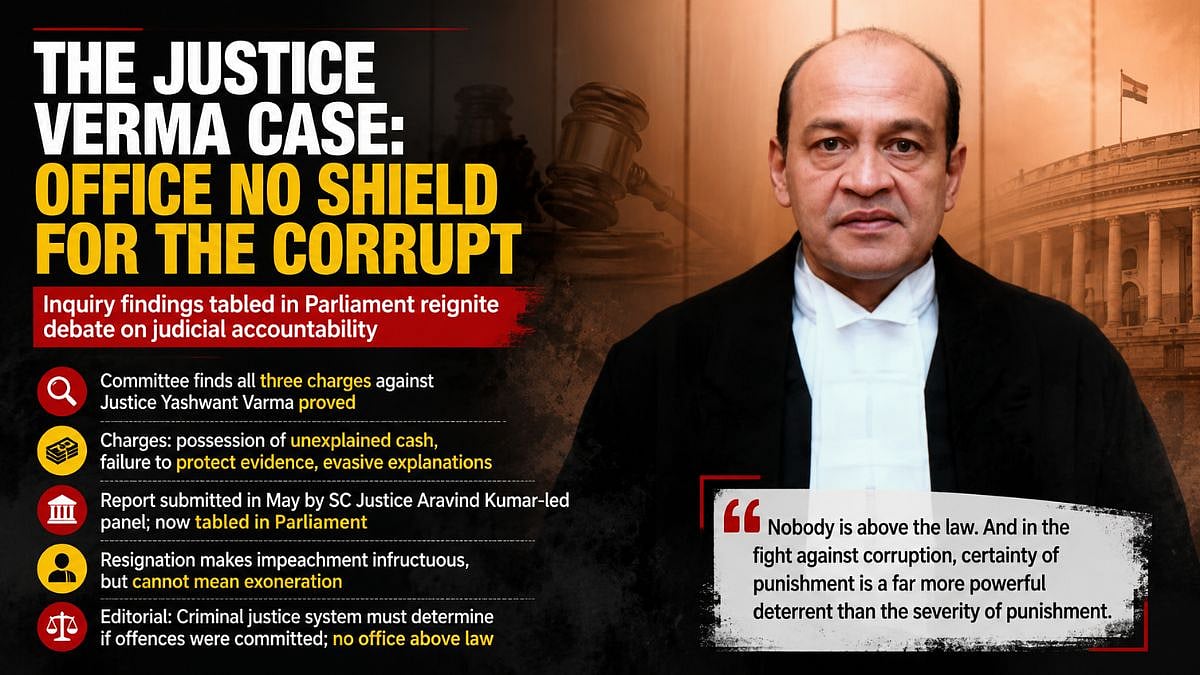
A three-member Judges’ Inquiry Committee has found former Delhi High Court judge Yashwant Varma guilty of three charges: possession of unexplained cash, failure to protect material evidence, and giving evasive explanations. The committee, headed by Supreme Court Justice Aravind Kumar, submitted its report to Lok Sabha Speaker Om Birla in May.
The discovery of half-burnt currency notes at Justice Varma's residence following a fire 17 months ago led to the investigation. The committee's findings have now been tabled in Parliament. Justice Varma's explanations for the presence and source of the cash were deemed evasive by the committee.
The inquiry was conducted under the Judges (Inquiry) Act, 1968. However, Justice Varma's resignation has rendered the impeachment proceedings ineffective. The question now arises: should a person found guilty of misconduct by a judicially constituted inquiry be allowed to walk away simply because they are no longer in office?
The answer is a resounding no. The criminal justice system must determine whether criminal offenses were committed. Justice Varma, like any other citizen, should have the opportunity to prove his innocence in a court of law. No office, however exalted, should be a shield against investigation.
The judiciary demands accountability from everyone else, and it must apply the same standard to its own members. The episode has damaged public confidence in the judiciary. Parliament must also question the meaning of its proceedings if resignation can bring them to an abrupt end.
The lesson is simple: nobody is above the law. Certainty of punishment is a more powerful deterrent than the severity of punishment in the fight against corruption. The case highlights the need for accountability and transparency in the judiciary.
The discovery of the half-burnt currency notes was extraordinary, and what followed was disturbing. Allegations were made that efforts were made to remove or destroy evidence after the fire. Justice Varma's failure to provide a convincing explanation for the presence and source of the cash raised questions about his integrity.
The committee's findings are a significant step towards holding those in power accountable for their actions. The case serves as a reminder that the judiciary is not above the law and that those who commit misconduct will be held accountable.
In conclusion, the Justice Verma case highlights the need for accountability and transparency in the judiciary. The criminal justice system must determine whether criminal offenses were committed, and Justice Varma must be given the opportunity to prove his innocence in a court of law. The case is a significant step towards holding those in power accountable for their actions and restoring public confidence in the judiciary.
The Indian judiciary has a reputation for being independent and impartial. However, cases like Justice Verma's undermine this reputation and damage public confidence. The judiciary must take steps to restore this confidence by ensuring that those who commit misconduct are held accountable.
The case also raises questions about the effectiveness of the impeachment process. If resignation can bring impeachment proceedings to an abrupt end, then the process is ineffective. Parliament must review the impeachment process to ensure that it is effective in holding those in power accountable for their actions.
In the end, the Justice Verma case is a reminder that nobody is above the law. The judiciary, like any other institution, must be accountable to the people. The case is a significant step towards ensuring that those in power are held accountable for their actions and that the judiciary is transparent and accountable.
The Indian public expects the judiciary to be independent, impartial, and accountable. The Justice Verma case is a test of the judiciary's commitment to these values. The case highlights the need for accountability and transparency in the judiciary and the need for the criminal justice system to determine whether criminal offenses were committed.
The case is a significant step towards restoring public confidence in the judiciary. The judiciary must take steps to ensure that those who commit misconduct are held accountable, and the impeachment process must be effective in holding those in power accountable for their actions. The Justice Verma case is a reminder that the judiciary is not above the law and that those who commit misconduct will be held accountable.
The case has significant implications for the Indian judiciary and the country as a whole. It highlights the need for accountability and transparency in the judiciary and the need for the criminal justice system to determine whether criminal offenses were committed. The case is a significant step towards ensuring that those in power are held accountable for their actions and that the judiciary is transparent and accountable.
In the end, the Justice Verma case is a reminder that the judiciary is not above the law. The case highlights the need for accountability and transparency in the judiciary and the need for the criminal justice system to determine whether criminal offenses were committed. The case is a significant step towards restoring public confidence in the judiciary and ensuring that those in power are held accountable for their actions.
Frequently asked questions
What were the charges against Justice Verma?
The charges against Justice Verma were possession of unexplained cash, failure to protect material evidence, and giving evasive explanations.
What is the significance of the Justice Verma case?
The Justice Verma case highlights the need for accountability and transparency in the judiciary and the need for the criminal justice system to determine whether criminal offenses were committed.