Central Railway Tests Vetiver Grass To Prevent Landslides
Vetiver grass to stabilise slopes, reduce monsoon risks. Testing in Mumbai-Pune ghat section.
'%3E%3Crect%20width%3D'96'%20height%3D'96'%20fill%3D'%23B3261E'%2F%3E%3Ccircle%20cx%3D'30'%20cy%3D'24'%20r%3D'44'%20fill%3D'%23fff'%20opacity%3D'.12'%2F%3E%3Ccircle%20cx%3D'60'%20cy%3D'74'%20r%3D'40'%20fill%3D'%23000'%20opacity%3D'.10'%2F%3E%3C%2Fg%3E%3Cg%20fill%3D'%23fff'%3E%3Crect%20x%3D'29'%20y%3D'49'%20width%3D'8'%20height%3D'19'%20rx%3D'1'%2F%3E%3Crect%20x%3D'39'%20y%3D'40'%20width%3D'9'%20height%3D'28'%20rx%3D'1'%2F%3E%3Crect%20x%3D'50'%20y%3D'45'%20width%3D'8'%20height%3D'23'%20rx%3D'1'%2F%3E%3Crect%20x%3D'60'%20y%3D'53'%20width%3D'7'%20height%3D'15'%20rx%3D'1'%2F%3E%3Crect%20x%3D'41'%20y%3D'34'%20width%3D'5'%20height%3D'6'%2F%3E%3C%2Fg%3E%3C%2Fsvg%3E)
Central Railway has begun testing Vetiver grass as a nature-based solution to stabilise vulnerable slopes in the Mumbai-Pune ghat section. This move comes after multiple landslides disrupted train operations during heavy monsoon rains on July 6.
The landslides near Thakurwadi and Monkey Hill affected all three railway lines in the Karjat-Lonavala ghat section, leading to cancellations, diversions, and regulation of several trains. Restoration work continued for nearly 20 days.
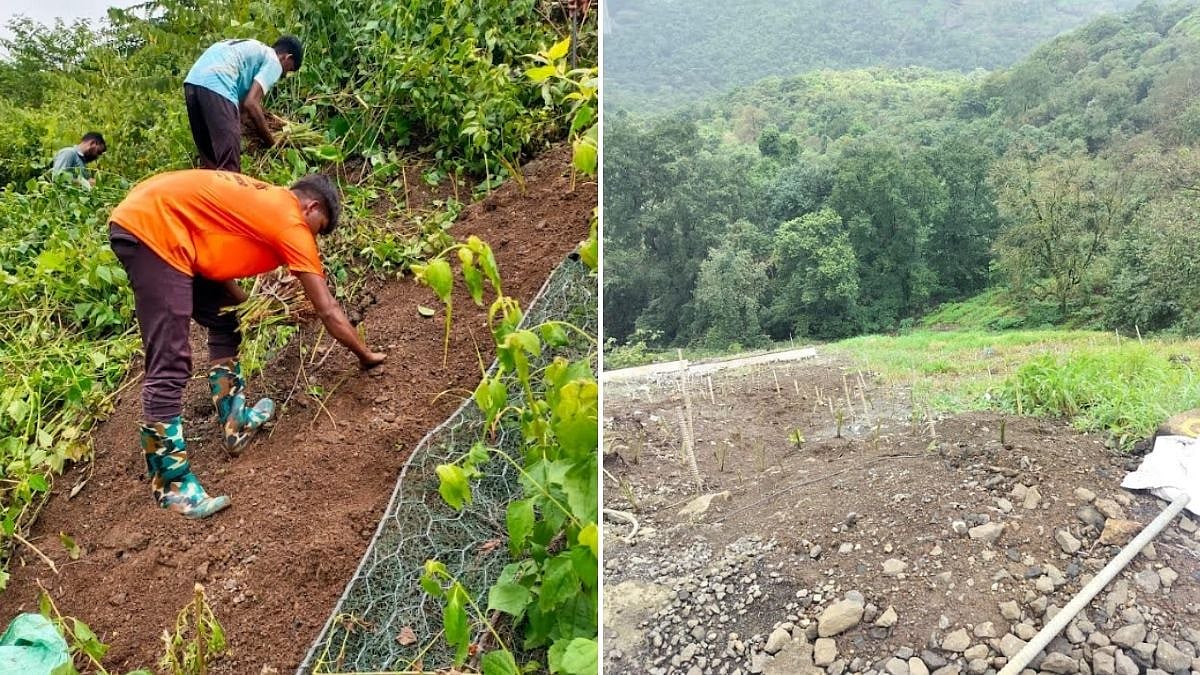
To address this issue, Central Railway has undertaken Vetiver grass plantation across 5,300 sqm in the South-East Ghat section. The grass is known for its deep and dense root system, which is expected to bind soil, reduce surface runoff, and help prevent shallow slope failures.
The pilot project covers 1,050 sqm near the Khandala-Monkey Hill section and 4,250 sqm between Thakurwadi Cabin and Palasdhari. Railway officials hope that this nature-based intervention will complement conventional engineering measures and reduce monsoon-related risks to train operations.
Vetiver grass has been used in various parts of the world to prevent landslides and soil erosion. Its roots can grow up to 3 meters deep, making it an effective solution for stabilising slopes.
The Mumbai-Pune ghat section is prone to landslides during the monsoon season, and Central Railway has been taking measures to prevent such incidents. The use of Vetiver grass is a new approach, and officials are hopeful that it will yield positive results.
The testing of Vetiver grass is a significant step towards reducing the risk of landslides in the Mumbai-Pune ghat section. If successful, it could be implemented in other vulnerable areas, providing a safe and reliable train service to passengers.
In recent years, the Mumbai-Pune ghat section has witnessed several landslides, causing disruptions to train services. The use of Vetiver grass could be a game-changer in preventing such incidents and ensuring the smooth operation of trains.
As the monsoon season is expected to continue for a few more months, Central Railway is taking all necessary measures to prevent landslides and ensure the safety of passengers. The testing of Vetiver grass is a welcome move, and its success could have a significant impact on the railway sector.
The success of this project could also lead to the implementation of similar measures in other parts of the country, where landslides are a common occurrence. It could also pave the way for the use of other nature-based solutions to address environmental challenges.
In conclusion, the testing of Vetiver grass by Central Railway is a significant step towards preventing landslides in the Mumbai-Pune ghat section. Its success could have a major impact on the railway sector and provide a safe and reliable train service to passengers.
Frequently asked questions
What is Vetiver grass and how does it help prevent landslides?
Vetiver grass has a deep and dense root system that binds soil, reduces surface runoff, and helps prevent shallow slope failures.
Where is the Vetiver grass being tested by Central Railway?
The Vetiver grass is being tested in the Mumbai-Pune ghat section, specifically in the South-East Ghat section, covering 5,300 sqm.