Saree Saves 21 Tamil Nadu Pilgrims in Nepal Flash Flood
Tamil Nadu pilgrims caught in Nepal flash flood use saree as lifeline. Pilgrims scramble up mountainside to escape raging waters.
'%3E%3Crect%20width%3D'96'%20height%3D'96'%20fill%3D'%23B3261E'%2F%3E%3Ccircle%20cx%3D'30'%20cy%3D'24'%20r%3D'44'%20fill%3D'%23fff'%20opacity%3D'.12'%2F%3E%3Ccircle%20cx%3D'60'%20cy%3D'74'%20r%3D'40'%20fill%3D'%23000'%20opacity%3D'.10'%2F%3E%3C%2Fg%3E%3Cg%20fill%3D'%23fff'%3E%3Crect%20x%3D'29'%20y%3D'49'%20width%3D'8'%20height%3D'19'%20rx%3D'1'%2F%3E%3Crect%20x%3D'39'%20y%3D'40'%20width%3D'9'%20height%3D'28'%20rx%3D'1'%2F%3E%3Crect%20x%3D'50'%20y%3D'45'%20width%3D'8'%20height%3D'23'%20rx%3D'1'%2F%3E%3Crect%20x%3D'60'%20y%3D'53'%20width%3D'7'%20height%3D'15'%20rx%3D'1'%2F%3E%3Crect%20x%3D'41'%20y%3D'34'%20width%3D'5'%20height%3D'6'%2F%3E%3C%2Fg%3E%3C%2Fsvg%3E)
A group of 21 Tamil Nadu pilgrims found themselves in a desperate situation when a flash flood struck the Timure area near Nepal's border with Tibet on August 26. The pilgrims were on their way from Syabrubesi towards Kerung as part of the Mount Kailash-Mansarovar Yatra when the mountains suddenly turned hostile.
The flash flood and mudslide swept away vehicles nearby, but the Tamil Nadu pilgrims escaped being caught in the torrent by just a few feet. Their bus came to a halt at a relatively safer bend, but staying inside was no longer an option. The pilgrims scrambled out, many of them making their way through the driver's side before attempting to climb a steep, muddy embankment.
The slope offered little help, with the ground being slippery and the mud making it difficult to find a foothold. Several pilgrims, many of them over 50, repeatedly slipped while trying to climb. What should have been a short ascent turned into a desperate struggle that lasted roughly one to two-and-a-half hours.
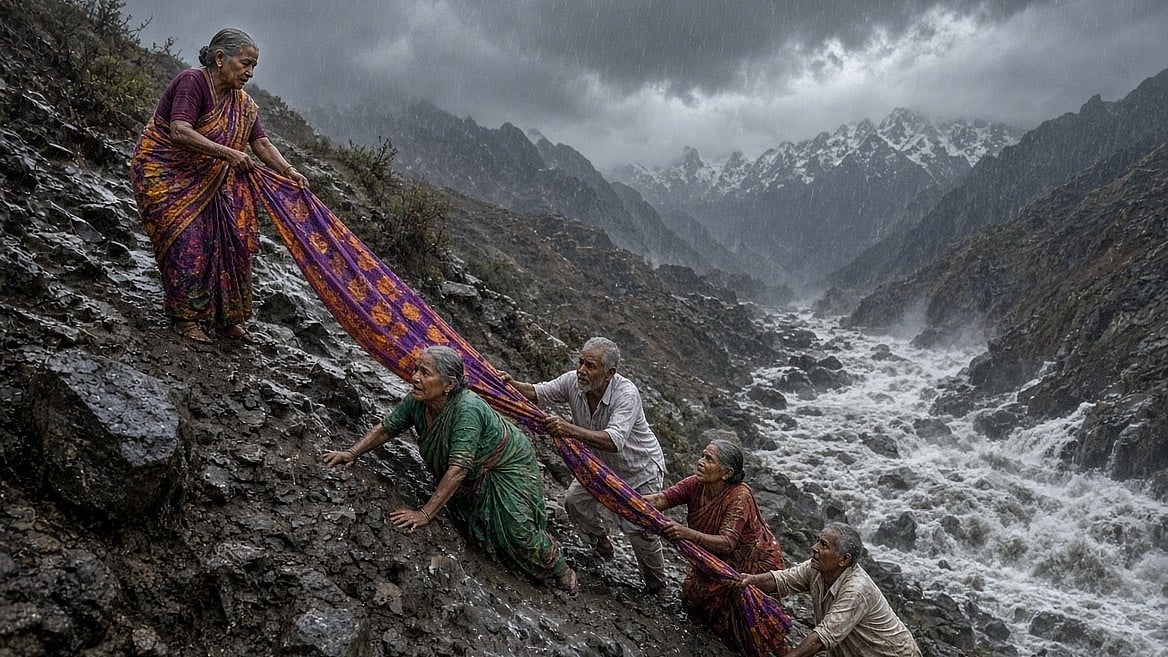
It was then that a Mayiladuthurai couple, Rathinakumar and his wife Poonguzhali, came up with a plan to use a saree as a makeshift rope to help the stranded pilgrims. Poonguzhali removed her saree, put on a sweater, and lowered the saree down towards those struggling on the slope. The saree became a lifeline, something the pilgrims could hold on to as they tried to pull themselves out of danger.
A metal cable available at the site was also used, and one by one, the stranded pilgrims were hauled towards safer ground. In one instance, a woman who was unable to climb was reportedly asked to tie the saree around her waist so those above could pull her up. Rathinakumar too went back towards the danger zone to help others climb.
The pilgrims had to depend on one another, reaching down to those below, holding hands, gripping the saree and cable, and pulling each other up the slippery slope. For the older members of the group, every step was a battle against the mud and fear of being swept away. But eventually, all 21 reached higher ground.
The flood had not only taken away vehicles and roads around them but had also left the pilgrims stranded in an increasingly difficult landscape. The pilgrims remained on higher ground for around a day and a half, waiting for help to arrive.
The incident highlights the importance of quick thinking and teamwork in the face of disaster. The use of the saree as a makeshift rope was a clever idea that helped save the lives of the 21 pilgrims. The incident also underscores the risks and challenges associated with traveling to remote and rugged areas, and the need for proper planning and preparation.
The Mount Kailash-Mansarovar Yatra is a popular pilgrimage route that attracts thousands of devotees every year. The route passes through some of the most rugged and remote areas of the Himalayas, and pilgrims often face challenges such as high altitude, harsh weather, and difficult terrain.
In this case, the pilgrims were lucky to have escaped the flash flood with their lives. The incident serves as a reminder of the importance of being prepared for emergencies and having a plan in place in case of unexpected events.
The use of the saree as a lifeline is a testament to the resourcefulness and quick thinking of the pilgrims. It also highlights the importance of teamwork and cooperation in the face of disaster. The incident will likely be remembered as a remarkable example of human ingenuity and resilience in the face of adversity.
The pilgrims' ordeal finally came to an end when they were rescued and taken to safety. The incident has left a lasting impact on the pilgrims, who are grateful to have escaped the flash flood with their lives. The use of the saree as a makeshift rope will be remembered as a clever and resourceful solution that helped save the lives of the 21 pilgrims.
In conclusion, the incident highlights the importance of quick thinking, teamwork, and resourcefulness in the face of disaster. The use of the saree as a makeshift rope was a clever idea that helped save the lives of the 21 pilgrims. The incident serves as a reminder of the importance of being prepared for emergencies and having a plan in place in case of unexpected events.
The significance of this incident cannot be overstated. It highlights the risks and challenges associated with traveling to remote and rugged areas, and the need for proper planning and preparation. It also underscores the importance of teamwork and cooperation in the face of disaster. The incident will likely be remembered as a remarkable example of human ingenuity and resilience in the face of adversity.
Frequently asked questions
What happened to the 21 Tamil Nadu pilgrims in Nepal?
They were caught in a flash flood and used a saree as a makeshift rope to escape.
How did the pilgrims manage to escape the flood?
They used a saree and a metal cable to pull each other up the slippery slope to higher ground.