17-Year-Old Edward Kang Trains AI for Autism, ADHD Screening
Teenager creates AI tool, breakthrough in autism and ADHD detection, innovative approach
'%3E%3Crect%20width%3D'96'%20height%3D'96'%20fill%3D'%23B3261E'%2F%3E%3Ccircle%20cx%3D'30'%20cy%3D'24'%20r%3D'44'%20fill%3D'%23fff'%20opacity%3D'.12'%2F%3E%3Ccircle%20cx%3D'60'%20cy%3D'74'%20r%3D'40'%20fill%3D'%23000'%20opacity%3D'.10'%2F%3E%3C%2Fg%3E%3Cg%20fill%3D'%23fff'%3E%3Crect%20x%3D'29'%20y%3D'49'%20width%3D'8'%20height%3D'19'%20rx%3D'1'%2F%3E%3Crect%20x%3D'39'%20y%3D'40'%20width%3D'9'%20height%3D'28'%20rx%3D'1'%2F%3E%3Crect%20x%3D'50'%20y%3D'45'%20width%3D'8'%20height%3D'23'%20rx%3D'1'%2F%3E%3Crect%20x%3D'60'%20y%3D'53'%20width%3D'7'%20height%3D'15'%20rx%3D'1'%2F%3E%3Crect%20x%3D'41'%20y%3D'34'%20width%3D'5'%20height%3D'6'%2F%3E%3C%2Fg%3E%3C%2Fsvg%3E)
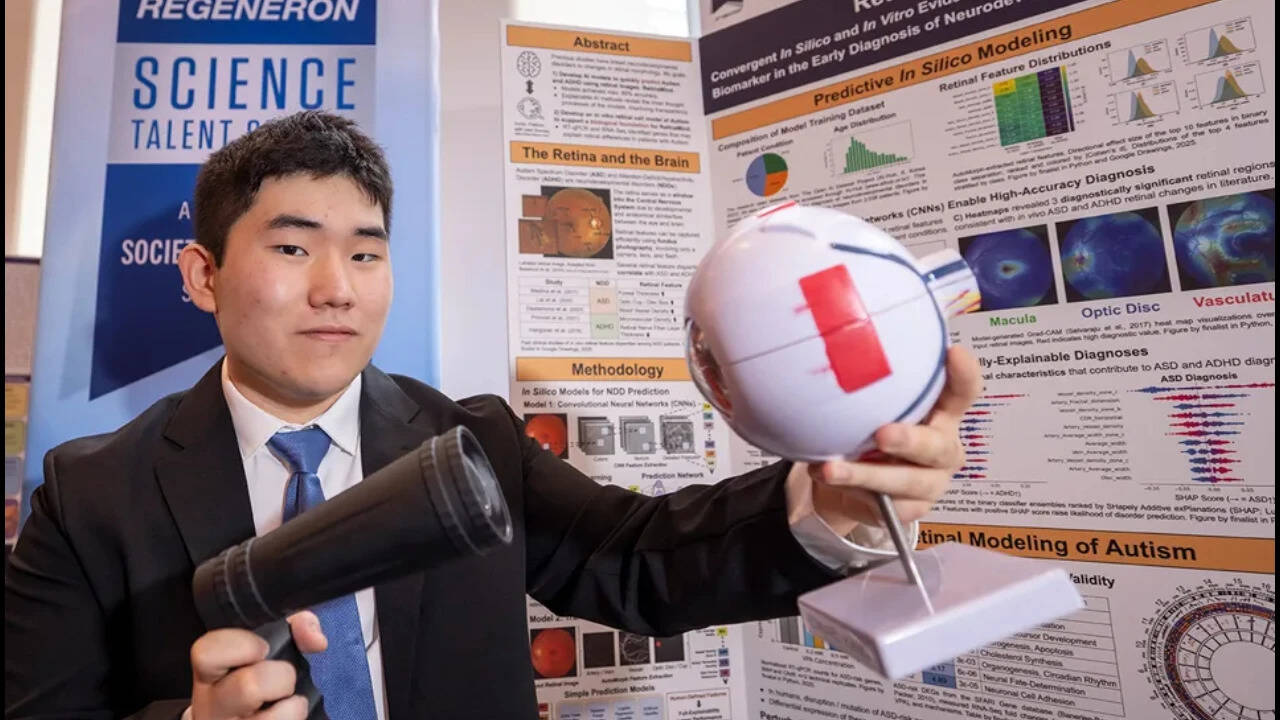
A 17-year-old student, Edward Kang, has successfully trained artificial intelligence to screen for autism and ADHD. This breakthrough innovation has the potential to revolutionize the detection and diagnosis of these conditions.
Edward Kang's achievement is a testament to the growing capabilities of AI in the medical field. By leveraging machine learning algorithms, Kang has developed a tool that can analyze data and identify patterns indicative of autism and ADHD.
The use of AI in medical diagnosis is becoming increasingly prevalent, with applications in image recognition, disease prediction, and patient monitoring. Kang's work builds upon this trend, demonstrating the potential for AI to improve the accuracy and efficiency of diagnostic processes.
Autism and ADHD are complex neurodevelopmental disorders that affect millions of people worldwide. Early detection and intervention are critical in managing these conditions, and AI-powered screening tools like Kang's can play a vital role in this process.
Kang's innovation has significant implications for the medical community, particularly in the fields of pediatrics and psychiatry. By providing a more accurate and efficient means of screening for autism and ADHD, healthcare professionals can better allocate resources and provide targeted support to affected individuals.
The development of AI-powered screening tools also raises important questions about the role of technology in healthcare. As AI becomes more integrated into medical practice, it is essential to consider issues related to data privacy, algorithmic bias, and the potential for over-reliance on technology.
In the context of autism and ADHD diagnosis, AI can help reduce the burden on healthcare systems by providing a preliminary screening mechanism. This can enable earlier intervention and treatment, ultimately leading to better outcomes for affected individuals.
Edward Kang's achievement serves as a reminder of the potential for young people to drive innovation and make a positive impact in their communities. His work on AI-powered screening for autism and ADHD is a remarkable example of the power of technology to improve human health and well-being.
The significance of Kang's innovation extends beyond the medical field, highlighting the importance of interdisciplinary approaches to problem-solving. By combining insights from computer science, neuroscience, and medicine, Kang has developed a tool that can make a tangible difference in people's lives.
In conclusion, Edward Kang's AI-powered screening tool for autism and ADHD represents a major breakthrough in medical diagnosis. As AI continues to evolve and improve, it is likely that we will see further innovations in this field, ultimately leading to better health outcomes and improved quality of life for individuals affected by these conditions.
Frequently asked questions
What is the significance of Edward Kang's AI-powered screening tool?
Edward Kang's AI-powered screening tool has the potential to revolutionize the detection and diagnosis of autism and ADHD, enabling earlier intervention and treatment.
How can AI be used in medical diagnosis?
AI can be used in medical diagnosis to analyze data, identify patterns, and provide preliminary screening mechanisms, ultimately leading to better health outcomes and improved quality of life for affected individuals.