Thane Court Convicts Bangladeshi Woman For Illegal Stay
A 50-year-old Bangladeshi woman has been convicted for illegal entry and stay in India. She will be deported after serving her sentence.
'%3E%3Crect%20width%3D'96'%20height%3D'96'%20fill%3D'%23B3261E'%2F%3E%3Ccircle%20cx%3D'30'%20cy%3D'24'%20r%3D'44'%20fill%3D'%23fff'%20opacity%3D'.12'%2F%3E%3Ccircle%20cx%3D'60'%20cy%3D'74'%20r%3D'40'%20fill%3D'%23000'%20opacity%3D'.10'%2F%3E%3C%2Fg%3E%3Cg%20fill%3D'%23fff'%3E%3Crect%20x%3D'29'%20y%3D'49'%20width%3D'8'%20height%3D'19'%20rx%3D'1'%2F%3E%3Crect%20x%3D'39'%20y%3D'40'%20width%3D'9'%20height%3D'28'%20rx%3D'1'%2F%3E%3Crect%20x%3D'50'%20y%3D'45'%20width%3D'8'%20height%3D'23'%20rx%3D'1'%2F%3E%3Crect%20x%3D'60'%20y%3D'53'%20width%3D'7'%20height%3D'15'%20rx%3D'1'%2F%3E%3Crect%20x%3D'41'%20y%3D'34'%20width%3D'5'%20height%3D'6'%2F%3E%3C%2Fg%3E%3C%2Fsvg%3E)
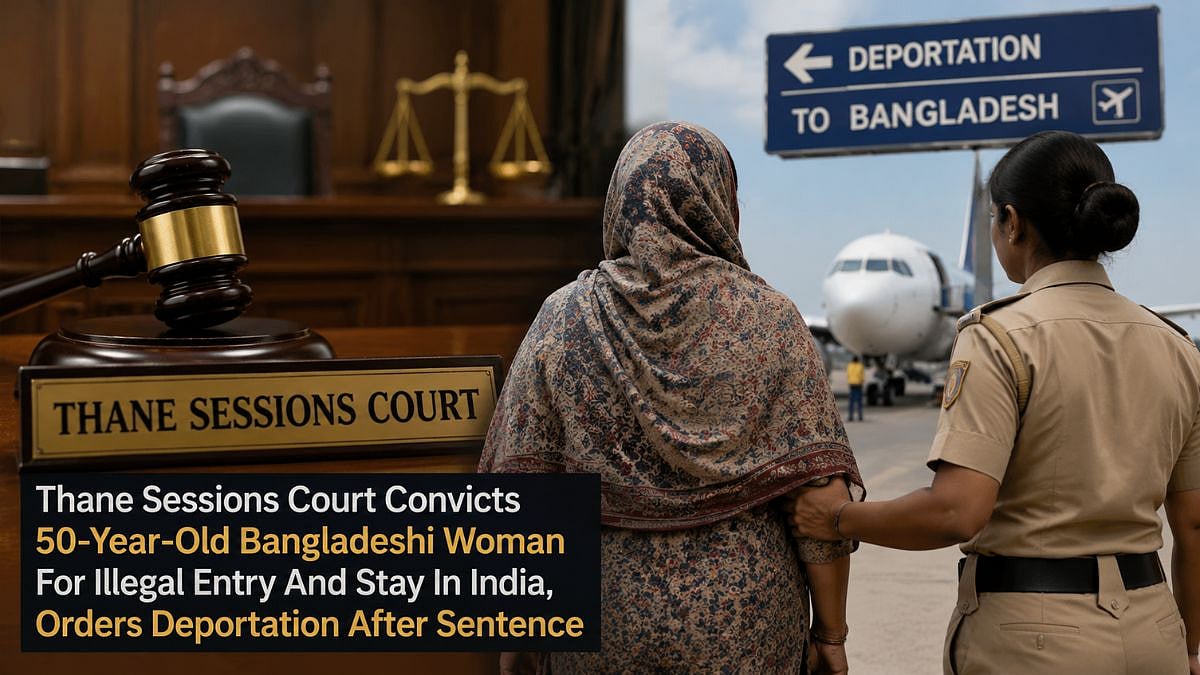
A Thane Sessions Court has convicted a 50-year-old Bangladeshi woman, Nunahar Kamal Shaikh, for illegally entering and residing in India without valid travel documents. The court sentenced her to rigorous imprisonment for six months and 27 days under each offence, with both sentences to run concurrently.
The woman was apprehended during a raid conducted by the Special Crime Branch on the night of August 31 and September 1, 2018, at Penkarpada Slum in Mira Road. The police alleged that she admitted to being a Bangladeshi national and failed to produce any passport, visa or documents establishing Indian citizenship despite being served with a notice.
During the trial, the prosecution examined four witnesses, including members of the raiding party and the investigating officer. The court found their testimonies consistent and reliable, observing that they corroborated each other on material aspects of the raid and the accused's failure to produce valid documents.
The accused claimed that she possessed documents proving Indian nationality and alleged that a false case had been registered against her. She produced an Aadhaar card, PAN card, voter ID, bank passbook and other documents during the trial. However, the court held that these documents were produced only at a belated stage and had not been furnished during the investigation despite a seven-day notice.
The court noted that under Section 9 of the Foreigners Act, the burden of proving that a person is not a foreigner lies upon that person, and the accused had failed to discharge that burden. The court also imposed fines of Rs 500 and Rs 1,000 for the two offences, respectively.
The woman was granted the benefit of set-off under Section 428 of the Code of Criminal Procedure, as she had already remained in custody from September 1, 2018, to March 28, 2019. The court ordered that she be deported to Bangladesh after completion of her sentence.
The court, however, acquitted the woman of the offence under Section 14A of the Foreigners Act, as the prosecution led no evidence to show that Penkarpada Slum in Mira Road had been declared a restricted or prohibited area under the law.
The case highlights the importance of verifying the nationality and travel documents of individuals residing in India. The court's decision to convict the woman and order her deportation serves as a reminder of the consequences of illegal entry and stay in the country.
The Thane Sessions Court's judgment is significant, as it sets a precedent for similar cases involving illegal entry and stay in India. The court's decision to acquit the woman of the offence under Section 14A of the Foreigners Act also underscores the importance of adhering to the provisions of the law.
In recent years, there have been several cases of illegal entry and stay in India, particularly in the Mumbai Metropolitan Region. The authorities have been cracking down on such cases, and the court's decision is a testament to the efforts being made to address this issue.
The deportation of the woman will be carried out after she completes her sentence. The court's order is a reminder that India takes the issue of illegal entry and stay seriously, and those found guilty will face the consequences.
The case has also raised questions about the verification process for nationality and travel documents in India. The court's decision highlights the need for stricter verification processes to prevent cases of illegal entry and stay.
In conclusion, the Thane Sessions Court's conviction of the 50-year-old Bangladeshi woman for illegal entry and stay in India serves as a reminder of the importance of adhering to the provisions of the law. The court's decision to order her deportation after completion of her sentence is a testament to the efforts being made to address the issue of illegal entry and stay in India.
The significance of this case lies in its impact on the community and the authorities' efforts to prevent similar cases in the future. The court's decision will likely serve as a deterrent to those who attempt to enter or stay in India illegally, and it underscores the importance of verifying the nationality and travel documents of individuals residing in the country.
The case is also a reminder of the need for cooperation between the authorities and the community to prevent cases of illegal entry and stay. The court's decision is a step in the right direction, and it is likely to have a positive impact on the community and the country as a whole.
In the end, the Thane Sessions Court's decision to convict the 50-year-old Bangladeshi woman for illegal entry and stay in India is a significant one, and it highlights the importance of adhering to the provisions of the law. The court's decision will likely have a positive impact on the community and the country, and it serves as a reminder of the consequences of illegal entry and stay in India.