Supreme Court To Set Protocol On Pellet Guns For Crowd Control
The Supreme Court will create a protocol for using pellet guns during protests. A petition challenged their use against civilians.
'%3E%3Crect%20width%3D'96'%20height%3D'96'%20fill%3D'%231A5276'%2F%3E%3Ccircle%20cx%3D'30'%20cy%3D'24'%20r%3D'44'%20fill%3D'%23fff'%20opacity%3D'.12'%2F%3E%3Ccircle%20cx%3D'60'%20cy%3D'74'%20r%3D'40'%20fill%3D'%23000'%20opacity%3D'.10'%2F%3E%3C%2Fg%3E%3Cg%20fill%3D'%23fff'%3E%3Cpath%20d%3D'M31%2041%20L48%2031%20L65%2041%20Z'%2F%3E%3Crect%20x%3D'33'%20y%3D'43'%20width%3D'4'%20height%3D'17'%2F%3E%3Crect%20x%3D'41'%20y%3D'43'%20width%3D'4'%20height%3D'17'%2F%3E%3Crect%20x%3D'51'%20y%3D'43'%20width%3D'4'%20height%3D'17'%2F%3E%3Crect%20x%3D'59'%20y%3D'43'%20width%3D'4'%20height%3D'17'%2F%3E%3Crect%20x%3D'30'%20y%3D'62'%20width%3D'36'%20height%3D'4'%20rx%3D'1'%2F%3E%3C%2Fg%3E%3C%2Fsvg%3E)
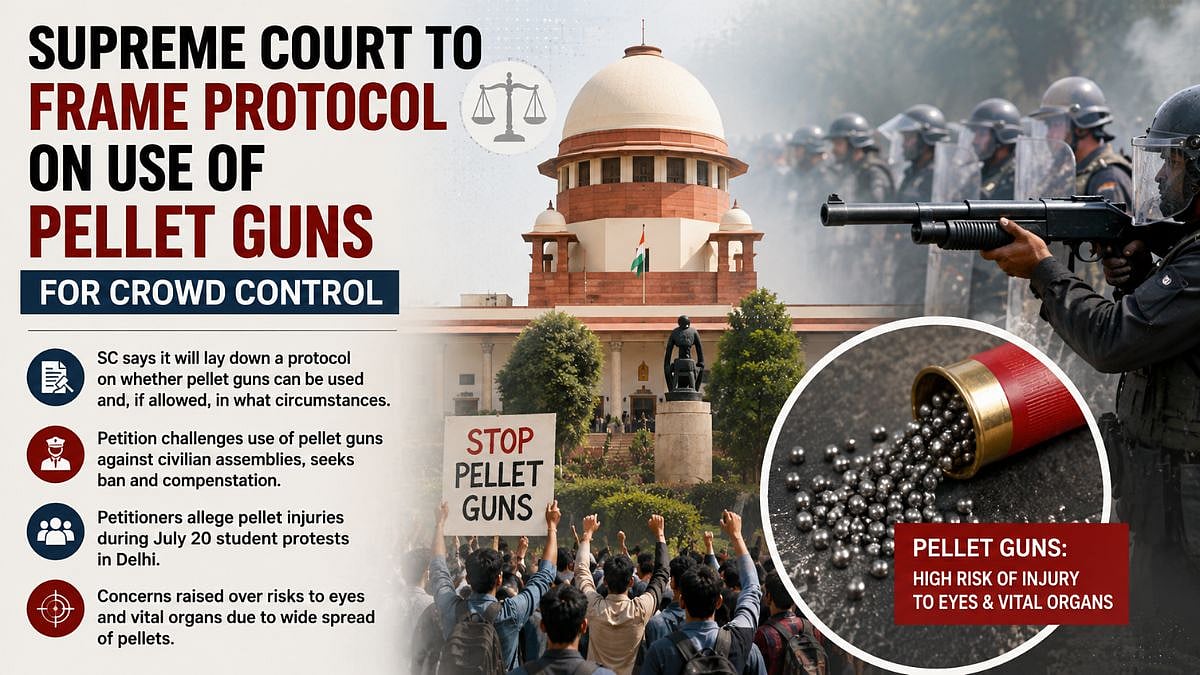
The Supreme Court of India has decided to establish a protocol governing the use of pellet guns by law enforcement agencies for crowd control during civilian protests. This decision was made on Monday as the court heard a petition seeking a ban on the use of pellet guns against civilian assemblies and compensation for two protesters who suffered pellet injuries during student protests in Delhi on July 20.
A bench comprising Chief Justice of India Surya Kant, Justice Joymalya Bagchi, and Justice V. Mohana was hearing the writ petition. The petitioners argued that there was no standing order authorising the Delhi Police to use pellet guns and that the weapon was inherently unsuitable for deployment against civilians.
Advocate Vrinda Grover, appearing for the petitioners, submitted that her research had found no standing order or regulation mentioning the use of pellet guns from 1967 to the present. She said pellet guns were used in Kashmir in 2010 and subsequently in 2016. A standard operating procedure (SOP) was prepared in 2011 by a Union High Task Force, while a High-Powered Committee submitted a report in 2016.
The petitioners urged the court to direct the Union government to file an affidavit disclosing whether any standing order governing the use of pellet guns existed. The Chief Justice of India stated that the court would take the affidavit and, with the assistance of domain experts, lay down a protocol on whether pellet guns can be used and, if allowed, in what circumstances.
The court's proposed exercise assumes significance because it could bring clarity to when and under what circumstances law enforcement agencies may use pellet guns. The submissions before the court also raise questions about the regulatory framework governing the use of such weapons against civilian gatherings.
The matter has been listed along with other petitions concerning police action during the July 20 student protests in Delhi. The petition was filed by former IPS officer Yashovardhan Azad and two others, Prasant Kumar Singh and Sheikh Irshad Mansoori, who said they were injured by pellets fired by the Rapid Action Force (RAF) during the Sansad Chalo demonstration.
The use of pellet guns has been a topic of controversy, with many arguing that they are too lethal for crowd control. The Supreme Court's decision to establish a protocol will provide much-needed clarity on the use of these weapons.
In the context of India's history of protests and demonstrations, the use of pellet guns has been a subject of debate. The court's decision will have significant implications for the future of crowd control and the protection of civilians during protests.
The establishment of a protocol will also raise questions about the accountability of law enforcement agencies and the measures in place to prevent the misuse of pellet guns. As the court moves forward with this exercise, it is likely to face challenges in balancing the need for crowd control with the protection of civilians.
Ultimately, the Supreme Court's decision to establish a protocol on the use of pellet guns for crowd control is a step towards ensuring that the rights of civilians are protected during protests and demonstrations. The protocol will provide a framework for law enforcement agencies to follow, reducing the risk of injury and harm to civilians.
The significance of this decision cannot be overstated, as it has the potential to impact the way law enforcement agencies approach crowd control in the future. As the court continues to hear the petition and establish the protocol, it is likely that this issue will remain a topic of discussion and debate in the coming months.
In conclusion, the Supreme Court's decision to establish a protocol on the use of pellet guns for crowd control is a crucial step towards protecting the rights of civilians during protests and demonstrations. The protocol will provide clarity on the use of these weapons and will have significant implications for the future of crowd control in India.
Frequently asked questions
What is the Supreme Court's decision on pellet guns?
The Supreme Court has decided to establish a protocol governing the use of pellet guns by law enforcement agencies for crowd control during civilian protests.
Why are pellet guns controversial?
Pellet guns are considered too lethal for crowd control, and their use has been a topic of debate in India.