India Bans Renewable Energy Projects Near International Borders
New security rules restrict solar, wind, and hybrid projects. National security concerns cited.
'%3E%3Crect%20width%3D'96'%20height%3D'96'%20fill%3D'%234A235A'%2F%3E%3Ccircle%20cx%3D'30'%20cy%3D'24'%20r%3D'44'%20fill%3D'%23fff'%20opacity%3D'.12'%2F%3E%3Ccircle%20cx%3D'60'%20cy%3D'74'%20r%3D'40'%20fill%3D'%23000'%20opacity%3D'.10'%2F%3E%3C%2Fg%3E%3Cg%20fill%3D'none'%20stroke%3D'%23fff'%20stroke-width%3D'3'%3E%3Ccircle%20cx%3D'48'%20cy%3D'48'%20r%3D'16'%2F%3E%3Cellipse%20cx%3D'48'%20cy%3D'48'%20rx%3D'6.5'%20ry%3D'16'%2F%3E%3Cline%20x1%3D'32'%20y1%3D'42'%20x2%3D'64'%20y2%3D'42'%2F%3E%3Cline%20x1%3D'32'%20y1%3D'54'%20x2%3D'64'%20y2%3D'54'%2F%3E%3C%2Fg%3E%3C%2Fsvg%3E)
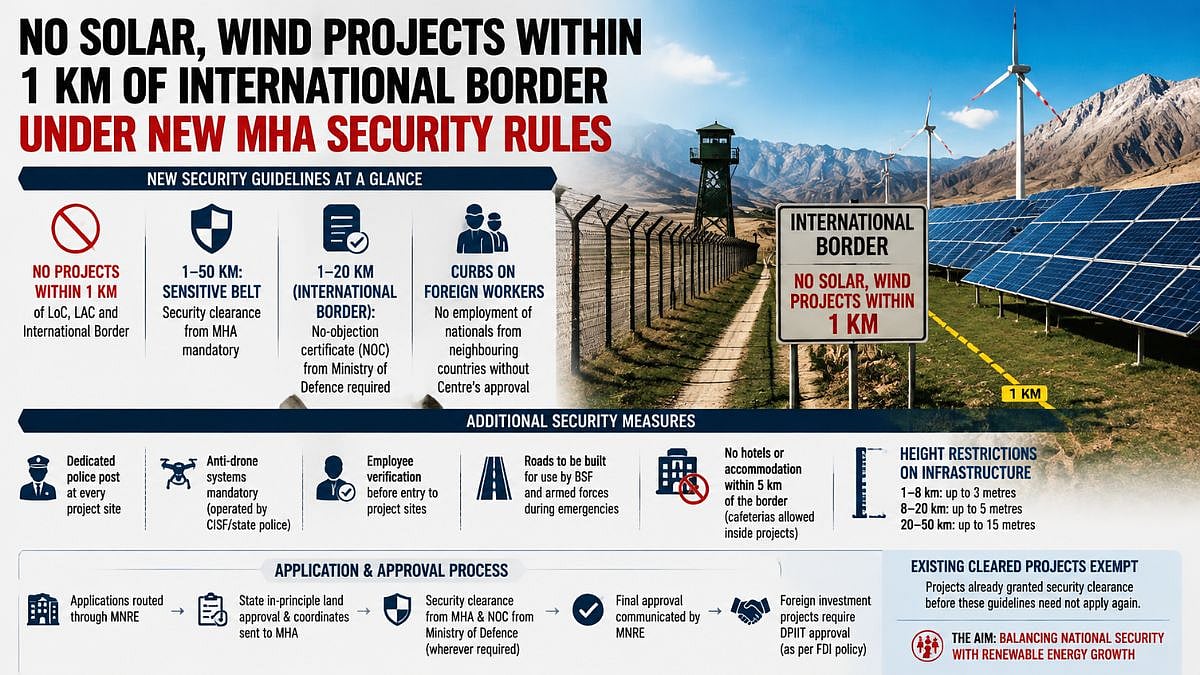
The Ministry of Home Affairs (MHA) has issued new guidelines restricting solar, wind, and hybrid renewable energy projects near India's international borders. As of August 8, 2026, a blanket ban has been imposed on project activity within 1 km of the Line of Control (LoC), Line of Actual Control (LAC), and the International Border (IB).
The MHA has classified areas extending up to 50 km as sensitive, bringing proposed renewable energy projects in this belt under closer security scrutiny. Projects proposed between 1 km and 50 km of the LoC, LAC, or International Border will require security clearance from the MHA and will be examined on a case-by-case basis.
For projects between 1 km and 20 km of the International Border, an additional no-objection certificate (NOC) from the Ministry of Defence will be required. The MHA had first issued an office memorandum on June 5 before releasing the detailed guidelines. These new norms will also apply to projects required to submit fresh applications.
The guidelines come amid an increasing number of applications concerning the suitability of setting up solar, wind, and hybrid renewable energy projects in border areas. According to the MHA, such projects could have national security implications. The restrictions underline the challenge facing the government as it expands renewable energy capacity while ensuring that large infrastructure projects close to strategically sensitive borders do not create security vulnerabilities.
The guidelines also tighten rules governing foreign participation in projects located in sensitive areas. Developers cannot employ engineers, workers, staff, or other employees from neighbouring land-border countries, particularly Pakistan, Bangladesh, and China, without prior approval from the Centre.
Project developers will also require the Centre's approval and security clearance from the MHA before transferring project land to any foreign company. The ministry has stated that the guidelines were framed after consultations with stakeholders and are intended to balance national security requirements with the government's push to expand renewable energy and improve ease of doing business.
Existing projects that had already received security clearance before the new guidelines were issued will not have to apply again. Fresh applications will be routed through the Ministry of New and Renewable Energy (MNRE). The ministry will forward proposals, along with the state government's in-principle land approval and project coordinates, to the MHA for security clearance and to the Defence Ministry for an NOC wherever required.
The MNRE must also ensure that project land is allocated in a manner that prevents long stretches of construction from running parallel to the international border. The new guidelines highlight the government's efforts to balance national security concerns with the need to expand renewable energy capacity in the country.
In conclusion, the new guidelines issued by the MHA will have significant implications for the development of renewable energy projects in India, particularly in areas near international borders. While the guidelines may pose challenges for project developers, they are intended to ensure that national security concerns are addressed while promoting the growth of renewable energy in the country.
The government's push to expand renewable energy capacity is a key part of its efforts to reduce dependence on fossil fuels and mitigate the impact of climate change. However, the new guidelines highlight the need for careful planning and coordination to ensure that large infrastructure projects do not compromise national security.
As the country continues to grow and develop its renewable energy sector, it is likely that the government will face ongoing challenges in balancing national security concerns with the need to promote economic growth and development. The new guidelines are an important step in addressing these challenges and ensuring that India's renewable energy sector continues to grow and thrive in a secure and sustainable manner.
Frequently asked questions
What is the main reason for the new guidelines restricting renewable energy projects near international borders?
National security concerns