India's Education System Fails 10% of Rajasthan Schools
Rajasthan admits 611 schools have no buildings, 2047 lack toilets, and 1049 lack water.
'%3E%3Crect%20width%3D'96'%20height%3D'96'%20fill%3D'%23B3261E'%2F%3E%3Ccircle%20cx%3D'30'%20cy%3D'24'%20r%3D'44'%20fill%3D'%23fff'%20opacity%3D'.12'%2F%3E%3Ccircle%20cx%3D'60'%20cy%3D'74'%20r%3D'40'%20fill%3D'%23000'%20opacity%3D'.10'%2F%3E%3C%2Fg%3E%3Cg%20fill%3D'%23fff'%3E%3Crect%20x%3D'29'%20y%3D'49'%20width%3D'8'%20height%3D'19'%20rx%3D'1'%2F%3E%3Crect%20x%3D'39'%20y%3D'40'%20width%3D'9'%20height%3D'28'%20rx%3D'1'%2F%3E%3Crect%20x%3D'50'%20y%3D'45'%20width%3D'8'%20height%3D'23'%20rx%3D'1'%2F%3E%3Crect%20x%3D'60'%20y%3D'53'%20width%3D'7'%20height%3D'15'%20rx%3D'1'%2F%3E%3Crect%20x%3D'41'%20y%3D'34'%20width%3D'5'%20height%3D'6'%2F%3E%3C%2Fg%3E%3C%2Fsvg%3E)
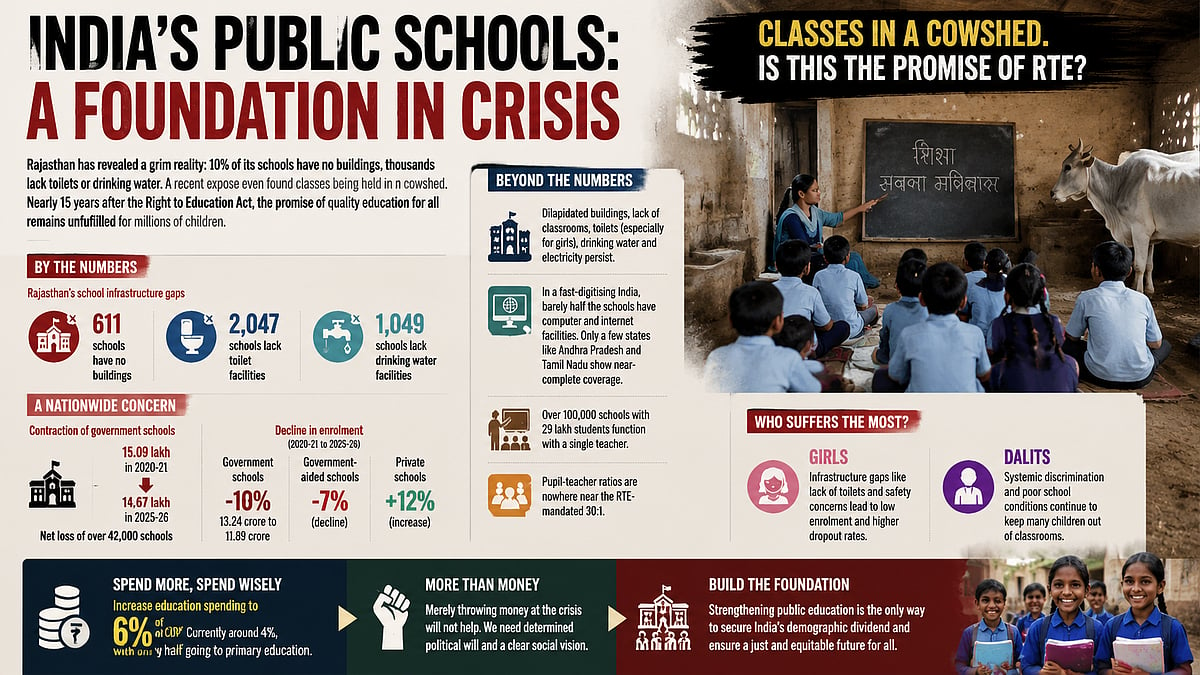
A significant crisis is unfolding in India's public school education system, particularly at the primary level. In Rajasthan, the government has acknowledged that around 10% of its 64,484 schools lack basic infrastructure, including buildings, toilets, and drinking water facilities. This revelation has been highlighted by the Cockroach Janta Party, a pressure group focused on education sector shortcomings.
The issue is not limited to Rajasthan, as the entire country is grappling with crumbling infrastructure in government schools. Despite the Right to Education (RTE) being enacted 15 years ago, many schools still lack essential facilities, and student outcomes are suffering. Grade 3 students are often unable to read Grade 2 text or perform simple mathematics.
There are four key issues that should concern the current government. Firstly, the number of government schools has decreased from 15.09 lakh in 2020-21 to 14.67 lakh in 2025-26, resulting in a net loss of over 42,000 schools across India. Secondly, enrolment in government schools has declined by over 10% during the same period, while private school enrolment has increased by 12%.
The existing schools are plagued by age-old infrastructure problems, including dilapidated buildings, lack of classrooms, toilets, drinking water, and electricity. Furthermore, barely half of the schools have computer and internet facilities, with only a few states like Andhra Pradesh and Tamil Nadu showing near-complete coverage.
Another significant issue is that over 100,000 schools with 29 lakh students function with a single teacher, and the pupil-teacher ratios are far from the RTE-mandated 30:1. The Cockroach Janta Party campaign has rightly exposed these issues, which are having a disproportionate impact on girls and Dalits.
The government must increase its spending on education to 6% of the GDP, up from the current 4%. However, simply allocating more funds will not solve the crisis. Determined political will and social vision are necessary to strengthen the foundation of India's demographic dividend.
The situation is dire, with wide variations across states, but the general picture is one of malaise and distress. The government's decade-old Beti Bachao, Beti Padhao campaign has not yielded the desired results, and systemic issues continue to hinder the education of girls and Dalits.
In conclusion, the crisis in India's education system is a significant concern that requires immediate attention. The government must take concrete steps to address the infrastructure issues, improve student outcomes, and increase access to education for all, particularly girls and Dalits. Only then can India hope to reap the benefits of its demographic dividend and secure a brighter future for its citizens.
The education system is the backbone of any country, and India's future depends on its ability to provide quality education to its citizens. The current state of affairs is a wake-up call for the government to take decisive action and ensure that every child has access to a decent education.
Ultimately, the fate of India's future generations hangs in the balance, and it is imperative that the government takes the necessary steps to address the crisis in the education system. The country's demographic dividend can only be realized if its citizens are equipped with the skills and knowledge necessary to compete in the global economy.
The government must prioritize education and take a holistic approach to address the issues plaguing the system. This includes increasing funding, improving infrastructure, and ensuring that every child has access to quality education. Only then can India hope to achieve its full potential and secure a bright future for its citizens.
In the end, the crisis in India's education system is a complex issue that requires a multifaceted approach. The government, civil society, and the private sector must work together to address the challenges facing the education system and ensure that every child has access to a decent education. This is the only way to secure a bright future for India and its citizens.
Frequently asked questions
What percentage of Rajasthan schools lack buildings?
Around 10% of Rajasthan schools lack buildings.
How many government schools have closed in the last 5 years?
Over 42,000 government schools have closed in the last 5 years.