Scotland, Wales, Northern Ireland Sign Pact for Greater Autonomy
UK leaders sign historic pact, Scotland, Wales, and Northern Ireland seek self-determination. Pressure mounts on UK Prime Minister Andy Burnham.
'%3E%3Crect%20width%3D'96'%20height%3D'96'%20fill%3D'%234A235A'%2F%3E%3Ccircle%20cx%3D'30'%20cy%3D'24'%20r%3D'44'%20fill%3D'%23fff'%20opacity%3D'.12'%2F%3E%3Ccircle%20cx%3D'60'%20cy%3D'74'%20r%3D'40'%20fill%3D'%23000'%20opacity%3D'.10'%2F%3E%3C%2Fg%3E%3Cg%20fill%3D'none'%20stroke%3D'%23fff'%20stroke-width%3D'3'%3E%3Ccircle%20cx%3D'48'%20cy%3D'48'%20r%3D'16'%2F%3E%3Cellipse%20cx%3D'48'%20cy%3D'48'%20rx%3D'6.5'%20ry%3D'16'%2F%3E%3Cline%20x1%3D'32'%20y1%3D'42'%20x2%3D'64'%20y2%3D'42'%2F%3E%3Cline%20x1%3D'32'%20y1%3D'54'%20x2%3D'64'%20y2%3D'54'%2F%3E%3C%2Fg%3E%3C%2Fsvg%3E)
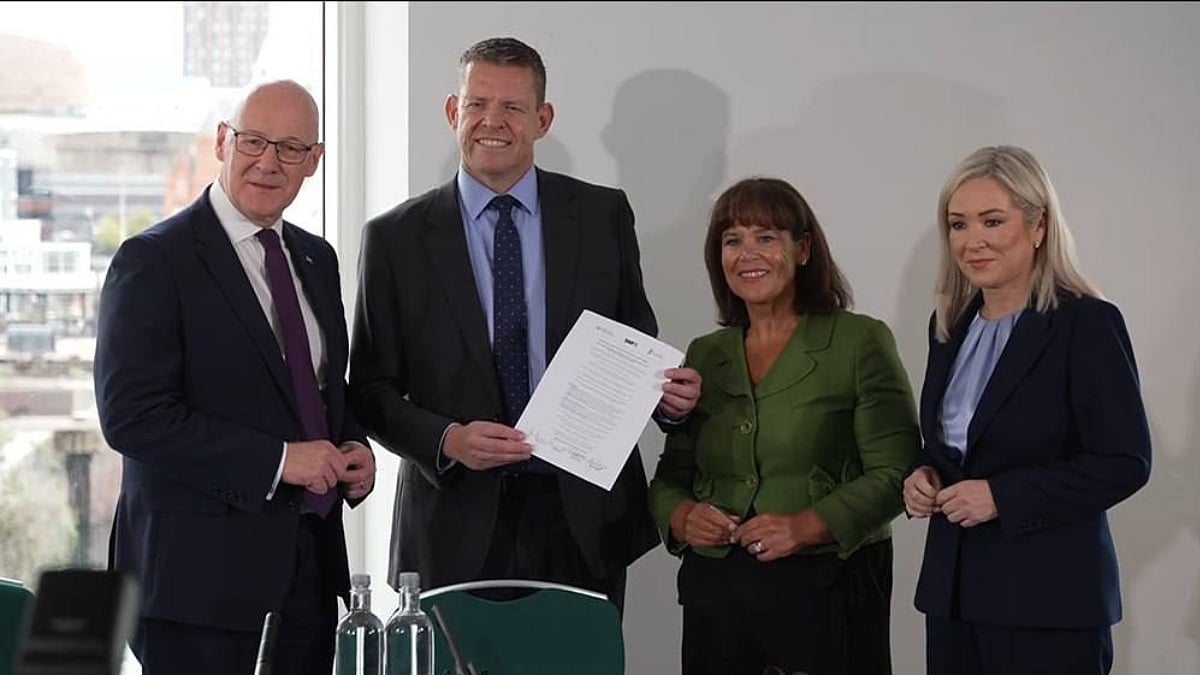
A historic pact has been signed by leaders from Scotland, Wales, and Northern Ireland, calling for greater autonomy and self-determination from Westminster. The joint memorandum of understanding (MoU) was signed in Cardiff on Monday by Scottish First Minister John Swinney, First Minister of Wales Rhun ap Iorwerth, and Sinn Féin vice-president Michelle O'Neill.
The pact declares that the three nations have the right to decide their own futures and suggests that Westminster's influence is nearing its end. The document states that the nations have the right to self-determination and that Westminster should not be able to prevent them from exercising that right.
The leaders said that their nations have the right to self-determination and that no Westminster government has the right to block democracy or undermine the principle that their people will decide their own future. While Swinney and O'Neill backed calls for referendums on their nations' futures, Iorwerth stopped short of setting a timeline for a vote in Wales.
The development has added to the political pressure on UK Prime Minister Andy Burnham, whose spokesperson Tom Wells defended the union and called for greater cooperation rather than division. Wells said that the United Kingdom is at its best when people come together around shared values and problem-solving, rather than division.
The signing of the pact is a significant move towards greater autonomy for the three nations and marks a new era in their relationship with Westminster. The pact is seen as a challenge to Westminster's control over the devolved administrations and is likely to have far-reaching implications for the future of the United Kingdom.
The UK has a long history of devolution, with Scotland, Wales, and Northern Ireland having their own devolved governments. However, the pact signed on Monday marks a new level of cooperation and determination among the three nations to take control of their own futures.
The move is likely to be seen as a significant blow to the UK government's efforts to maintain the status quo and will add to the pressure on Prime Minister Burnham to reconsider the UK's relationship with its devolved administrations. As the UK navigates this new era of autonomy and self-determination, it remains to be seen how the relationship between Westminster and the devolved administrations will evolve.
In the context of the UK's history of devolution, the signing of the pact is a significant development that marks a new era of cooperation and determination among the three nations. The pact is likely to have far-reaching implications for the future of the United Kingdom and will be closely watched by politicians and citizens across the UK.
The implications of the pact are still unclear, but it is likely to lead to a significant shift in the balance of power between Westminster and the devolved administrations. As the UK navigates this new era of autonomy and self-determination, it remains to be seen how the relationship between Westminster and the devolved administrations will evolve and what the future holds for the United Kingdom.
In conclusion, the signing of the pact by Scotland, Wales, and Northern Ireland marks a significant move towards greater autonomy and self-determination for the three nations. The development is likely to have far-reaching implications for the future of the United Kingdom and will be closely watched by politicians and citizens across the UK.
Frequently asked questions
What is the significance of the pact signed by Scotland, Wales, and Northern Ireland?
The pact marks a significant move towards greater autonomy and self-determination for the three nations and challenges Westminster's control over the devolved administrations.
What are the implications of the pact for the future of the United Kingdom?
The implications are still unclear, but the pact is likely to lead to a significant shift in the balance of power between Westminster and the devolved administrations.