Vivek Raghavan Named Among TIME's 100 Most Influential AI Leaders
Sarvam AI co-founder recognized for homegrown AI stack. Raghavan played key role in Aadhaar authentication system.
'%3E%3Crect%20width%3D'96'%20height%3D'96'%20fill%3D'%230B6E4F'%2F%3E%3Ccircle%20cx%3D'30'%20cy%3D'24'%20r%3D'44'%20fill%3D'%23fff'%20opacity%3D'.12'%2F%3E%3Ccircle%20cx%3D'60'%20cy%3D'74'%20r%3D'40'%20fill%3D'%23000'%20opacity%3D'.10'%2F%3E%3C%2Fg%3E%3Cg%20fill%3D'none'%20stroke%3D'%23fff'%20stroke-width%3D'3.2'%20stroke-linecap%3D'round'%20stroke-linejoin%3D'round'%3E%3Cpolyline%20points%3D'31%2C59%2041%2C49%2049%2C54%2063%2C37'%2F%3E%3Cpolyline%20points%3D'55%2C37%2063%2C37%2063%2C45'%2F%3E%3C%2Fg%3E%3C%2Fsvg%3E)
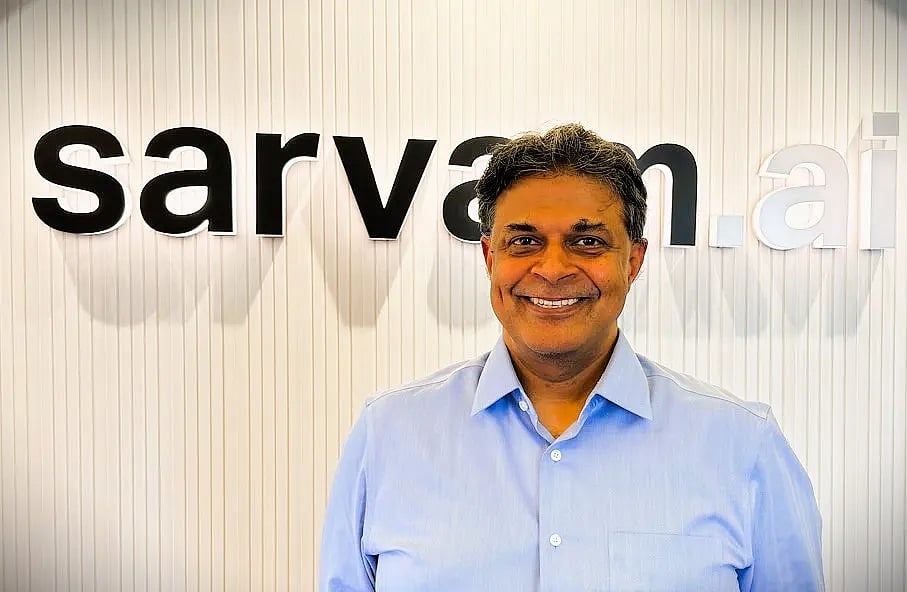
Vivek Raghavan, the co-founder of Indian AI startup Sarvam AI, has been named among the 100 most influential leaders in artificial intelligence by TIME magazine. This recognition is a testament to his significant contributions to the field of AI, particularly in developing a completely homegrown, Indian-language AI stack.
Raghavan's journey in the tech industry began with his education at IIT Delhi, where he completed his BTech in 1989. He later earned a PhD in Electrical and Computer Engineering from Carnegie Mellon University in 1993. Prior to co-founding Sarvam AI, Raghavan spent nearly two decades in the electronic design automation (EDA) industry and founded two EDA companies. He also held senior management positions at Magma Design Automation, Synopsys, and Avant! Corporation.
One of Raghavan's most notable achievements was his work on the Aadhaar programme, where he served as the Chief Biometric Architect. He played a key role in developing the Aadhaar authentication system, which has had a significant impact on India's digital public infrastructure. Raghavan's work on Aadhaar focused on creating biometric systems capable of operating at enormous scale, and he later introduced artificial intelligence into Aadhaar-related processes to improve service quality and detect potential identity fraud.
Raghavan's involvement with technology extends beyond Aadhaar. He served as the volunteer CTO of Team Indus, India's entry into the Google Lunar X-Prize, and was part of the Supreme Court of India's AI committee. He was also involved in the rollout of SUVAS, a system designed to translate court judgments and orders into Indian languages. As the Chief AI Evangelist at the EkStep Foundation, Raghavan worked with government and policy stakeholders to advise Bhashini, the Digital India initiative aimed at making digital services accessible in citizens' local languages.
In August 2023, Raghavan co-founded Sarvam AI with Pratyush Kumar, with the goal of developing AI systems for India's linguistic diversity. The Bengaluru-based startup has launched products such as Sarvam Vision, an OCR and visual-understanding tool, and Bulbul V3, a multilingual text-to-speech model. Recently, Nvidia became a strategic investor in Sarvam AI, joining a roughly $75 million Series B funding round that values the business at about $1.5 billion.
Raghavan's recognition by TIME magazine is a significant achievement, not only for him but also for the Indian AI community. His work on developing a homegrown AI stack has the potential to make a significant impact on India's digital public infrastructure, and his contributions to the field of AI will likely continue to shape the industry in the years to come.
The recognition of Raghavan's work by TIME magazine highlights the growing importance of AI in India and the need for homegrown solutions that cater to the country's linguistic diversity. As India continues to invest in its digital public infrastructure, the work of individuals like Raghavan will play a crucial role in shaping the country's AI landscape.
In conclusion, Vivek Raghavan's recognition as one of the 100 most influential leaders in AI is a testament to his significant contributions to the field. His work on developing a homegrown AI stack and his involvement in various initiatives aimed at making digital services accessible in Indian languages have the potential to make a significant impact on India's digital public infrastructure.
Frequently asked questions
What is Sarvam AI and what does it do?
Sarvam AI is an Indian AI startup that develops AI systems for India's linguistic diversity. It has launched products such as Sarvam Vision and Bulbul V3.
What is Vivek Raghavan's background and experience in AI?
Vivek Raghavan is an IIT Delhi alumnus with a PhD in Electrical and Computer Engineering from Carnegie Mellon University. He has nearly two decades of experience in the electronic design automation industry and has worked on various AI initiatives, including the Aadhaar programme.