Parliamentary Committee Recommends Cancer As Notifiable Disease
Cancer cases in India rise to 15.6 lakh, committee suggests making it notifiable.
'%3E%3Crect%20width%3D'96'%20height%3D'96'%20fill%3D'%231A5276'%2F%3E%3Ccircle%20cx%3D'30'%20cy%3D'24'%20r%3D'44'%20fill%3D'%23fff'%20opacity%3D'.12'%2F%3E%3Ccircle%20cx%3D'60'%20cy%3D'74'%20r%3D'40'%20fill%3D'%23000'%20opacity%3D'.10'%2F%3E%3C%2Fg%3E%3Cg%20fill%3D'%23fff'%3E%3Cpath%20d%3D'M31%2041%20L48%2031%20L65%2041%20Z'%2F%3E%3Crect%20x%3D'33'%20y%3D'43'%20width%3D'4'%20height%3D'17'%2F%3E%3Crect%20x%3D'41'%20y%3D'43'%20width%3D'4'%20height%3D'17'%2F%3E%3Crect%20x%3D'51'%20y%3D'43'%20width%3D'4'%20height%3D'17'%2F%3E%3Crect%20x%3D'59'%20y%3D'43'%20width%3D'4'%20height%3D'17'%2F%3E%3Crect%20x%3D'30'%20y%3D'62'%20width%3D'36'%20height%3D'4'%20rx%3D'1'%2F%3E%3C%2Fg%3E%3C%2Fsvg%3E)
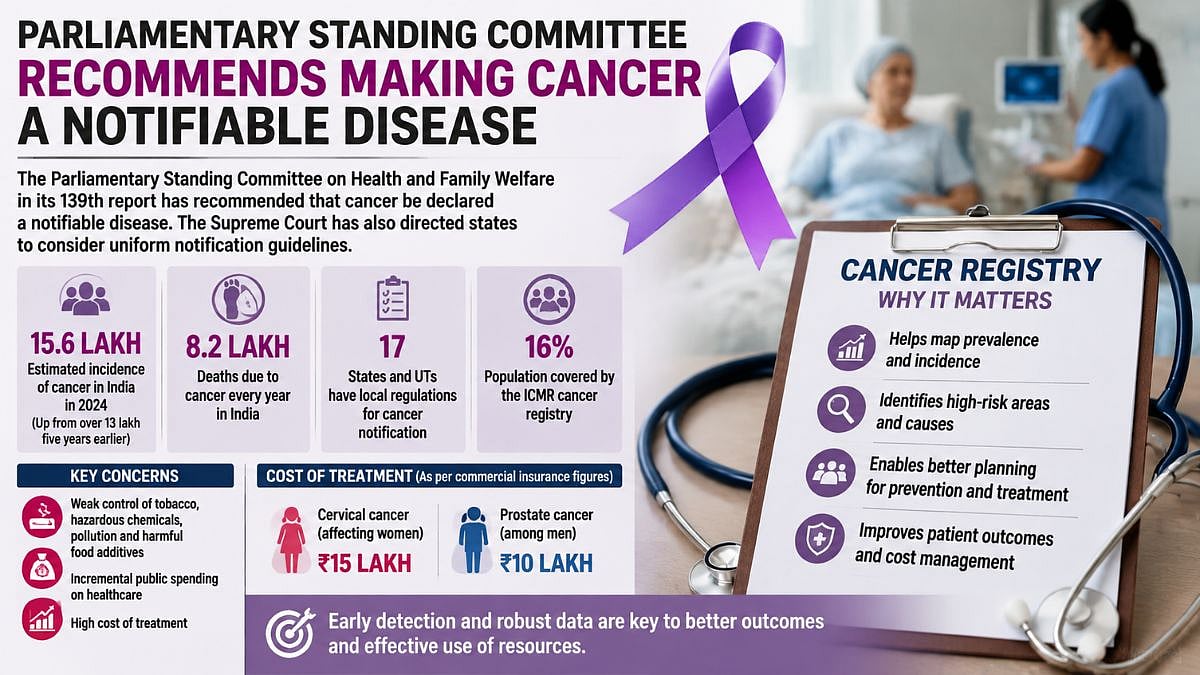
The Parliamentary Standing Committee on Health and Family Welfare has recommended that cancer be made a notifiable disease in India. This recommendation comes as the estimated incidence of cancer in India is expected to reach 15.6 lakh cases in 2024, up from 13 lakh five years earlier.
Cancer is currently responsible for approximately 8.2 lakh deaths per year in India. Despite its high incidence, cancer is not a notifiable disease at the national level, although 17 states and Union Territories have made it notifiable under local regulations.
The Union government has been hesitant to make cancer a notifiable disease, citing that health is a state subject and that cancer is a non-communicable disease. However, this argument has been disputed, as certain types of cancer, such as cervical cancer, are linked to the human papillomavirus.
Accurate data on cancer is essential for understanding its prevalence and incidence, which can inform remedial measures. India has a registry maintained by the ICMR, but it only covers about 16% of the population.
The recommendation to make cancer a notifiable disease has been welcomed, and the Supreme Court has also directed states to consider uniform notification guidelines. This move is seen as a crucial step in addressing the growing burden of cancer in India, which has the third-highest incidence of cancer in the world.
India's cancer registry is underdeveloped compared to other countries, such as those in Europe and North America. The country's failure to scale up its cancer registry and expand public financing of healthcare is a significant concern.
The cost of treating cancer can be prohibitively expensive, with cervical cancer treatment costing up to ₹15 lakh and prostate cancer treatment costing up to ₹10 lakh. Early detection and treatment can improve medical outcomes and reduce costs.
A robust database is essential for understanding the causes and effects of cancer, and making it a notifiable disease can help establish causative links and inform public health policy.
In conclusion, the recommendation to make cancer a notifiable disease is a crucial step in addressing the growing burden of cancer in India. It is essential that the government takes concrete steps to implement this recommendation and improve the country's cancer registry and public health infrastructure.
The move to make cancer a notifiable disease is expected to have a significant impact on public health in India. With the growing incidence of cancer, it is essential that the government takes proactive steps to address this issue.
The Parliamentary Standing Committee's recommendation is a welcome step in this direction, and it is hoped that the government will take concrete actions to implement this recommendation and improve the country's public health infrastructure.
Frequently asked questions
What is the estimated incidence of cancer in India in 2024?
The estimated incidence of cancer in India in 2024 is 15.6 lakh cases.
Why is it important to make cancer a notifiable disease?
Making cancer a notifiable disease can help establish causative links and inform public health policy, which can lead to better prevention, detection, and treatment of the disease.