India Tests Kusha Missile, Own S-400 Rival
India's Kusha missile test, a step towards air defence shield. Rivals Russian S-400
'%3E%3Crect%20width%3D'96'%20height%3D'96'%20fill%3D'%231A5276'%2F%3E%3Ccircle%20cx%3D'30'%20cy%3D'24'%20r%3D'44'%20fill%3D'%23fff'%20opacity%3D'.12'%2F%3E%3Ccircle%20cx%3D'60'%20cy%3D'74'%20r%3D'40'%20fill%3D'%23000'%20opacity%3D'.10'%2F%3E%3C%2Fg%3E%3Cg%20fill%3D'%23fff'%3E%3Cpath%20d%3D'M31%2041%20L48%2031%20L65%2041%20Z'%2F%3E%3Crect%20x%3D'33'%20y%3D'43'%20width%3D'4'%20height%3D'17'%2F%3E%3Crect%20x%3D'41'%20y%3D'43'%20width%3D'4'%20height%3D'17'%2F%3E%3Crect%20x%3D'51'%20y%3D'43'%20width%3D'4'%20height%3D'17'%2F%3E%3Crect%20x%3D'59'%20y%3D'43'%20width%3D'4'%20height%3D'17'%2F%3E%3Crect%20x%3D'30'%20y%3D'62'%20width%3D'36'%20height%3D'4'%20rx%3D'1'%2F%3E%3C%2Fg%3E%3C%2Fsvg%3E)
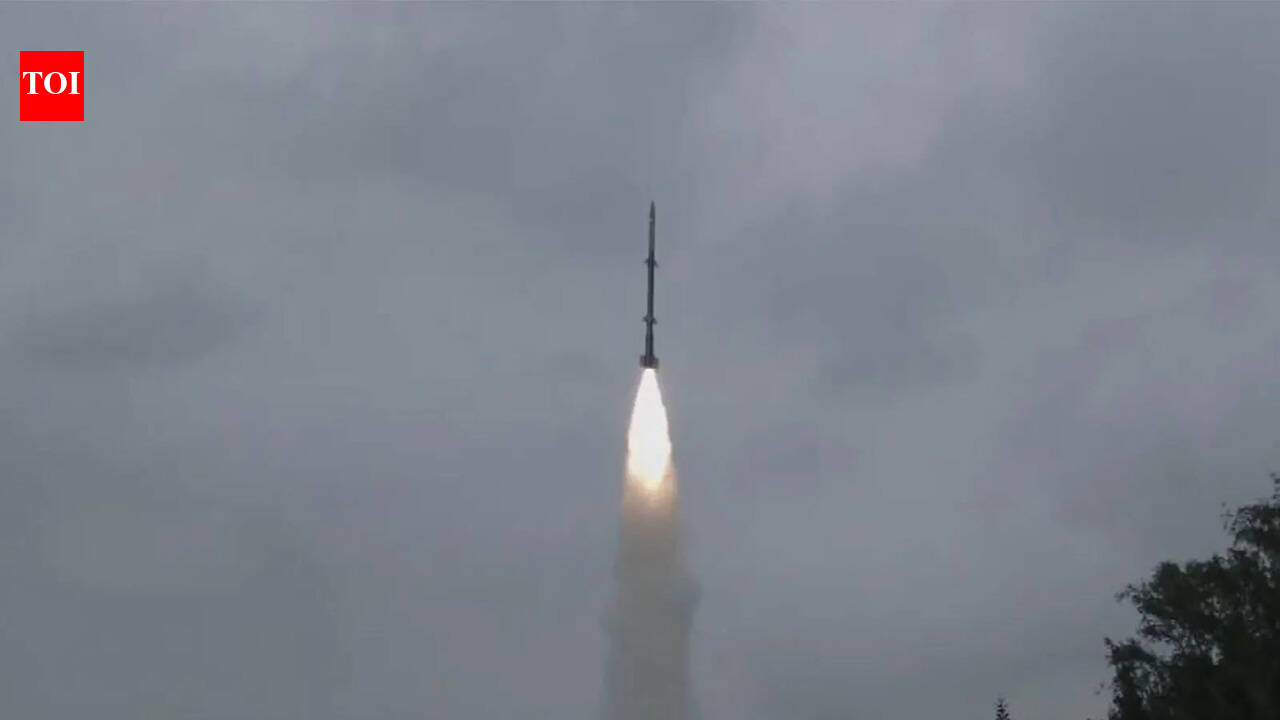
India has successfully tested its maiden Kusha Surface-to-Air Missile, marking a significant milestone in the development of a layered air defence shield under Mission Sudarshan Chakra. The Kusha missile system is designed in three variants, with ranges of 150 km, 250 km, and 350 km, aiming to rival the capabilities of the Russian S-400 missile system.
The test demonstrates the Defence Research and Development Organisation's (DRDO) ability to intercept threats in both endo- and exo-atmospheric domains. This capability is crucial in enhancing India's air defence capabilities and providing a robust shield against aerial threats.
The Kusha missile system is designed to be scalable and indigenous, allowing for greater flexibility and adaptability in its deployment. This is in contrast to the Russian S-400 system, which, while highly effective, is a foreign system with limitations on its scalability and adaptability.
However, as recent conflicts in the Gulf region have shown, missile defence requires redundancy and integration to be effective. A single system, no matter how advanced, is not enough to provide comprehensive protection against saturation attacks. Therefore, India must now invest in developing and integrating sensors, lasers, and command networks to ensure the resilience of its air defence shield.
The development of the Kusha missile system is a significant step towards achieving this goal. With its advanced capabilities and indigenous design, the Kusha system has the potential to play a critical role in India's air defence architecture.
In the context of India's air defence modernisation, the Kusha missile system is a key component of the country's efforts to enhance its capabilities and protect its airspace. The system's development is also a testament to India's growing capabilities in the field of defence research and development.
The success of the Kusha missile test is a significant achievement for India's defence establishment and underscores the country's commitment to developing a robust and effective air defence shield. As India continues to develop and deploy advanced air defence systems, it is likely to play an increasingly important role in regional and global security dynamics.
In conclusion, the test of the Kusha missile system marks a significant milestone in India's efforts to develop a layered air defence shield. While the system is not designed to stop ballistic missiles, it has the potential to play a critical role in enhancing India's air defence capabilities and providing a robust shield against aerial threats.
The development of the Kusha missile system is a significant step towards achieving India's goal of developing a comprehensive and integrated air defence architecture. With its advanced capabilities and indigenous design, the Kusha system is likely to play a key role in India's air defence modernisation efforts and contribute to the country's growing capabilities in the field of defence research and development.
What it means for India is that the country is moving closer to achieving its goal of developing a robust and effective air defence shield, which is critical for protecting its airspace and enhancing its national security. The success of the Kusha missile test is a significant achievement for India's defence establishment and underscores the country's commitment to developing advanced defence capabilities.
Frequently asked questions
What is the range of the Kusha missile system?
The Kusha missile system has three variants with ranges of 150 km, 250 km, and 350 km.
Is the Kusha missile system designed to stop ballistic missiles?
No, the Kusha missile system is not designed to stop ballistic missiles.