Bombay HC Orders Clear Rules On Flat Alterations
Bombay High Court asks state government to frame clear policy on flat alterations.
'%3E%3Crect%20width%3D'96'%20height%3D'96'%20fill%3D'%23B3261E'%2F%3E%3Ccircle%20cx%3D'30'%20cy%3D'24'%20r%3D'44'%20fill%3D'%23fff'%20opacity%3D'.12'%2F%3E%3Ccircle%20cx%3D'60'%20cy%3D'74'%20r%3D'40'%20fill%3D'%23000'%20opacity%3D'.10'%2F%3E%3C%2Fg%3E%3Cg%20fill%3D'%23fff'%3E%3Crect%20x%3D'29'%20y%3D'49'%20width%3D'8'%20height%3D'19'%20rx%3D'1'%2F%3E%3Crect%20x%3D'39'%20y%3D'40'%20width%3D'9'%20height%3D'28'%20rx%3D'1'%2F%3E%3Crect%20x%3D'50'%20y%3D'45'%20width%3D'8'%20height%3D'23'%20rx%3D'1'%2F%3E%3Crect%20x%3D'60'%20y%3D'53'%20width%3D'7'%20height%3D'15'%20rx%3D'1'%2F%3E%3Crect%20x%3D'41'%20y%3D'34'%20width%3D'5'%20height%3D'6'%2F%3E%3C%2Fg%3E%3C%2Fsvg%3E)
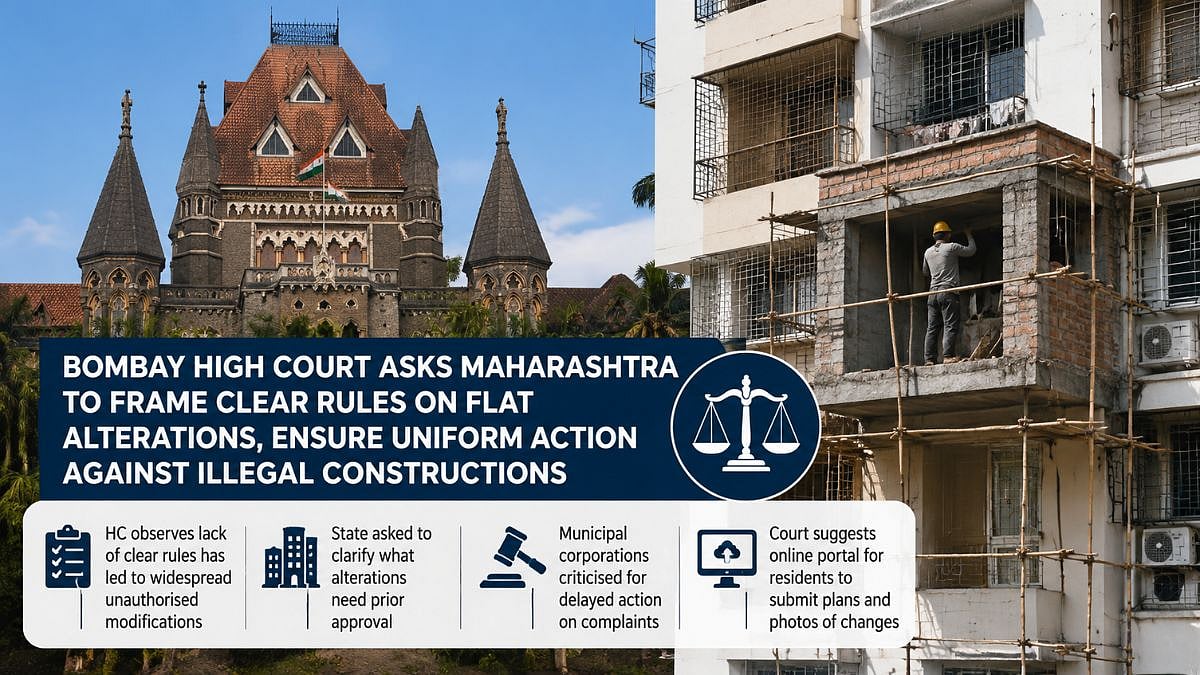
The Bombay High Court has ordered the Maharashtra government to establish a clear policy on the types of alterations that flat owners can make to their properties without prior approval from the municipal authorities. This decision was made in response to a petition filed by a Panvel resident, Ravindra Kini, who complained about unauthorised alterations made by a neighbour in his housing society.
The court observed that the lack of clear rules has contributed to widespread unauthorised modifications in residential buildings. A Bench of Justices Ajey Gadkari and Kamal Khata stated that the proposed framework should clarify whether residents can make certain changes, such as installing protective grills or covering open terraces with lightweight structures, without prior approval.
The directions came after the court heard Kini's petition against the Panvel Municipal Corporation (PMC) for allegedly failing to take action on his complaints. Kini claimed that his neighbour had made unauthorised alterations, including enclosing open terraces and erecting a permanent balcony shade, which caused nuisance and raised concerns over the building's structural stability.
The PMC admitted that the terrace enclosures were unauthorised and had demolished the tin sheds in 2021. However, further action was stalled due to a civil court order. The High Court found that similar unauthorised alterations had been carried out by several other residents in the society.
The court rejected the argument that one flat owner was being singled out and directed the PMC to examine all such constructions and take action within six months. The Bench also criticised the delay in acting on Kini's complaint, noting that it took the civic body nearly two years to respond.
The court suggested creating an online portal for residents to upload plans and photographs of proposed alterations, allowing authorities to quickly decide whether prior permission is required. The Registrar was directed to communicate the judgment to the Urban Development Department for framing appropriate rules, circulars, or guidelines.
The court's decision aims to encourage citizens to abide by the law and avoid widespread uncertainty. The lack of clear rules has led to confusion among residents, and the court's order seeks to address this issue.
The Maharashtra government will need to work on framing a clear policy on flat alterations, which will provide guidance to residents and authorities. This policy will help to prevent unauthorised constructions and ensure that residents make necessary approvals before making any changes to their properties.
The court's decision is significant, as it highlights the need for clear rules and regulations to govern flat alterations. The lack of clear rules has led to widespread unauthorised modifications, which can have serious consequences, including compromising the structural stability of buildings.
In conclusion, the Bombay High Court's order is a step towards encouraging citizens to abide by the law and preventing unauthorised constructions. The Maharashtra government must now work on framing a clear policy on flat alterations, which will provide guidance to residents and authorities.
The decision is also a reminder that municipal corporations have a responsibility to act against illegal constructions and cannot turn a blind eye to such activities. The court's observation that large-scale unauthorised constructions cannot be permitted to continue merely because similar illegalities have been committed by several persons is a significant one.
Overall, the court's order is a positive step towards addressing the issue of unauthorised flat alterations in Maharashtra. It is expected that the state government will work on framing a clear policy, which will help to prevent such incidents in the future.
The online portal suggested by the court will also help to make the process of seeking approvals more efficient and convenient for residents. This will encourage more people to seek necessary approvals before making any changes to their properties, which will help to prevent unauthorised constructions.
In the end, the court's decision is a victory for residents who have been complaining about unauthorised alterations in their housing societies. It is hoped that the Maharashtra government will take the court's order seriously and work on framing a clear policy on flat alterations, which will provide relief to many residents across the state.