Nepal Floods Caused By Ice-Rock Avalanche, Not Rainfall
Nepal floods triggered by avalanche, death toll rises to 903. Scientists rule out heavy rainfall as cause.
'%3E%3Crect%20width%3D'96'%20height%3D'96'%20fill%3D'%23B3261E'%2F%3E%3Ccircle%20cx%3D'30'%20cy%3D'24'%20r%3D'44'%20fill%3D'%23fff'%20opacity%3D'.12'%2F%3E%3Ccircle%20cx%3D'60'%20cy%3D'74'%20r%3D'40'%20fill%3D'%23000'%20opacity%3D'.10'%2F%3E%3C%2Fg%3E%3Cg%20fill%3D'%23fff'%3E%3Crect%20x%3D'29'%20y%3D'49'%20width%3D'8'%20height%3D'19'%20rx%3D'1'%2F%3E%3Crect%20x%3D'39'%20y%3D'40'%20width%3D'9'%20height%3D'28'%20rx%3D'1'%2F%3E%3Crect%20x%3D'50'%20y%3D'45'%20width%3D'8'%20height%3D'23'%20rx%3D'1'%2F%3E%3Crect%20x%3D'60'%20y%3D'53'%20width%3D'7'%20height%3D'15'%20rx%3D'1'%2F%3E%3Crect%20x%3D'41'%20y%3D'34'%20width%3D'5'%20height%3D'6'%2F%3E%3C%2Fg%3E%3C%2Fsvg%3E)
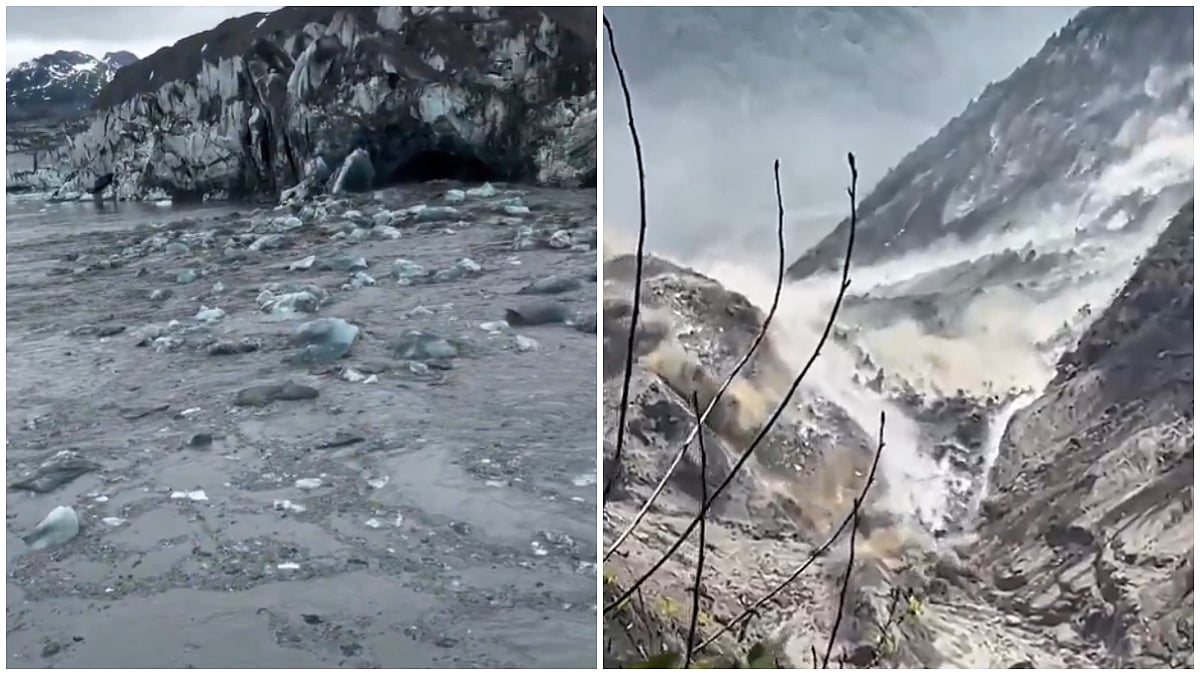
A massive ice-rock avalanche in the high Himalayas triggered the devastating floods that swept through Nepal's Bhotekoshi-Trishuli corridor, according to a preliminary report by Nepalese scientists. The report, commissioned by the Nepal Environment Society, was released on Sunday.
The death toll from the flash floods rose to 903 on Monday as bodies continued to be recovered, authorities said. The avalanche originated in the Langtang-Lirung area of Rasuwa and entered the Lhende River, generating a powerful debris-laden flood.
The study found that a massive volume of ice, rock, and debris fell from an elevation of about 5,200 meters in the Langtang-Lirung area and travelled downstream through the Bhotekoshi and into the Trishuli. Researchers concluded that the disaster was not caused by a glacial lake outburst flood (GLOF).
The ice-rock mass began falling from the northern part of Langtang-Lirung at around 8:37 am on Wednesday and descended steep terrain before reaching the Lhende River at an elevation of around 2,930 meters. Satellite images showed major geographical changes across about 10 square kilometers, while a section of glacier covering approximately 0.56 square kilometers had broken away.
Experts said further field investigation was needed to determine the precise geological mechanism, the contribution of melting ice, and whether the river was temporarily blocked upstream. The study also found that the ice-rock mass travelled about 22 kilometers to Rasuwagadhi in just over seven minutes, reaching an estimated average speed of 46.3 meters per second, or 167 kilometers per hour.
Despite slowing, the flow continued to carry huge quantities of rock, sediment, and soil. The study also found that the river's level and flow in the Rasuwagadhi and Syafrubesi areas declined several hours before the flood arrived.
The floods devastated towns and villages across northern and central Nepal on August 26. The Nepal Centre for Disaster Management President Bishal Nath Upreti said that initially, many thought it was a glacial lake outburst flood, but later it became clear that there had been an ice-rock avalanche.
The disaster has raised concerns about the impact of climate change on the region's glaciers and rivers. The Nepalese government has announced plans to conduct further research and monitoring to better understand the risks and mitigate the effects of such disasters.
In the meantime, rescue efforts are ongoing, and three Indians were rescued by the Nepali Army from a flood-hit village in Rasuwa. The Indian Embassy has facilitated their return.
The incident highlights the importance of disaster preparedness and response in the region. The Nepalese government and international organizations are working together to provide aid and support to those affected by the floods.
The study's findings have significant implications for the region's disaster management and climate change mitigation strategies. As the region continues to experience the impacts of climate change, it is essential to prioritize research, monitoring, and preparedness to minimize the risks and effects of such disasters.
In conclusion, the Nepal floods were a devastating disaster that highlighted the importance of understanding the causes and effects of such events. The preliminary report's findings provide valuable insights into the role of ice-rock avalanches in triggering floods and emphasize the need for further research and monitoring to mitigate the risks and effects of climate change in the region.
Frequently asked questions
What triggered the Nepal floods?
A massive ice-rock avalanche in the high Himalayas triggered the floods.
How many people died in the floods?
The death toll rose to 903 as bodies continued to be recovered.