Supreme Court to Hear Plea on Namaz Site Near Bhojshala Complex
Supreme Court to hear plea on July 24, Muslim side alleges alternate site 2km away
'%3E%3Crect%20width%3D'96'%20height%3D'96'%20fill%3D'%231A5276'%2F%3E%3Ccircle%20cx%3D'30'%20cy%3D'24'%20r%3D'44'%20fill%3D'%23fff'%20opacity%3D'.12'%2F%3E%3Ccircle%20cx%3D'60'%20cy%3D'74'%20r%3D'40'%20fill%3D'%23000'%20opacity%3D'.10'%2F%3E%3C%2Fg%3E%3Cg%20fill%3D'%23fff'%3E%3Cpath%20d%3D'M31%2041%20L48%2031%20L65%2041%20Z'%2F%3E%3Crect%20x%3D'33'%20y%3D'43'%20width%3D'4'%20height%3D'17'%2F%3E%3Crect%20x%3D'41'%20y%3D'43'%20width%3D'4'%20height%3D'17'%2F%3E%3Crect%20x%3D'51'%20y%3D'43'%20width%3D'4'%20height%3D'17'%2F%3E%3Crect%20x%3D'59'%20y%3D'43'%20width%3D'4'%20height%3D'17'%2F%3E%3Crect%20x%3D'30'%20y%3D'62'%20width%3D'36'%20height%3D'4'%20rx%3D'1'%2F%3E%3C%2Fg%3E%3C%2Fsvg%3E)
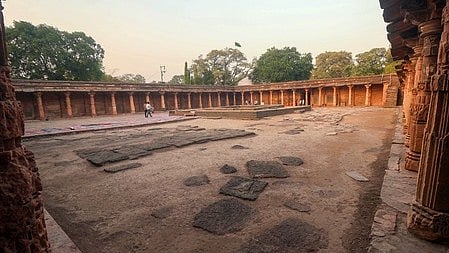
The Supreme Court has agreed to hear an application filed by the Muslim side on July 24, alleging that the alternate site allocated for offering namaz is 2km away from the Bhojshala complex in Dhar, Madhya Pradesh.
The application was filed after the apex court directed the allocation of a separate open space adjacent to the complex for the Muslim community to offer namaz on Fridays between 1-3 pm. However, the Muslim side claims that the allocated site is 2km away from the complex, which is not in accordance with the court's direction.
Senior advocate Huzefa Ahmadi mentioned the application before a bench headed by Chief Justice of India Surya Kant, stating that the land granted for Friday prayers is 2km away from the site. He added that the Muslim community has already missed one Friday prayer.
Solicitor General Tushar Mehta, appearing for the Madhya Pradesh government, claimed that the allocated site is 900m away from the complex. He assured the bench that the authorities are in the process of identifying a nearby site.
The bench reminded the Solicitor General that the court had directed the allocation of an adjacent site for namaz and asked him to find an alternate place adjacent to the site.
The dispute revolves around the 11th-century Bhojshala-Kamal Maula complex in Dhar district, which the Madhya Pradesh High Court has held as a temple dedicated to Goddess Saraswati. The Muslim side has challenged this verdict in the Supreme Court, seeking restoration of the 2003 ASI arrangement governing worship at the site.
The Supreme Court has issued notice to the Madhya Pradesh government, the Hindu parties, and the Archaeological Survey of India (ASI) on the batch of appeals filed by the Muslim side. The court has also directed the ASI not to undertake any structural alterations at the disputed complex without its permission.
The case has sparked tensions in the region, with a meeting held between the district administration and representatives of the Muslim community at the Collector's office in Dhar following the Supreme Court's interim order.
The Supreme Court's hearing on July 24 is expected to provide clarity on the allocation of the alternate site for namaz and the future of the disputed Bhojshala complex.
The dispute highlights the ongoing tensions between the Hindu and Muslim communities in India, with the Supreme Court playing a crucial role in resolving such disputes.
In conclusion, the Supreme Court's decision to hear the plea on July 24 is a significant development in the Bhojshala case, and its outcome is likely to have far-reaching implications for the Muslim community in Dhar and the broader religious landscape in India.
Frequently asked questions
What is the dispute about the Bhojshala-Kamal Maula complex?
The dispute revolves around the 11th-century Bhojshala-Kamal Maula complex in Dhar district, which the Madhya Pradesh High Court has held as a temple dedicated to Goddess Saraswati, while the Muslim side claims it as a mosque.
What has the Supreme Court directed in the case?
The Supreme Court has directed the allocation of a separate open space adjacent to the complex for the Muslim community to offer namaz on Fridays between 1-3 pm and has asked the ASI not to undertake any structural alterations at the disputed complex without its permission.