MMRDA To Monitor Kurla-Bandra POD Taxi Project Quality
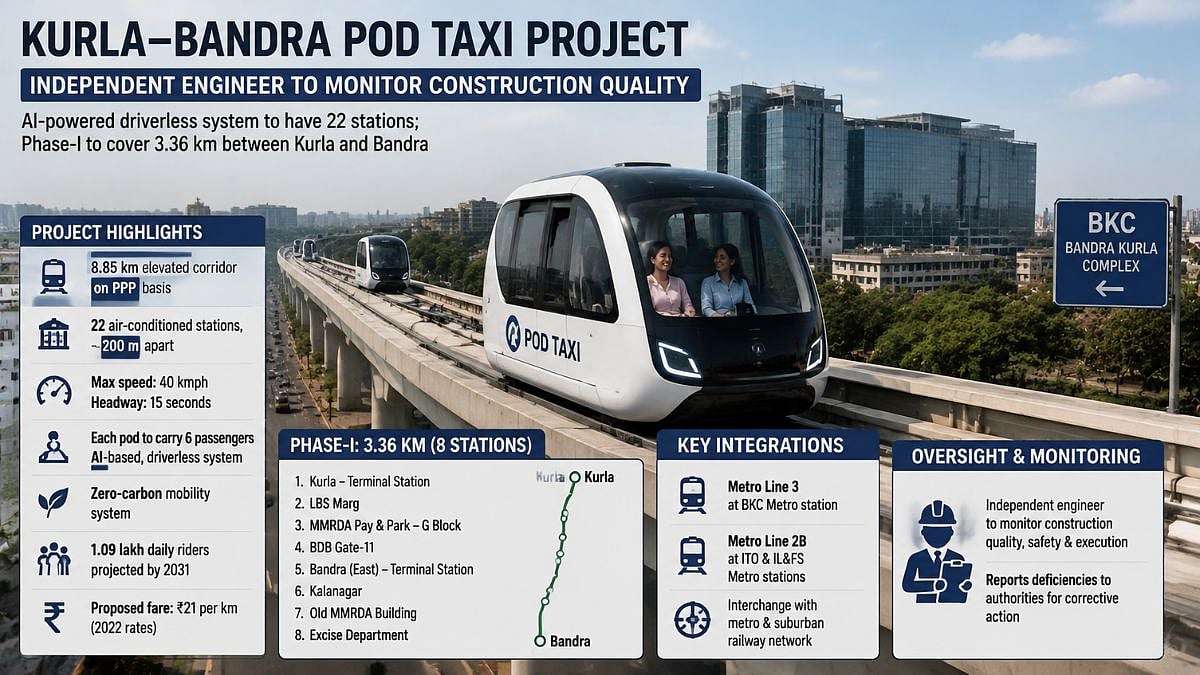
MMRDA plans to appoint an independent engineer to monitor the construction quality of the 8.85-km Kurla-Bandra POD Taxi project. The project will have 22 air-conditioned stations and use AI-based, driverless operating technology.
'%3E%3Crect%20width%3D'96'%20height%3D'96'%20fill%3D'%23B3261E'%2F%3E%3Ccircle%20cx%3D'30'%20cy%3D'24'%20r%3D'44'%20fill%3D'%23fff'%20opacity%3D'.12'%2F%3E%3Ccircle%20cx%3D'60'%20cy%3D'74'%20r%3D'40'%20fill%3D'%23000'%20opacity%3D'.10'%2F%3E%3C%2Fg%3E%3Cg%20fill%3D'%23fff'%3E%3Crect%20x%3D'29'%20y%3D'49'%20width%3D'8'%20height%3D'19'%20rx%3D'1'%2F%3E%3Crect%20x%3D'39'%20y%3D'40'%20width%3D'9'%20height%3D'28'%20rx%3D'1'%2F%3E%3Crect%20x%3D'50'%20y%3D'45'%20width%3D'8'%20height%3D'23'%20rx%3D'1'%2F%3E%3Crect%20x%3D'60'%20y%3D'53'%20width%3D'7'%20height%3D'15'%20rx%3D'1'%2F%3E%3Crect%20x%3D'41'%20y%3D'34'%20width%3D'5'%20height%3D'6'%2F%3E%3C%2Fg%3E%3C%2Fsvg%3E)
The Mumbai Metropolitan Region Development Authority (MMRDA) is set to appoint an independent engineer to oversee the construction quality and execution of the proposed Automated Rapid Transit System (PODTaxi) between Kurla and Bandra. This move aims to ensure that the project is independently scrutinized throughout its implementation.
The independent engineer will be appointed through a tender process and will function independently of both MMRDA and the agency responsible for implementing the pod taxi system. The engineer's primary responsibility will be to monitor construction, project progress, and quality, reporting any deficiencies or shortcomings to the concerned authorities.
The proposed 8.85-km Automated Rapid Transit System is being implemented on a Public-Private Partnership (PPP) basis, without any cost to the state government or MMRDA. Despite having no project cost burden, MMRDA is expected to generate revenue from the system.
The project envisages 22 air-conditioned stations, planned to be spaced approximately 200 meters apart, to improve accessibility for commuters. The first phase will cover 3.36 km and connect Bandra and Kurla. The Phase-I stations include Kurla Terminal Station, LBS Marg, MMRDA Pay & Park – G Block, and Bandra (East) Terminal Station, among others.
The system is planned to provide first- and last-mile connectivity to Kurla and Bandra suburban railway stations, while also improving access to the Bandra-Kurla Complex (BKC). The pod taxi system will use AI-based, driverless operating technology, with battery-powered pods running on a dedicated guideway. Each pod will accommodate six passengers and have a maximum operating speed of 40 kmph.
The pods will operate at a headway of just 15 seconds and will be able to stop only at the station selected by passengers, allowing them to bypass other stations and potentially reduce travel time. Each pod will measure 3.9 meters in length, 2.01 meters in width, and 1.8 meters in height and will be fully air-conditioned.
The pod taxi system is planned as an elevated transport network aimed at improving connectivity to BKC, one of Mumbai's major commercial and financial districts. The system will integrate with Metro Line 3 at the BKC Metro station and with Metro Line 2B at the ITO and IL&FS metro stations, creating additional interchange options between the pod taxi, metro, and suburban railway networks.
A depot has also been planned at an RLDA plot in Bandra East to support operations and maintenance of the system. With BKC attracting thousands of daily commuters, the proposed system is expected to provide an additional public transport option for short-distance travel.
The appointment of an independent engineer to monitor the construction quality of the project is a significant step towards ensuring the successful implementation of the Kurla-Bandra POD Taxi project. This move demonstrates MMRDA's commitment to delivering a high-quality transportation system that meets the needs of Mumbai's commuters.
The Kurla-Bandra POD Taxi project is expected to have a significant impact on the city's transportation landscape, providing a convenient and efficient mode of transport for thousands of commuters. With its advanced technology and user-friendly design, the system is poised to become a model for future transportation projects in Mumbai.
In conclusion, the MMRDA's decision to appoint an independent engineer to monitor the construction quality of the Kurla-Bandra POD Taxi project is a positive step towards ensuring the project's success. The project's potential to improve connectivity and provide a convenient mode of transport for commuters makes it a significant development for the city of Mumbai.
Frequently asked questions
What is the length of the Kurla-Bandra POD Taxi project?
The project is 8.85 km long.
How many stations will the project have?
The project will have 22 air-conditioned stations.