Canadian Teen Builds AI Robot Turtle to Detect Microplastics
16-year-old Evan Budz creates autonomous robot, wins $50,000 scholarship. Detects microplastics with 94% accuracy.
'%3E%3Crect%20width%3D'96'%20height%3D'96'%20fill%3D'%23B3261E'%2F%3E%3Ccircle%20cx%3D'30'%20cy%3D'24'%20r%3D'44'%20fill%3D'%23fff'%20opacity%3D'.12'%2F%3E%3Ccircle%20cx%3D'60'%20cy%3D'74'%20r%3D'40'%20fill%3D'%23000'%20opacity%3D'.10'%2F%3E%3C%2Fg%3E%3Cg%20fill%3D'%23fff'%3E%3Crect%20x%3D'29'%20y%3D'49'%20width%3D'8'%20height%3D'19'%20rx%3D'1'%2F%3E%3Crect%20x%3D'39'%20y%3D'40'%20width%3D'9'%20height%3D'28'%20rx%3D'1'%2F%3E%3Crect%20x%3D'50'%20y%3D'45'%20width%3D'8'%20height%3D'23'%20rx%3D'1'%2F%3E%3Crect%20x%3D'60'%20y%3D'53'%20width%3D'7'%20height%3D'15'%20rx%3D'1'%2F%3E%3Crect%20x%3D'41'%20y%3D'34'%20width%3D'5'%20height%3D'6'%2F%3E%3C%2Fg%3E%3C%2Fsvg%3E)
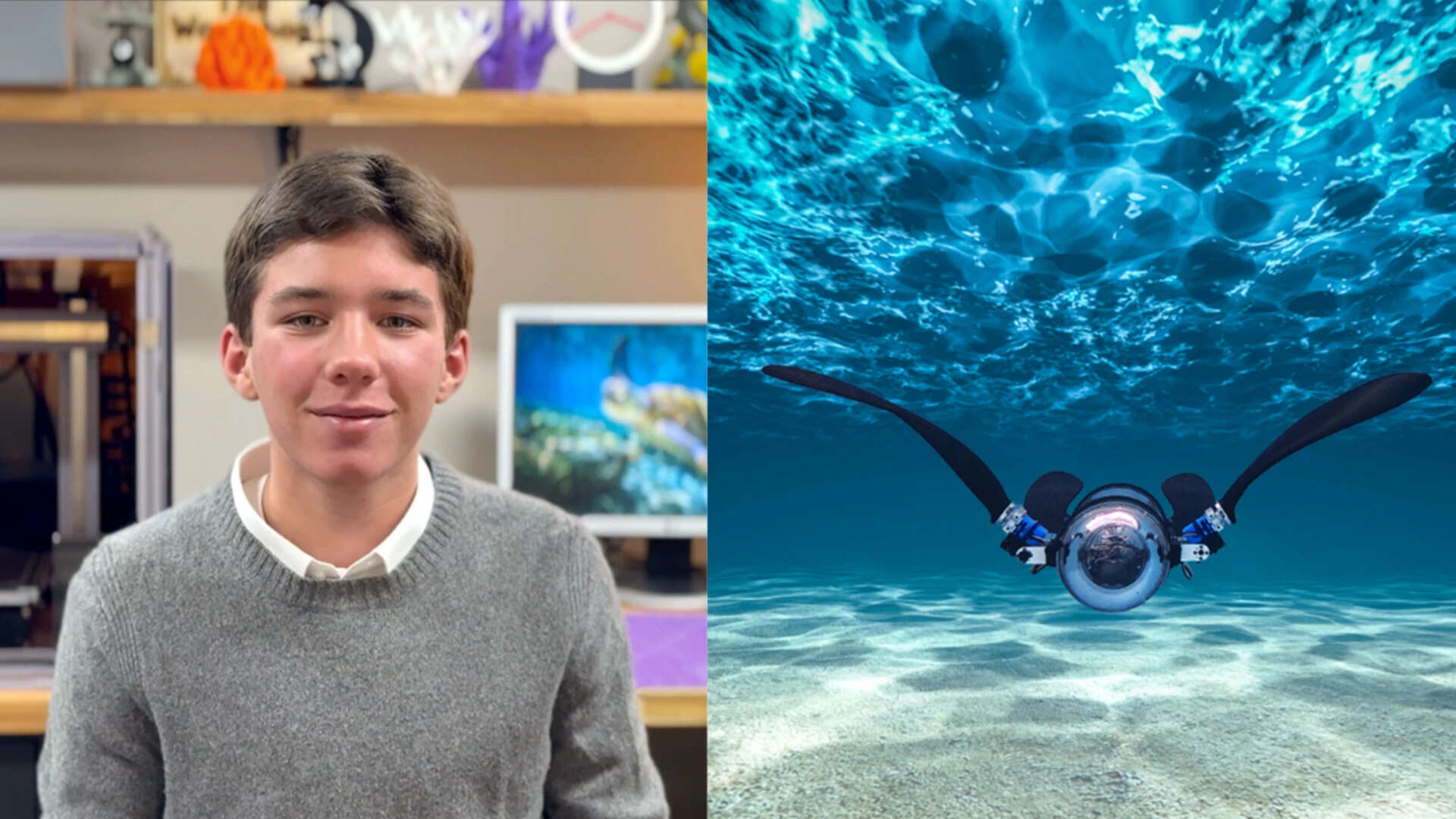
A 16-year-old Canadian student, Evan Budz, has successfully built an autonomous AI robot turtle that can detect microplastics in lakes with a high degree of accuracy. The robot turtle, which was the result of approximately 4,000 hours of work, is equipped with an underwater holographic camera that enables it to identify microplastics that are invisible to the human eye.
The robot turtle is designed to swim on its own and detect microplastics in remote water bodies, with an impressive accuracy rate of 94%. This innovation has the potential to replace traditional lab testing methods, which can be slow and expensive. Evan's goal is to provide a more efficient and cost-effective solution for detecting microplastics in lakes and other water bodies.
Evan's project earned him a $50,000 scholarship at the 2026 Regeneron ISEF, a prestigious international science and engineering fair. The scholarship is a testament to the significance and potential impact of his invention.
The issue of microplastics in water bodies is a growing concern, as these tiny particles can harm aquatic life and contaminate the food chain. Traditional methods of detecting microplastics involve collecting water samples and sending them to labs for analysis, which can be a time-consuming and costly process. Evan's robot turtle offers a promising solution to this problem, as it can detect microplastics on the spot and provide immediate results.
The use of AI and robotics in environmental conservation is a rapidly evolving field, with many innovators and researchers exploring new ways to use technology to protect the environment. Evan's project is a notable example of how young people can contribute to this field and make a positive impact.
The development of the robot turtle is also a testament to the power of dedication and hard work. Evan spent thousands of hours designing and building the robot, and his efforts have paid off in a significant way. His project has the potential to inspire other young people to pursue careers in science, technology, engineering, and math (STEM) and to make a positive impact on the environment.
In the future, Evan's robot turtle could be used in a variety of applications, from monitoring water quality in lakes and rivers to detecting microplastics in ocean waters. The potential impact of this technology is significant, and it could play a major role in helping to protect the environment and preserve the health of aquatic ecosystems.
Overall, Evan's project is a remarkable achievement that demonstrates the potential of AI and robotics to address environmental challenges. His innovation has the potential to make a significant impact on the way we detect and monitor microplastics in water bodies, and it could inspire a new generation of young people to pursue careers in STEM and environmental conservation.
The success of Evan's project also highlights the importance of supporting and encouraging young people to pursue their interests in science and technology. By providing opportunities and resources for young innovators to develop their ideas and projects, we can help to create a more sustainable and environmentally conscious future.
In conclusion, Evan's AI robot turtle is a groundbreaking innovation that has the potential to revolutionize the way we detect and monitor microplastics in water bodies. His project is a testament to the power of dedication, hard work, and creativity, and it could inspire a new generation of young people to pursue careers in STEM and environmental conservation.
Frequently asked questions
What is the purpose of the AI robot turtle built by Evan Budz?
The AI robot turtle is designed to detect microplastics in lakes and other water bodies, replacing slow and expensive lab testing methods.
How accurate is the AI robot turtle in detecting microplastics?
The AI robot turtle can detect microplastics with an accuracy rate of 94%.