India's All-Women Crew Completes Historic Maritime Circumnavigation
Nine women officers from India's Army, Navy, and Air Force made history by completing a 314-day voyage around the globe. They sailed 25,500 nautical miles on the indigenously built IASV Triveni.
'%3E%3Crect%20width%3D'96'%20height%3D'96'%20fill%3D'%23B3261E'%2F%3E%3Ccircle%20cx%3D'30'%20cy%3D'24'%20r%3D'44'%20fill%3D'%23fff'%20opacity%3D'.12'%2F%3E%3Ccircle%20cx%3D'60'%20cy%3D'74'%20r%3D'40'%20fill%3D'%23000'%20opacity%3D'.10'%2F%3E%3C%2Fg%3E%3Cg%20fill%3D'%23fff'%3E%3Crect%20x%3D'29'%20y%3D'49'%20width%3D'8'%20height%3D'19'%20rx%3D'1'%2F%3E%3Crect%20x%3D'39'%20y%3D'40'%20width%3D'9'%20height%3D'28'%20rx%3D'1'%2F%3E%3Crect%20x%3D'50'%20y%3D'45'%20width%3D'8'%20height%3D'23'%20rx%3D'1'%2F%3E%3Crect%20x%3D'60'%20y%3D'53'%20width%3D'7'%20height%3D'15'%20rx%3D'1'%2F%3E%3Crect%20x%3D'41'%20y%3D'34'%20width%3D'5'%20height%3D'6'%2F%3E%3C%2Fg%3E%3C%2Fsvg%3E)
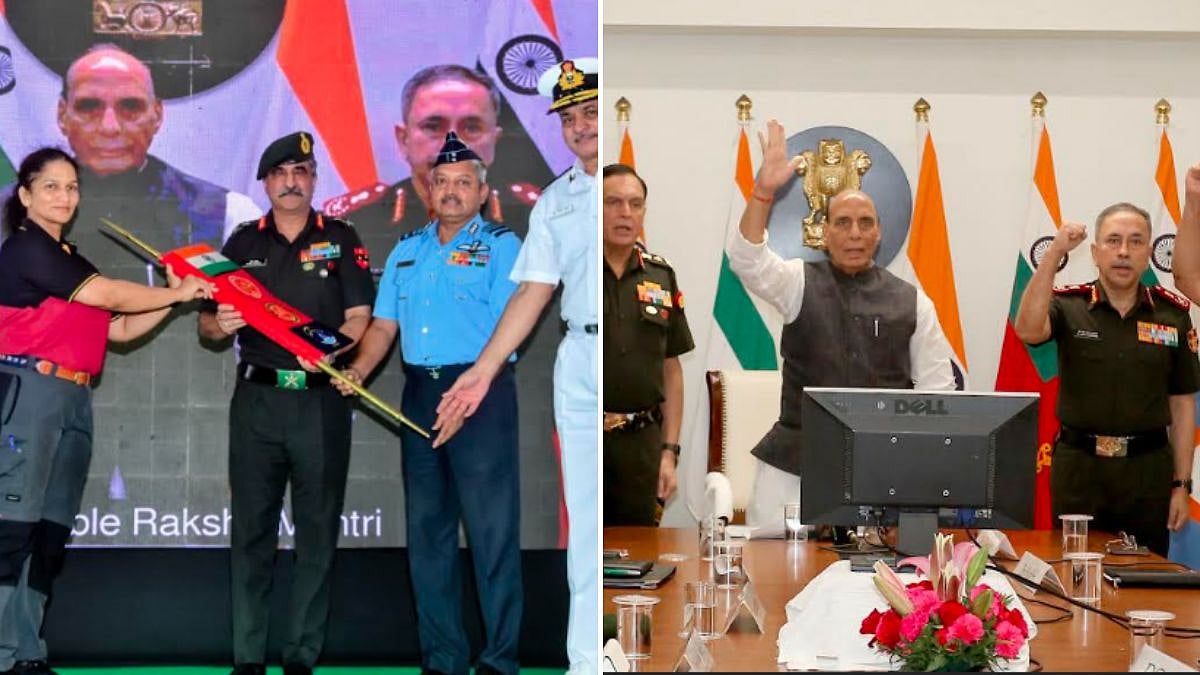
On Wednesday, nine women officers from India's Army, Navy, and Air Force stepped back onto dry land in Mumbai, completing an epic 314-day voyage around the globe. This historic feat makes them the first-ever tri-service all-women team to accomplish a complete maritime circumnavigation.
The crew sailed aboard the indigenously built Indian Army Sailing Vessel (IASV) Triveni, which covered 25,500 nautical miles across four oceans and three Great Capes. The vessel departed from Mumbai on September 11, 2025, on the ambitious expedition titled 'Samudra Pradakshina'. During their journey, they logged nearly 25,500 nautical miles across four major oceans, covering Australia's Fremantle, New Zealand's Lyttelton, Argentina's Buenos Aires, South Africa's Cape Town, and returned back to Mumbai.
The crew met every rigorous international benchmark for true circumnavigation, which includes crossing all meridians of longitude, navigating the Equator twice, transiting the international date line, and rounding up the three treacherous Great Capes – Cape Leeuwin, Cape Horn, and the Cape of Good Hope. The voyage was defined by sheer grit, particularly during their passage through the notorious Drake Passage and the rounding of South America's Cape Horn – widely regarded as the Everest of ocean sailing.
By conquering these punishing, storm-swept waters, all nine officers earned induction into the prestigious fraternity of Cape Horners. The indigenous vessel acted as a floating embassy during diplomatic port calls in Australia, New Zealand, Argentina, and South Africa, projecting Indian maritime heritage, military professionalism, and soft power abroad.
The expedition was officially flagged-in on Wednesday during a high-profile hybrid ceremony at the Gateway of India. Union Defence Minister Rajnath Singh, along with Chief of Defence Staff General NS Raja Subramani and the top leadership of the three Armed Services, presided over the event virtually from New Delhi.
The Defence Minister described the expedition as a testament to India's Nari Shakti and a symbol of the nation's resolve, a proof of the effectiveness of tri-service synergy. The crew has proven that human courage is mightier than any storm, making every Indian woman proud and showcasing the nation's capabilities.
The successful completion of this expedition marks a significant milestone in India's maritime history, demonstrating the country's ability to build and sail indigenously built vessels across the globe. It also highlights the importance of tri-service synergy and the role of women in the Indian Armed Forces.
In conclusion, the all-women crew's historic achievement is a testament to their courage, determination, and skills, making them an inspiration to millions of Indians. Their feat will be remembered for generations to come, and it will continue to motivate and empower women to pursue careers in the Indian Armed Forces.
The crew's achievement is also a reflection of India's growing maritime capabilities and its commitment to promoting women's empowerment and gender equality. As the country continues to grow and develop, it is essential to recognize and celebrate the achievements of women like these nine officers, who have made history and inspired a nation.
The Indian government has been actively promoting women's participation in the Armed Forces, and this expedition is a significant step in that direction. The success of this expedition will likely pave the way for more women to join the Indian Armed Forces and participate in similar expeditions in the future.
Overall, the all-women crew's historic achievement is a significant milestone in India's maritime history, and it will continue to inspire and motivate women to pursue careers in the Indian Armed Forces.
Frequently asked questions
What is the name of the vessel used for the maritime circumnavigation?
The vessel used for the maritime circumnavigation is the Indian Army Sailing Vessel (IASV) Triveni.
How many nautical miles did the IASV Triveni cover during the expedition?
The IASV Triveni covered 25,500 nautical miles during the expedition.