Online Current Account Opening Simplifies Business Banking
Small business owners can now open current accounts online, reducing paperwork and time costs. This simplification can increase digital payments and formalize cash flow.
'%3E%3Crect%20width%3D'96'%20height%3D'96'%20fill%3D'%23B3261E'%2F%3E%3Ccircle%20cx%3D'30'%20cy%3D'24'%20r%3D'44'%20fill%3D'%23fff'%20opacity%3D'.12'%2F%3E%3Ccircle%20cx%3D'60'%20cy%3D'74'%20r%3D'40'%20fill%3D'%23000'%20opacity%3D'.10'%2F%3E%3C%2Fg%3E%3Cg%20fill%3D'%23fff'%3E%3Crect%20x%3D'29'%20y%3D'49'%20width%3D'8'%20height%3D'19'%20rx%3D'1'%2F%3E%3Crect%20x%3D'39'%20y%3D'40'%20width%3D'9'%20height%3D'28'%20rx%3D'1'%2F%3E%3Crect%20x%3D'50'%20y%3D'45'%20width%3D'8'%20height%3D'23'%20rx%3D'1'%2F%3E%3Crect%20x%3D'60'%20y%3D'53'%20width%3D'7'%20height%3D'15'%20rx%3D'1'%2F%3E%3Crect%20x%3D'41'%20y%3D'34'%20width%3D'5'%20height%3D'6'%2F%3E%3C%2Fg%3E%3C%2Fsvg%3E)
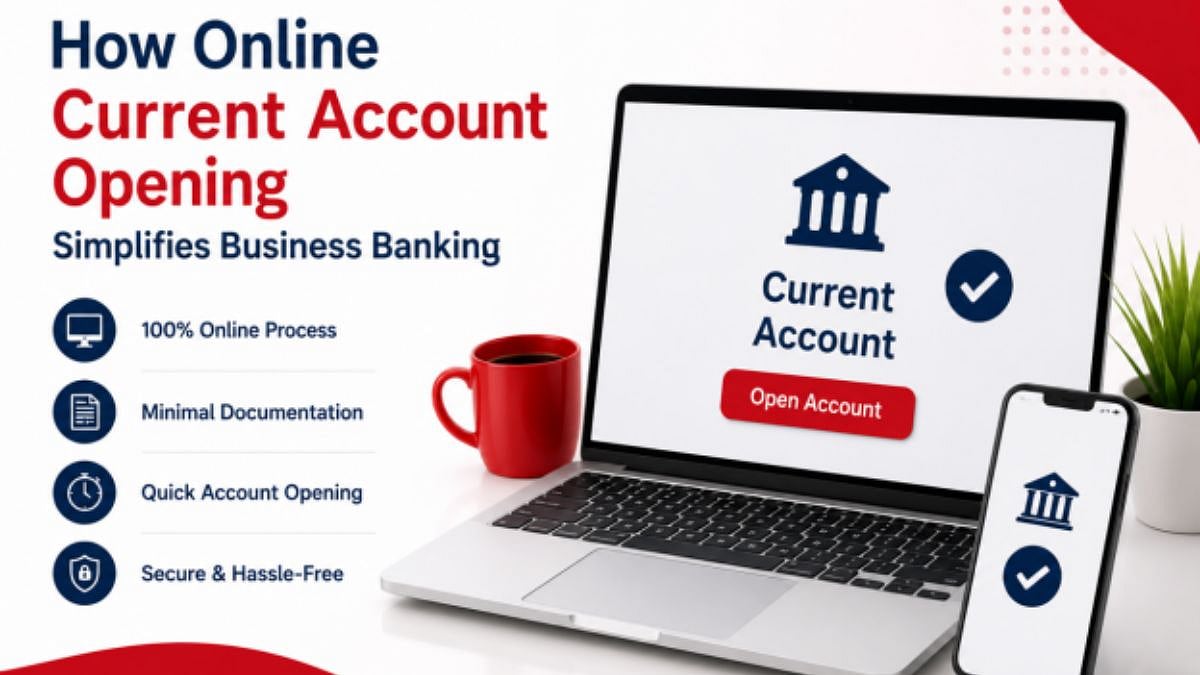
A significant development in the banking sector is making it easier for small business owners in India to open current accounts online. This innovation removes the need for a physical visit to the bank branch, reducing the time and paperwork associated with the process.
For many small shop owners, opening a current account has traditionally been a chore that involves a day lost at the branch, shuffling documents, and uncertainty about when payments will start clearing. However, with the ability to open a current account online, this friction is significantly reduced.
The impact of online current account opening is multifaceted. It enables businesses to formalize their cash flow, separate business and personal transactions, and accept digital payments. This, in turn, affects bookkeeping, borrowing, and tax compliance. For instance, a Kirana owner can now quickly open an account and start accepting UPI or card payments, reducing the activation friction associated with these services.
The real impact of online current account opening is felt in the day-to-day cash flow of businesses. It speeds up access to collections and overdraft facilities, allowing businesses to manage their working capital more effectively. Instead of waiting weeks for account verification, many banks now complete KYC and sanction limits within days. This timing can make a significant difference for traders who need working capital before festival season, enabling them to stock up on inventory and capitalize on sales opportunities.
When the current account opening process is smooth, business owners feel more confident using card machines and payment links, which increases recorded turnover. This, in turn, helps when applying for loans or negotiating supplier credit. However, it's essential to note that the ease of online current account opening can also prompt impulse decisions, such as accepting faster credit offers without fully analyzing repayments.
Banks and advisers need to design onboarding processes that balance convenience with nudges toward prudent credit use. This includes ensuring that customers understand the terms and conditions of credit offers and the potential risks associated with them.
The online current account opening process must also align with KYC, GST linkage, and deposit account rules. Customers typically upload PAN, proof of business, and address proofs as part of the application process. For small enterprises without formal paperwork, banks often accept alternative declarations and visit verifications, which helps to promote financial inclusion.
Clear prompts during the application process, such as what to upload, expected timelines, and any limits on transaction types, can reduce call-center load and customer anxiety. This streamlined process helps to build trust and confidence in the banking system, encouraging more businesses to formalize their cash flow and adopt digital payment systems.
Once a business switches to a dedicated current account, transaction histories become lending signals. Lenders look at inflows, average balance, and payment cadence to assess creditworthiness. An online-opened current account that's activated promptly lets merchants prove steady receipts faster, which can lead to tailored working capital solutions and better borrowing terms.
In conclusion, the ability to open current accounts online is a significant development that can simplify business banking and increase financial inclusion. By reducing paperwork and time costs, it can encourage more small business owners to formalize their cash flow and adopt digital payment systems. This, in turn, can have a positive impact on the overall economy, promoting growth and development in the small business sector.