Capitalism Evolves With AI And Circularity
New tools transform businesses, prioritizing social progress and environmental sustainability.
'%3E%3Crect%20width%3D'96'%20height%3D'96'%20fill%3D'%23B3261E'%2F%3E%3Ccircle%20cx%3D'30'%20cy%3D'24'%20r%3D'44'%20fill%3D'%23fff'%20opacity%3D'.12'%2F%3E%3Ccircle%20cx%3D'60'%20cy%3D'74'%20r%3D'40'%20fill%3D'%23000'%20opacity%3D'.10'%2F%3E%3C%2Fg%3E%3Cg%20fill%3D'%23fff'%3E%3Crect%20x%3D'29'%20y%3D'49'%20width%3D'8'%20height%3D'19'%20rx%3D'1'%2F%3E%3Crect%20x%3D'39'%20y%3D'40'%20width%3D'9'%20height%3D'28'%20rx%3D'1'%2F%3E%3Crect%20x%3D'50'%20y%3D'45'%20width%3D'8'%20height%3D'23'%20rx%3D'1'%2F%3E%3Crect%20x%3D'60'%20y%3D'53'%20width%3D'7'%20height%3D'15'%20rx%3D'1'%2F%3E%3Crect%20x%3D'41'%20y%3D'34'%20width%3D'5'%20height%3D'6'%2F%3E%3C%2Fg%3E%3C%2Fsvg%3E)
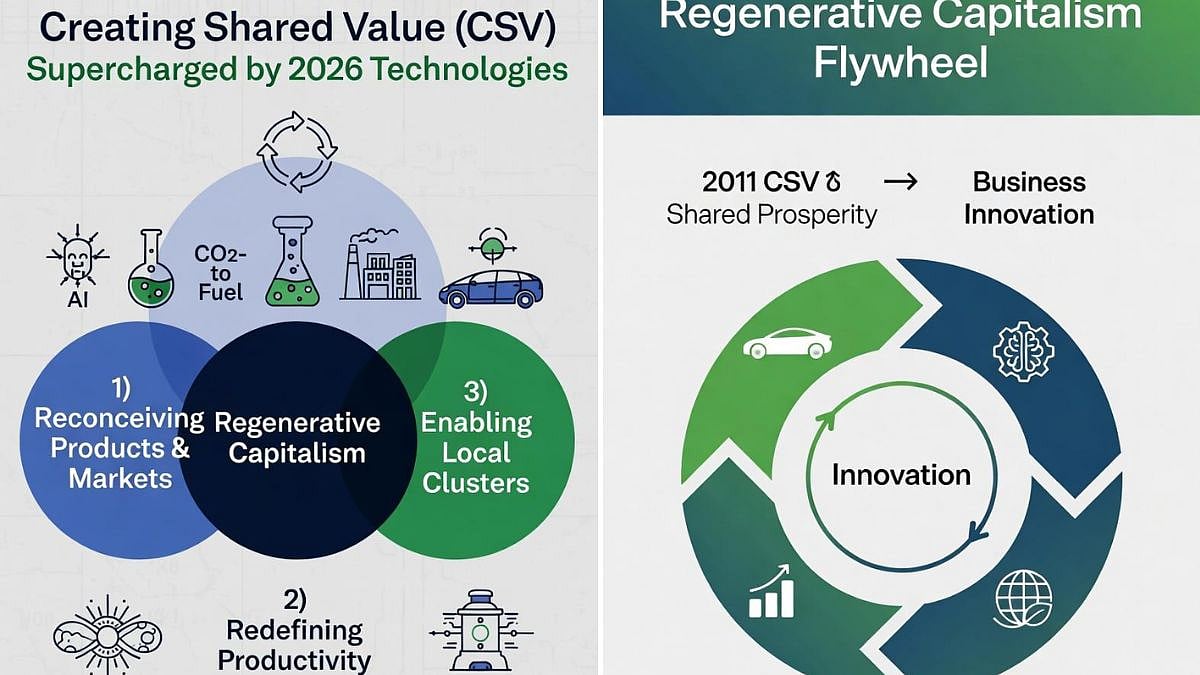
In 2011, Michael E. Porter and Mark R. Kramer introduced the concept of creating shared value, which aimed to reconnect business success with social progress. This idea emphasized the importance of businesses enhancing their competitiveness while advancing economic and social conditions in their communities. Fifteen years later, the diagnosis of capitalism's legitimacy crisis remains, but the tools available to address it have undergone significant transformations.
The emergence of autonomous agentic AI systems, carbon-conversion technologies, and waste-to-energy advancements has revolutionized the way businesses operate. These breakthroughs have enabled companies to adopt more sustainable and socially responsible practices, such as closed-loop design, AI-tracked material passports, and regenerative manufacturing. The renewables-to-fusion journey has also made significant progress, with private funding exceeding $4.5 billion and grid-pilot demonstrations underway.
The first avenue of creating shared value, which involves meeting unmet societal needs, has seen tremendous growth. Agentic AI agents are now being used to deliver personalized services, such as tutoring, healthcare diagnostics, and micro-insurance, in underserved regions. Carbon conversion has turned CO₂ into valuable feedstock, while waste-to-energy has converted municipal and industrial waste into syngas, hydrogen, and biochar. Fusion promises to provide baseload power denser than fission, and green mobility has introduced autonomous electric or hydrogen fleets charged by fusion micro-reactors.
The second avenue of creating shared value, which involves redefining productivity in the value chain, has also seen significant advancements. Precision at planetary scale has become a reality, with agentic AI material passports tracking products and components throughout their lifecycle. This has enabled companies to design products for infinite reuse, reducing material costs and increasing profits while minimizing waste and environmental impact.
The third avenue of creating shared value, which involves enabling local cluster development, has also been transformed by the new tools available. Agentic AI has enabled companies to create local data economies, while carbon conversion and waste-to-energy have created new opportunities for local economic development. Fusion and green mobility have also introduced new possibilities for local energy generation and transportation.
The adoption of these new tools and technologies has significant implications for businesses and society as a whole. By prioritizing social progress and environmental sustainability, companies can enhance their competitiveness while contributing to the well-being of their communities. As the world continues to evolve and face new challenges, the concept of creating shared value remains a vital framework for businesses to operate in a way that benefits both themselves and society.
The future of capitalism looks promising, with the potential for businesses to create shared value on a planetary scale. As companies continue to adopt and integrate these new tools and technologies, we can expect to see significant advancements in social progress and environmental sustainability. The evolution of capitalism is underway, and it is likely to have a profound impact on the way businesses operate and contribute to society.
In conclusion, the concept of creating shared value has undergone significant transformations in recent years, driven by the emergence of new tools and technologies. As businesses continue to adopt and integrate these advancements, we can expect to see a more sustainable and socially responsible form of capitalism emerge. This new era of capitalism has the potential to create shared value on a planetary scale, benefiting both businesses and society as a whole.
The implications of this new era of capitalism are far-reaching, and it is likely to have a significant impact on the way businesses operate and contribute to society. As companies prioritize social progress and environmental sustainability, we can expect to see significant advancements in areas such as education, healthcare, and energy generation. The future of capitalism looks promising, and it is likely to be shaped by the adoption of these new tools and technologies.
Overall, the evolution of capitalism is a complex and multifaceted phenomenon, driven by the emergence of new tools and technologies. As businesses continue to adopt and integrate these advancements, we can expect to see significant advancements in social progress and environmental sustainability. The concept of creating shared value remains a vital framework for businesses to operate in a way that benefits both themselves and society, and it is likely to play a key role in shaping the future of capitalism.
The new era of capitalism is characterized by a focus on social progress and environmental sustainability, and it is likely to have a profound impact on the way businesses operate and contribute to society. As companies prioritize these values, we can expect to see significant advancements in areas such as education, healthcare, and energy generation. The future of capitalism looks promising, and it is likely to be shaped by the adoption of these new tools and technologies.
In the end, the evolution of capitalism is a story of transformation and growth, driven by the emergence of new tools and technologies. As businesses continue to adopt and integrate these advancements, we can expect to see significant advancements in social progress and environmental sustainability. The concept of creating shared value remains a vital framework for businesses to operate in a way that benefits both themselves and society, and it is likely to play a key role in shaping the future of capitalism.