India Condemns Attacks On Ships In Strait Of Hormuz
India strongly condemns attacks on commercial vessels, calls for de-escalation in West Asia.
'%3E%3Crect%20width%3D'96'%20height%3D'96'%20fill%3D'%234A235A'%2F%3E%3Ccircle%20cx%3D'30'%20cy%3D'24'%20r%3D'44'%20fill%3D'%23fff'%20opacity%3D'.12'%2F%3E%3Ccircle%20cx%3D'60'%20cy%3D'74'%20r%3D'40'%20fill%3D'%23000'%20opacity%3D'.10'%2F%3E%3C%2Fg%3E%3Cg%20fill%3D'none'%20stroke%3D'%23fff'%20stroke-width%3D'3'%3E%3Ccircle%20cx%3D'48'%20cy%3D'48'%20r%3D'16'%2F%3E%3Cellipse%20cx%3D'48'%20cy%3D'48'%20rx%3D'6.5'%20ry%3D'16'%2F%3E%3Cline%20x1%3D'32'%20y1%3D'42'%20x2%3D'64'%20y2%3D'42'%2F%3E%3Cline%20x1%3D'32'%20y1%3D'54'%20x2%3D'64'%20y2%3D'54'%2F%3E%3C%2Fg%3E%3C%2Fsvg%3E)
India has strongly condemned the recent attacks on commercial vessels transiting the Strait of Hormuz, describing the renewed escalation in West Asia as deeply concerning.
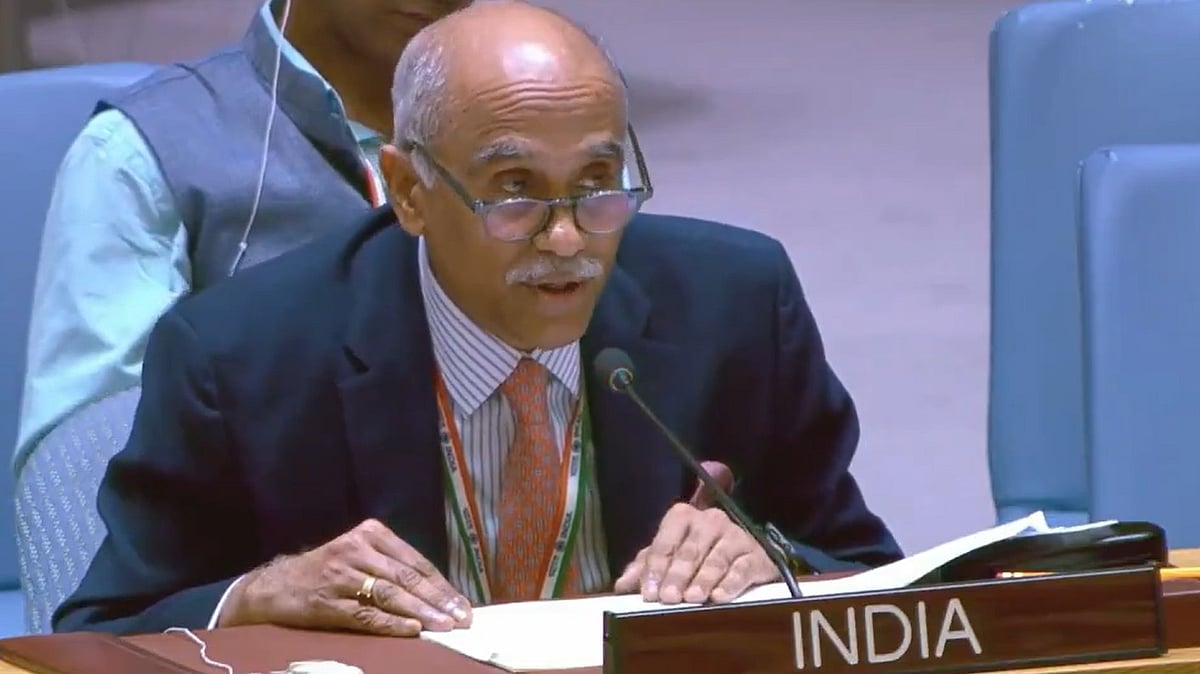
The condemnation was made by India's Permanent Representative to the UN, Ambassador Parvathaneni Harish, during a United Nations Security Council (UNSC) open debate on the Middle East.
Ambassador Harish stated that after a brief pause in the ongoing conflict in the region, there has been a worrying resumption of attacks and escalation of hostilities. He called for an immediate de-escalation of tensions and strongly condemned attacks on several vessels, including GFS Galaxy, MT Al Bahiyah and MT Mombasa, during their transit through the Strait of Hormuz this month.
Several Indian citizens were injured, including some seriously, in these attacks. One Indian tragically lost his life, and one is missing. India has consistently condemned acts of violence targeting seafarers and disrupting free and safe navigation through international waterways like the Strait of Hormuz.
India reiterated that it strongly advocates dialogue and diplomacy to restore peace, security and stability in the region. The targeting of commercial shipping and civilian infrastructure in the region must end, and free and unimpeded navigation and commerce through the international waterways in the region, in keeping with international law, must be restored.
At the UN, Ambassador Harish reaffirmed India's firm support for the safety of UNIFIL peacekeepers, strongly condemning attacks on UN personnel in Lebanon and calling for their protection.
The remarks came amid the US-Israel war against Iran. The UN has noted that after attacks on commercial vessels from July 6, Iran again declared the Strait of Hormuz closed on July 11. Daily vessel transits, which exceeded 100 before the conflict and had recovered to 49 by July 7, dropped to between eight and 15 by mid-July.
India has strategic and economic stakes in West Asia, with the region being of immense importance to the country. India's trade, energy security and economic interests are closely linked to the region, with bilateral annual trade standing at around $180 billion and cumulative Foreign Direct Investment exceeding $31 billion. The country also receives more than $52 billion in remittances from the Gulf Cooperation Council alone. Around 10 million Indians live and work in the Gulf region, and their safety and well-being are a key priority for India.
In conclusion, India's condemnation of the attacks on ships in the Strait of Hormuz and its call for de-escalation in West Asia reflect the country's commitment to peace, security, and stability in the region. The situation in West Asia has significant implications for India's economic and strategic interests, and the country will likely continue to play an active role in promoting dialogue and diplomacy in the region.
Frequently asked questions
What is the current situation in the Strait of Hormuz?
The Strait of Hormuz has been closed by Iran after attacks on commercial vessels, with daily vessel transits dropping significantly.
What are India's interests in West Asia?
India has strategic and economic stakes in West Asia, with bilateral annual trade standing at around $180 billion and cumulative Foreign Direct Investment exceeding $31 billion.