Supreme Court Seeks Centre's Response On Muslim Polygamy Plea
Supreme Court seeks Centre's response on petition challenging Muslim polygamy practice. Petitioners argue it violates fundamental rights.
'%3E%3Crect%20width%3D'96'%20height%3D'96'%20fill%3D'%231A5276'%2F%3E%3Ccircle%20cx%3D'30'%20cy%3D'24'%20r%3D'44'%20fill%3D'%23fff'%20opacity%3D'.12'%2F%3E%3Ccircle%20cx%3D'60'%20cy%3D'74'%20r%3D'40'%20fill%3D'%23000'%20opacity%3D'.10'%2F%3E%3C%2Fg%3E%3Cg%20fill%3D'%23fff'%3E%3Cpath%20d%3D'M31%2041%20L48%2031%20L65%2041%20Z'%2F%3E%3Crect%20x%3D'33'%20y%3D'43'%20width%3D'4'%20height%3D'17'%2F%3E%3Crect%20x%3D'41'%20y%3D'43'%20width%3D'4'%20height%3D'17'%2F%3E%3Crect%20x%3D'51'%20y%3D'43'%20width%3D'4'%20height%3D'17'%2F%3E%3Crect%20x%3D'59'%20y%3D'43'%20width%3D'4'%20height%3D'17'%2F%3E%3Crect%20x%3D'30'%20y%3D'62'%20width%3D'36'%20height%3D'4'%20rx%3D'1'%2F%3E%3C%2Fg%3E%3C%2Fsvg%3E)
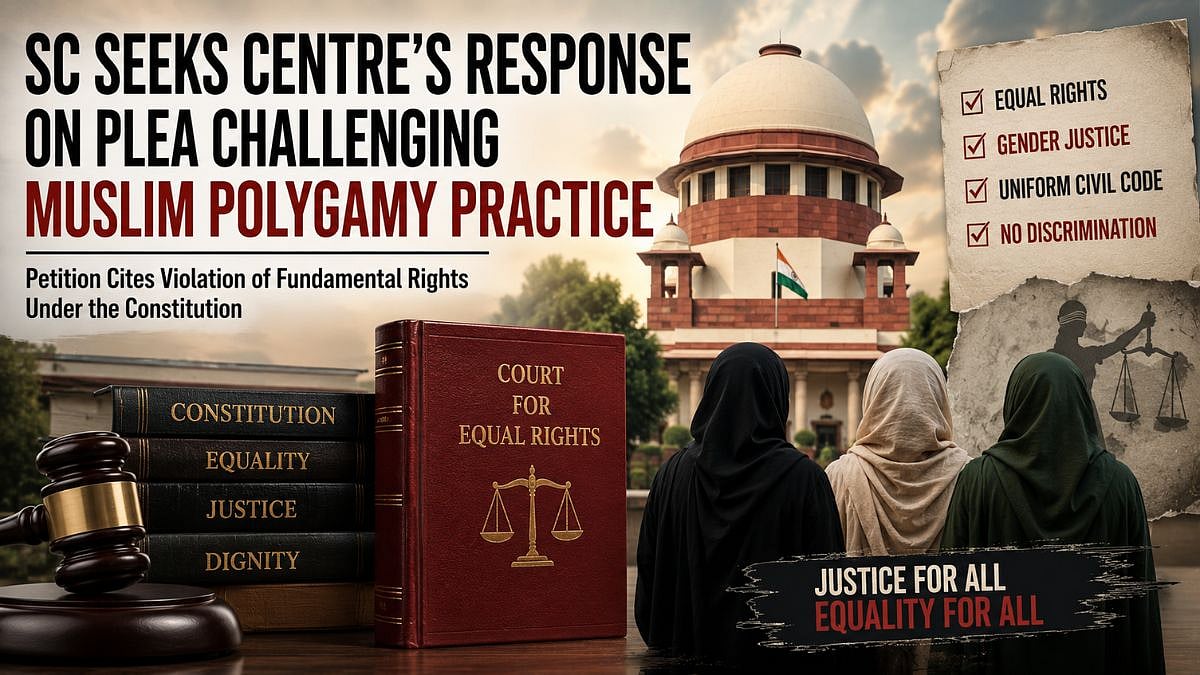
The Supreme Court on Friday sought the Centre's response to a petition challenging the practice of polygamy among Muslims, stating it violates the fundamental rights guaranteed under the Constitution.
A Bench of Chief Justice Surya Kant and Justices Joymalya Bagchi and V. Mohan issued notice to the Centre on the petition filed by women's rights activists Zakia Soman, Noorjehan Safia Niaz and others. The petition seeks to declare the practice of polygamy among Muslims unconstitutional.
The petitioners argue that the practice of polygamy is inherently discriminatory and violates Articles 14, 15 and 21 of the Constitution. They contend that while bigamy is a criminal offence for other citizens, Muslim men enjoy a legal exemption, creating unequal treatment under the law.
The petition seeks the uniform application of Section 82 of the Bharatiya Nyaya Sanhita (BNS), which criminalises bigamy, by removing the exemption available under Muslim Personal Law. It also urges the Centre to take legislative steps to abolish polygamy and declare such marriages void ab initio, regardless of religion.
The petitioners have argued that polygamy is not an essential religious practice and that it causes severe psychological, emotional and economic harm to women and children, affecting their right to live with dignity under Article 21. They also claim that the practice contributes to female destitution and is often used to bypass legal safeguards introduced after the abolition of instant triple talaq.
The court has tagged the matter with similar pending petitions, and the Centre's response is awaited. The petitioners have sought several measures aimed at protecting Muslim women, including compulsory registration of all Muslim marriages and divorces with State authorities and an immediate right to the matrimonial home for the first wife and children.
The petition challenges the constitutional validity of Section 2 of the Muslim Personal Law (Shariat) Application Act, 1937, which validates polygamy and creates a legal vacuum by denying Muslim women the protection against bigamy available to other citizens under Section 82 of the BNS.
The Supreme Court's decision to seek the Centre's response on the petition is a significant development in the ongoing debate on the practice of polygamy among Muslims. The petitioners' arguments highlight the need for equal protection under the law and the importance of protecting the rights of Muslim women.
The issue of polygamy has been a contentious one in India, with many arguing that it is a violation of women's rights and a form of discrimination. The Supreme Court's decision will be closely watched, as it has the potential to impact the lives of millions of Muslim women in the country.
In conclusion, the Supreme Court's decision to seek the Centre's response on the petition challenging the practice of polygamy among Muslims is a significant step towards addressing the issue of gender discrimination and unequal treatment under the law. The petitioners' arguments highlight the need for equal protection and the importance of protecting the rights of Muslim women.
The Centre's response is awaited, and the outcome of the case will be closely watched. The Supreme Court's decision has the potential to impact the lives of millions of Muslim women in the country and could be a significant step towards achieving gender justice and equality under the law.
The petitioners' contention that polygamy is not an essential religious practice and that it causes harm to women and children is a significant argument. The Supreme Court's decision will depend on its interpretation of the Constitution and the laws related to Muslim Personal Law.
The case highlights the importance of protecting the rights of Muslim women and the need for equal treatment under the law. The Supreme Court's decision will be a significant step towards achieving gender justice and equality in the country.
The issue of polygamy is a complex one, and the Supreme Court's decision will have significant implications for the lives of Muslim women in India. The petitioners' arguments highlight the need for equal protection under the law and the importance of protecting the rights of Muslim women.
The Centre's response to the petition will be crucial in determining the outcome of the case. The Supreme Court's decision will depend on its interpretation of the Constitution and the laws related to Muslim Personal Law. The case is a significant one, and the outcome will be closely watched by all stakeholders.
In the end, the Supreme Court's decision will be a significant step towards achieving gender justice and equality in the country. The petitioners' arguments highlight the need for equal protection under the law and the importance of protecting the rights of Muslim women. The case is a complex one, and the outcome will have significant implications for the lives of Muslim women in India.
Frequently asked questions
What is the petition about in the Supreme Court?
The petition challenges the practice of polygamy among Muslims, stating it violates the fundamental rights guaranteed under the Constitution.
What is the Centre's role in the petition?
The Centre has been issued notice by the Supreme Court and is required to respond to the petition.