US Scientists Build $12m Digital Brain for Drones
US researchers create insect-inspired drone brain. Autonomous drone swarms goal.
'%3E%3Crect%20width%3D'96'%20height%3D'96'%20fill%3D'%23B3261E'%2F%3E%3Ccircle%20cx%3D'30'%20cy%3D'24'%20r%3D'44'%20fill%3D'%23fff'%20opacity%3D'.12'%2F%3E%3Ccircle%20cx%3D'60'%20cy%3D'74'%20r%3D'40'%20fill%3D'%23000'%20opacity%3D'.10'%2F%3E%3C%2Fg%3E%3Cg%20fill%3D'%23fff'%3E%3Crect%20x%3D'29'%20y%3D'49'%20width%3D'8'%20height%3D'19'%20rx%3D'1'%2F%3E%3Crect%20x%3D'39'%20y%3D'40'%20width%3D'9'%20height%3D'28'%20rx%3D'1'%2F%3E%3Crect%20x%3D'50'%20y%3D'45'%20width%3D'8'%20height%3D'23'%20rx%3D'1'%2F%3E%3Crect%20x%3D'60'%20y%3D'53'%20width%3D'7'%20height%3D'15'%20rx%3D'1'%2F%3E%3Crect%20x%3D'41'%20y%3D'34'%20width%3D'5'%20height%3D'6'%2F%3E%3C%2Fg%3E%3C%2Fsvg%3E)
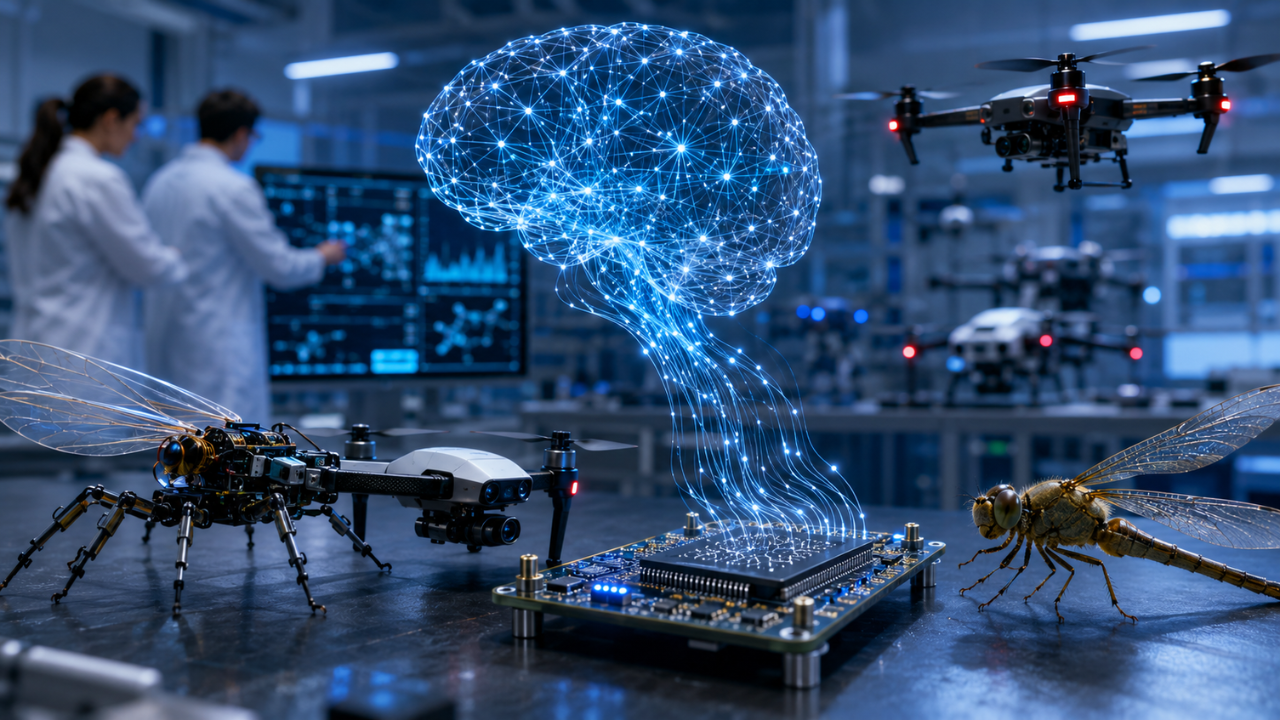
A team of scientists at Penn State is working on a $12 million project to develop a 'digital brain' for drones, inspired by the neural mechanisms of insects. The goal of this project is to create advanced drone decision-making systems that can process data onboard, replicating the natural filtering and coincidence detection seen in biology.
The research team is using analogue computing alongside graphene materials to achieve this. Graphene, a highly conductive and flexible material, is being utilized to create a unique computing system that can mimic the neural networks found in insects.
The project aims to enable fully autonomous drone swarms that can operate independently of external support. This means that the drones will be able to make decisions and navigate without the need for human intervention or external guidance.
The team has been demonstrating evolving prototypes of the digital brain annually, showcasing the progress they have made so far. The use of analogue computing and graphene materials has allowed them to create a system that is not only highly efficient but also extremely compact.
The development of autonomous drone swarms has the potential to revolutionize various industries, including surveillance, agriculture, and package delivery. With the ability to operate independently, drones can be used in a wide range of applications, from monitoring crops to delivering packages in remote areas.
The project is a significant step forward in the development of autonomous systems, and the use of insect-inspired neural mechanisms is a unique approach to creating advanced decision-making systems. The team's work has the potential to pave the way for the development of more sophisticated autonomous systems in the future.
The $12 million project is a testament to the growing interest in the development of autonomous systems, and the potential for these systems to transform various industries. As the project continues to evolve, it will be exciting to see the advancements that are made and the potential applications of the digital brain.
In the context of the growing use of drones in various industries, the development of autonomous drone swarms is a significant step forward. The ability to operate independently will allow drones to be used in a wide range of applications, from surveillance to package delivery.
The project's focus on creating a digital brain that can replicate the natural filtering and coincidence detection seen in biology is a unique approach to creating advanced decision-making systems. The use of analogue computing and graphene materials has allowed the team to create a system that is not only highly efficient but also extremely compact.
Overall, the development of the digital brain for drones is an exciting project that has the potential to revolutionize various industries. With its unique approach to creating advanced decision-making systems, the project is a significant step forward in the development of autonomous systems.
The significance of this project for the future of autonomous systems cannot be overstated. As the project continues to evolve, it will be exciting to see the advancements that are made and the potential applications of the digital brain. The development of autonomous drone swarms has the potential to transform various industries, and the project's focus on creating a digital brain that can replicate the natural filtering and coincidence detection seen in biology is a unique approach to creating advanced decision-making systems.
In conclusion, the $12 million project to develop a digital brain for drones is a significant step forward in the development of autonomous systems. The project's unique approach to creating advanced decision-making systems, inspired by the neural mechanisms of insects, has the potential to revolutionize various industries. As the project continues to evolve, it will be exciting to see the advancements that are made and the potential applications of the digital brain.
Frequently asked questions
What is the goal of the digital brain project for drones?
The goal is to enable fully autonomous drone swarms that can operate independently of external support.
What materials are being used to develop the digital brain?
The team is using analogue computing alongside graphene materials to create the digital brain.