Yasin Malik Won't Contest Sarla Bhat Murder Trial, Faces Death Penalty
Yasin Malik to face death penalty, divorces Pak wife Mushaal. Trial in 1990 murder case to proceed without contest.
'%3E%3Crect%20width%3D'96'%20height%3D'96'%20fill%3D'%231A5276'%2F%3E%3Ccircle%20cx%3D'30'%20cy%3D'24'%20r%3D'44'%20fill%3D'%23fff'%20opacity%3D'.12'%2F%3E%3Ccircle%20cx%3D'60'%20cy%3D'74'%20r%3D'40'%20fill%3D'%23000'%20opacity%3D'.10'%2F%3E%3C%2Fg%3E%3Cg%20fill%3D'%23fff'%3E%3Cpath%20d%3D'M31%2041%20L48%2031%20L65%2041%20Z'%2F%3E%3Crect%20x%3D'33'%20y%3D'43'%20width%3D'4'%20height%3D'17'%2F%3E%3Crect%20x%3D'41'%20y%3D'43'%20width%3D'4'%20height%3D'17'%2F%3E%3Crect%20x%3D'51'%20y%3D'43'%20width%3D'4'%20height%3D'17'%2F%3E%3Crect%20x%3D'59'%20y%3D'43'%20width%3D'4'%20height%3D'17'%2F%3E%3Crect%20x%3D'30'%20y%3D'62'%20width%3D'36'%20height%3D'4'%20rx%3D'1'%2F%3E%3C%2Fg%3E%3C%2Fsvg%3E)
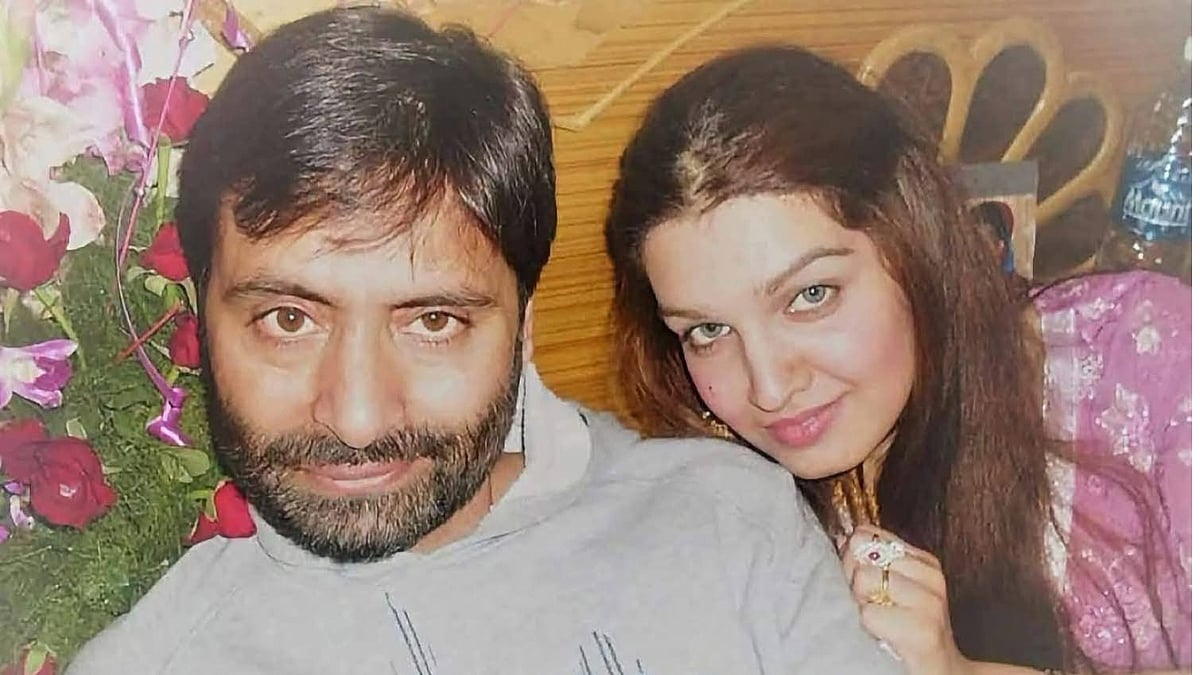
Yasin Malik, the chief of the Jammu and Kashmir Liberation Front (JKLF), has informed a Srinagar court that he no longer wishes to contest the trial in the 1990 murder case of Kashmiri Pandit nurse Sarla Bhat. Malik, currently lodged in Tihar jail, submitted a 25-page written statement through his lawyer, Abu Adil Pandit, stating his decision to face the death penalty.
The court has scheduled the next hearing for September 19. In his statement, Malik clarified that his decision to withdraw from the trial should not be construed as an admission of guilt. He claimed that he had been falsely implicated due to political circumstances.
Sarla Bhat was a staff nurse at the Sher-e-Kashmir Institute of Medical Sciences (SKIMS) in Srinagar, who was abducted in April 1990 and later found dead. The case remained unresolved for over three decades, until the State Investigation Agency (SIA) of the Jammu and Kashmir Police reopened it in 2025.
The chargesheet named Malik, along with four others, as the main accused in the case. Malik's decision comes more than four years after he was convicted in a separate terror-funding case, for which he was sentenced to life imprisonment.
In the same affidavit, Malik announced his decision to end his 16-year marriage to Mushaal Hussein Mullick, a Pakistani artist and activist. The couple married in 2009 and have a 13-year-old daughter, Razia Sultana.
Malik's decision to face the death penalty is a significant development in the case, which has been pending for over three decades. The case has been a source of pain and insecurity for the Kashmiri Pandit community, and Malik's decision may bring some closure to the family of the victim.
The National Investigation Agency (NIA) has sought an enhancement of Malik's life sentence to the death penalty in the terror-funding case. Malik's latest statement may have implications for his sentence in that case as well.
The JKLF has been a key player in the separatist movement in Jammu and Kashmir, and Malik's decision may have significant implications for the movement. However, it is unclear how the movement will respond to Malik's decision to face the death penalty.
In the context of the larger separatist movement in Jammu and Kashmir, Malik's decision may be seen as a significant setback. The movement has been marked by violence and unrest, and Malik's decision may be seen as a attempt to bring some closure to the conflict.
Overall, Malik's decision to face the death penalty is a significant development in the case, and may have implications for the separatist movement in Jammu and Kashmir. It remains to be seen how the movement will respond to Malik's decision, and what the implications will be for the region.
The case has also raised questions about the role of the Indian justice system in addressing the grievances of the Kashmiri Pandit community. The community has long felt that the Indian government has not done enough to address their concerns, and Malik's decision may be seen as a attempt to bring some justice to the community.
In conclusion, Yasin Malik's decision to face the death penalty is a significant development in the Sarla Bhat murder case, and may have implications for the separatist movement in Jammu and Kashmir. The case has been a source of pain and insecurity for the Kashmiri Pandit community, and Malik's decision may bring some closure to the family of the victim.
Frequently asked questions
What is the Sarla Bhat murder case about?
The Sarla Bhat murder case is about the abduction and murder of a Kashmiri Pandit nurse in 1990. Yasin Malik is one of the main accused in the case.
Why has Yasin Malik decided to face the death penalty?
Yasin Malik has decided to face the death penalty after careful deliberation and performing ‘Istikhara’, an Islamic prayer traditionally offered before making an important decision. He claims that he has been falsely implicated due to political circumstances.