Experts Unite For 'One Nation, One Election'
Jurists, judges, and experts endorse ONOE at round table conference
'%3E%3Crect%20width%3D'96'%20height%3D'96'%20fill%3D'%231A5276'%2F%3E%3Ccircle%20cx%3D'30'%20cy%3D'24'%20r%3D'44'%20fill%3D'%23fff'%20opacity%3D'.12'%2F%3E%3Ccircle%20cx%3D'60'%20cy%3D'74'%20r%3D'40'%20fill%3D'%23000'%20opacity%3D'.10'%2F%3E%3C%2Fg%3E%3Cg%20fill%3D'%23fff'%3E%3Cpath%20d%3D'M31%2041%20L48%2031%20L65%2041%20Z'%2F%3E%3Crect%20x%3D'33'%20y%3D'43'%20width%3D'4'%20height%3D'17'%2F%3E%3Crect%20x%3D'41'%20y%3D'43'%20width%3D'4'%20height%3D'17'%2F%3E%3Crect%20x%3D'51'%20y%3D'43'%20width%3D'4'%20height%3D'17'%2F%3E%3Crect%20x%3D'59'%20y%3D'43'%20width%3D'4'%20height%3D'17'%2F%3E%3Crect%20x%3D'30'%20y%3D'62'%20width%3D'36'%20height%3D'4'%20rx%3D'1'%2F%3E%3C%2Fg%3E%3C%2Fsvg%3E)
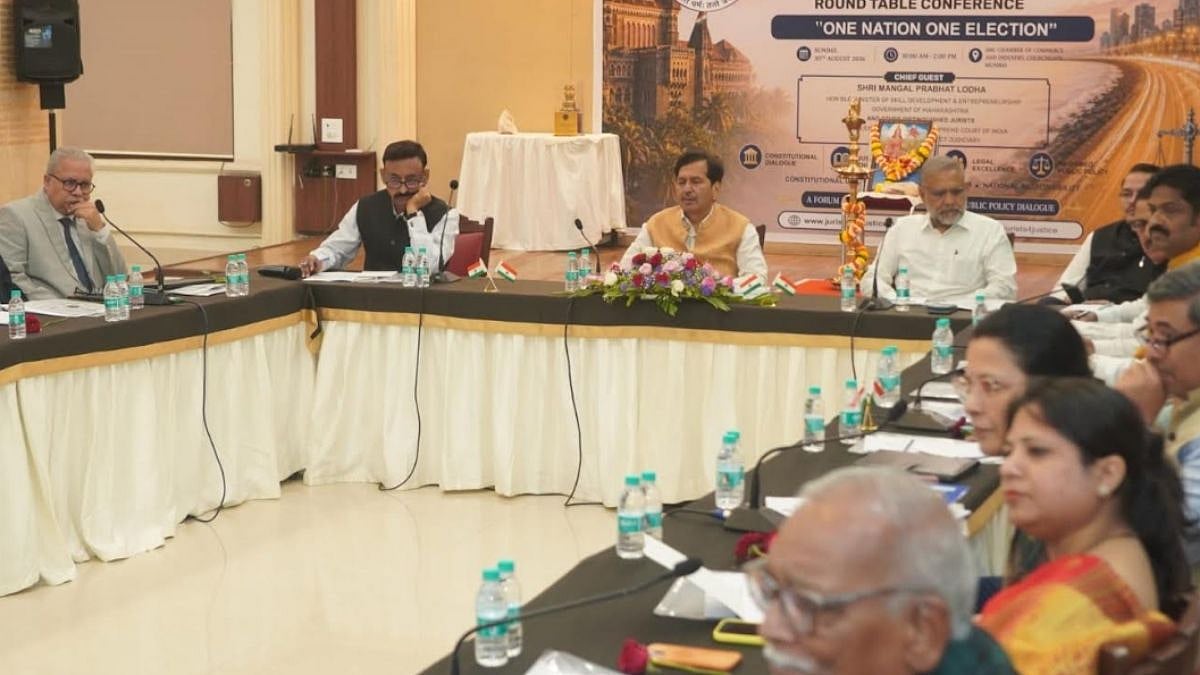
A recent Round Table Conference on 'One Nation, One Election' (ONOE) brought together nearly 50 eminent jurists, former High Court judges, academicians, senior advocates, financial experts, and other distinguished luminaries to deliberate on the merits and framework of holding simultaneous elections across the country.
The conference, organised by the Jurists for Justice Foundation, concluded with the unanimous adoption of a resolution in favour of ONOE. The proceedings commenced with the lighting of the ceremonial diya, followed by the Welcome Address delivered by Sh. Umesh Kumar Sirohi, President, Jurists for Justice Foundation.
The Keynote Address was delivered by Prof. Pritesh Arte, setting the tone for the core deliberations that followed. The main round table saw sequential interventions from eight distinguished speakers, each offering a distinct professional perspective, all favouring the adoption of ONOE.
Former Justice B.P. Deshpande put forth the constitutional aspects underpinning simultaneous elections, while Smt. Meeratai Khadakkar, former District Judge, extended her support for ONOE. Senior Advocate Anil Singh highlighted the practical aspects of implementation and favoured simultaneous elections.
Sh. Avinash Dharmadhikari examined the impact of frequent elections on police deployment and how ONOE could resolve this strain. Sh. Ravi Pani, Chartered Accountant, presented the economic and financial benefits of ONOE.
Prof. Adv. Dipak Parmar discussed the overall benefits of ONOE, drawing specific connections to the IPR framework. Sh. Nagesh V. Nhavakar elaborated on the constitutional aspects of adopting ONOE, while Smt. Chanda Nathani lent her support to the proposal.
The Chief Guest, Sh. Mangal Prabhat Lodha, Cabinet Minister for Skill, Employment, Entrepreneurship and Innovation, Government of Maharashtra, addressed the gathering and extended his support for ONOE. He observed that governance and national development would benefit significantly from simultaneous elections.
The conference highlighted the potential benefits of ONOE, including enhanced government efficiency, reduced electoral expenditure, and increased political stability. The unanimous endorsement of ONOE by the gathered experts underscores the growing support for this proposal.
In the context of India's democratic landscape, the idea of ONOE has been gaining traction in recent years. Proponents argue that simultaneous elections would help reduce the frequency of elections, decrease electoral expenditure, and promote political stability.
The conference's outcome is significant, as it brings together a diverse range of experts and stakeholders in support of ONOE. The proposal's potential impact on India's democratic system and governance structure is substantial, and its implementation could have far-reaching consequences.
In conclusion, the Round Table Conference on ONOE has contributed to the ongoing debate on this proposal, highlighting its potential benefits and gathering support from a broad range of experts. As the discussion on ONOE continues, it is likely that its implementation will remain a key topic of discussion in India's democratic landscape.
Frequently asked questions
What is One Nation, One Election?
One Nation, One Election (ONOE) refers to the proposal of holding simultaneous elections across the country.
Who supported ONOE at the round table conference?
Nearly 50 eminent jurists, former High Court judges, academicians, senior advocates, financial experts, and other distinguished luminaries supported ONOE at the conference.