US Introduces New Tariffs on 60 Trading Partners
New US tariffs, India joins 10% tier, global trade order shifts
'%3E%3Crect%20width%3D'96'%20height%3D'96'%20fill%3D'%234A235A'%2F%3E%3Ccircle%20cx%3D'30'%20cy%3D'24'%20r%3D'44'%20fill%3D'%23fff'%20opacity%3D'.12'%2F%3E%3Ccircle%20cx%3D'60'%20cy%3D'74'%20r%3D'40'%20fill%3D'%23000'%20opacity%3D'.10'%2F%3E%3C%2Fg%3E%3Cg%20fill%3D'none'%20stroke%3D'%23fff'%20stroke-width%3D'3'%3E%3Ccircle%20cx%3D'48'%20cy%3D'48'%20r%3D'16'%2F%3E%3Cellipse%20cx%3D'48'%20cy%3D'48'%20rx%3D'6.5'%20ry%3D'16'%2F%3E%3Cline%20x1%3D'32'%20y1%3D'42'%20x2%3D'64'%20y2%3D'42'%2F%3E%3Cline%20x1%3D'32'%20y1%3D'54'%20x2%3D'64'%20y2%3D'54'%2F%3E%3C%2Fg%3E%3C%2Fsvg%3E)
The United States has introduced a new Section 301 framework, replacing its temporary Section 122 tariffs, which will affect 60 trading partners, including India. From July 24, India will be subject to an additional 10% duty, along with economies such as Australia, Canada, the European Union, and the United Kingdom. Many other countries will face an additional 12.5% duty.
The stated objective of this new framework is to strengthen enforcement against goods produced through forced labour. This move reflects a broader shift in the global trading order, where access to markets depends not only on price and quality but also on strategic trust, labour standards, environmental compliance, technological resilience, and national security.
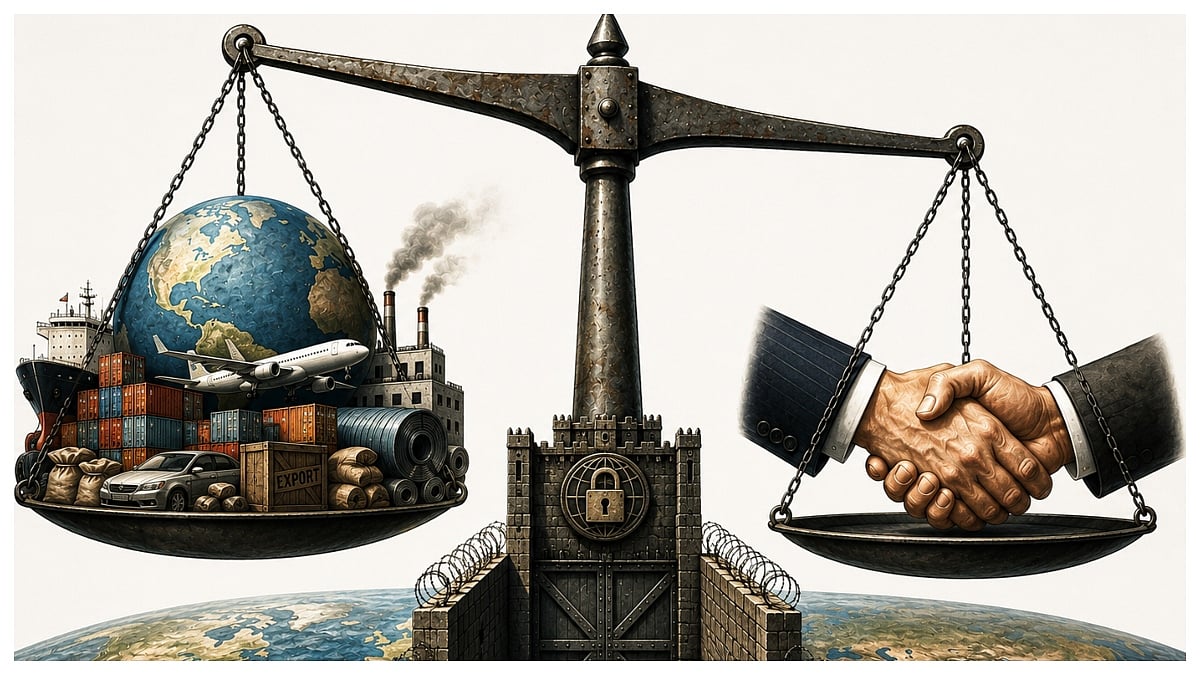
For three decades after the Cold War, many believed that increasingly open markets would gradually make borders economically less important. However, this age of optimistic globalisation is giving way to an era of conditional connectivity. Borders are no longer merely lines on maps but have become economic filters, with tariffs, export controls, sanctions, investment screening, and digital regulations determining who trades, how they trade, and on what terms.
The changing landscape presents both challenges and opportunities for India. Being among the economies subject to the lower 10% additional duty is relatively favourable within the new framework. However, competitive costs alone will not secure lasting success. Reliable institutions, resilient supply chains, transparent regulation, and international credibility will increasingly define economic strength.
In the past, trade was driven by the principle of cooperation and mutual benefit, with merchants from the ancient Sindhu civilisation trading with distant lands. The concept of Vasudhaiva Kutumbakam, or the world as one family, emphasized the importance of dignity and humanity in economic interactions. Today, the global trading order is moving in a different direction, with a greater emphasis on strategic trust and compliance with labour and environmental standards.
The new US tariffs will have significant implications for India's trade relationships and economic growth. As the global trading order continues to evolve, India must adapt to the changing landscape and focus on building reliable institutions, resilient supply chains, and international credibility to secure its position in the global economy.
The introduction of the new Section 301 framework marks a significant shift in the global trading order, with far-reaching implications for economies around the world. As countries navigate this new landscape, they must balance their economic interests with the need to comply with labour and environmental standards, and to build strategic trust with their trading partners.
In conclusion, the new US tariffs on 60 trading partners, including India, reflect a broader shift in the global trading order towards an era of conditional connectivity. As India navigates this changing landscape, it must focus on building reliable institutions, resilient supply chains, and international credibility to secure its position in the global economy.
The ultimate purpose of economics has never been merely to create wealth but to widen the circle of those able to share it. Every generation dreams of a world where birthplace matters less than human worth, where journeys become easier because trust becomes deeper, and where opportunity is determined more by talent than geography. The new US tariffs and the shifting global trading order present both challenges and opportunities for India to move closer to this ideal.
The Indian government must now focus on building a strong and resilient economy, with a focus on reliable institutions, transparent regulation, and international credibility. This will require significant investments in infrastructure, education, and skills training, as well as a commitment to complying with labour and environmental standards.
As the global trading order continues to evolve, India must be prepared to adapt and respond to the changing landscape. With its large and growing economy, India has the potential to play a major role in shaping the future of global trade. However, this will require a sustained effort to build reliable institutions, resilient supply chains, and international credibility, as well as a commitment to complying with labour and environmental standards.
In the end, the new US tariffs and the shifting global trading order present a significant challenge for India, but also an opportunity to build a stronger and more resilient economy. With the right policies and investments, India can navigate this changing landscape and emerge as a major player in the global economy.
The new US tariffs on 60 trading partners, including India, are a significant development in the global trading order. As countries around the world navigate this changing landscape, they must be prepared to adapt and respond to the new challenges and opportunities that arise. With its large and growing economy, India has the potential to play a major role in shaping the future of global trade, but this will require a sustained effort to build reliable institutions, resilient supply chains, and international credibility.
The introduction of the new Section 301 framework marks a significant shift in the global trading order, with far-reaching implications for economies around the world. As India navigates this changing landscape, it must focus on building reliable institutions, resilient supply chains, and international credibility to secure its position in the global economy. The ultimate purpose of economics has never been merely to create wealth but to widen the circle of those able to share it, and India must be prepared to play its part in shaping the future of global trade.
The new US tariffs and the shifting global trading order present a significant challenge for India, but also an opportunity to build a stronger and more resilient economy. With the right policies and investments, India can navigate this changing landscape and emerge as a major player in the global economy. The Indian government must now focus on building a strong and resilient economy, with a focus on reliable institutions, transparent regulation, and international credibility.
This will require significant investments in infrastructure, education, and skills training, as well as a commitment to complying with labour and environmental standards. As the global trading order continues to evolve, India must be prepared to adapt and respond to the changing landscape. With its large and growing economy, India has the potential to play a major role in shaping the future of global trade, but this will require a sustained effort to build reliable institutions, resilient supply chains, and international credibility.
In conclusion, the new US tariffs on 60 trading partners, including India, reflect a broader shift in the global trading order towards an era of conditional connectivity. As India navigates this changing landscape, it must focus on building reliable institutions, resilient supply chains, and international credibility to secure its position in the global economy. The ultimate purpose of economics has never been merely to create wealth but to widen the circle of those able to share it, and India must be prepared to play its part in shaping the future of global trade.
What it means for Mumbai and India is that the new US tariffs will have significant implications for the country's trade relationships and economic growth. As the global trading order continues to evolve, India must adapt to the changing landscape and focus on building reliable institutions, resilient supply chains, and international credibility to secure its position in the global economy.
The new US tariffs and the shifting global trading order present a significant challenge for India, but also an opportunity to build a stronger and more resilient economy. With the right policies and investments, India can navigate this changing landscape and emerge as a major player in the global economy. The Indian government must now focus on building a strong and resilient economy, with a focus on reliable institutions, transparent regulation, and international credibility.
This will require significant investments in infrastructure, education, and skills training, as well as a commitment to complying with labour and environmental standards. As the global trading order continues to evolve, India must be prepared to adapt and respond to the changing landscape. With its large and growing economy, India has the potential to play a major role in shaping the future of global trade, but this will require a sustained effort to build reliable institutions, resilient supply chains, and international credibility.
In the end, the new US tariffs and the shifting global trading order present a significant challenge for India, but also an opportunity to build a stronger and more resilient economy. With the right policies and investments, India can navigate this changing landscape and emerge as a major player in the global economy.
Frequently asked questions
What is the new US tariff framework?
The new US tariff framework is a Section 301 framework that replaces the temporary Section 122 tariffs and affects 60 trading partners, including India.
What is the objective of the new US tariff framework?
The stated objective of the new framework is to strengthen enforcement against goods produced through forced labour.