Maryland Opens Human Composting Facility
Maryland introduces eco-friendly burial alternative. Human remains converted to soil.
'%3E%3Crect%20width%3D'96'%20height%3D'96'%20fill%3D'%23B3261E'%2F%3E%3Ccircle%20cx%3D'30'%20cy%3D'24'%20r%3D'44'%20fill%3D'%23fff'%20opacity%3D'.12'%2F%3E%3Ccircle%20cx%3D'60'%20cy%3D'74'%20r%3D'40'%20fill%3D'%23000'%20opacity%3D'.10'%2F%3E%3C%2Fg%3E%3Cg%20fill%3D'%23fff'%3E%3Crect%20x%3D'29'%20y%3D'49'%20width%3D'8'%20height%3D'19'%20rx%3D'1'%2F%3E%3Crect%20x%3D'39'%20y%3D'40'%20width%3D'9'%20height%3D'28'%20rx%3D'1'%2F%3E%3Crect%20x%3D'50'%20y%3D'45'%20width%3D'8'%20height%3D'23'%20rx%3D'1'%2F%3E%3Crect%20x%3D'60'%20y%3D'53'%20width%3D'7'%20height%3D'15'%20rx%3D'1'%2F%3E%3Crect%20x%3D'41'%20y%3D'34'%20width%3D'5'%20height%3D'6'%2F%3E%3C%2Fg%3E%3C%2Fsvg%3E)
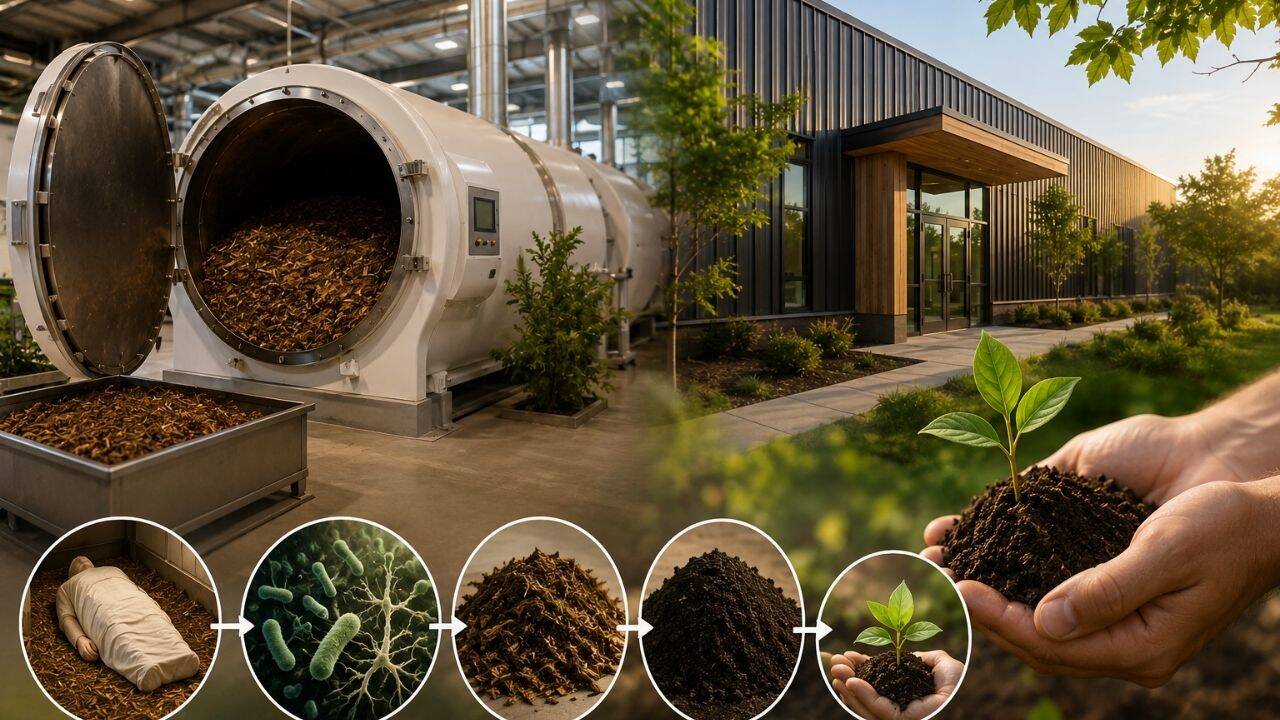
Maryland has launched a pioneering human composting facility in Elkridge, offering a sustainable alternative to traditional burial and cremation methods. This innovative approach, known as natural organic reduction, converts human remains into nutrient-dense soil in approximately one month.
The facility provides families with a unique option for end-of-life choices, allowing them to contribute to land conservation efforts. Families can choose to keep the resulting soil or donate it to support environmental projects.
The human composting process involves placing the body in a controlled environment, where microorganisms break down the remains into a nutrient-rich soil. This method is considered more environmentally friendly than traditional burial and cremation methods, as it reduces greenhouse gas emissions and conserves land.
Maryland's introduction of human composting as a burial alternative reflects a growing trend towards more sustainable and eco-friendly death care practices. As concern for the environment continues to grow, individuals are seeking out innovative and responsible ways to manage end-of-life choices.
The human composting facility in Elkridge is the first of its kind in Maryland, and it is expected to pave the way for similar initiatives in other states. The facility's operators aim to provide a dignified and sustainable option for families, while also promoting environmental stewardship.
The use of human composting as a burial alternative has been gaining traction in recent years, with several states in the US exploring its potential. Maryland's move to introduce this innovative approach is a significant step towards reducing the environmental impact of death care practices.
As the world grapples with the challenges of climate change and environmental degradation, the development of sustainable death care practices like human composting is becoming increasingly important. By providing a more eco-friendly alternative to traditional burial and cremation methods, Maryland's human composting facility is setting a precedent for more responsible and environmentally conscious end-of-life choices.
In conclusion, Maryland's introduction of human composting as a burial alternative marks a significant shift towards more sustainable and eco-friendly death care practices. As the demand for environmentally responsible options continues to grow, it is likely that human composting will become an increasingly popular choice for individuals and families seeking to minimize their environmental footprint.
Frequently asked questions
What is human composting?
Human composting is a process that converts human remains into nutrient-dense soil in about a month.
Where is the human composting facility located?
The human composting facility is located in Elkridge, Maryland.