Mumbai Court Denies Bail To 5 In ₹3.94 Crore SEBI Theft Case
5 accused denied bail, alleged theft of computer parts from SEBI
'%3E%3Crect%20width%3D'96'%20height%3D'96'%20fill%3D'%23B3261E'%2F%3E%3Ccircle%20cx%3D'30'%20cy%3D'24'%20r%3D'44'%20fill%3D'%23fff'%20opacity%3D'.12'%2F%3E%3Ccircle%20cx%3D'60'%20cy%3D'74'%20r%3D'40'%20fill%3D'%23000'%20opacity%3D'.10'%2F%3E%3C%2Fg%3E%3Cg%20fill%3D'%23fff'%3E%3Crect%20x%3D'29'%20y%3D'49'%20width%3D'8'%20height%3D'19'%20rx%3D'1'%2F%3E%3Crect%20x%3D'39'%20y%3D'40'%20width%3D'9'%20height%3D'28'%20rx%3D'1'%2F%3E%3Crect%20x%3D'50'%20y%3D'45'%20width%3D'8'%20height%3D'23'%20rx%3D'1'%2F%3E%3Crect%20x%3D'60'%20y%3D'53'%20width%3D'7'%20height%3D'15'%20rx%3D'1'%2F%3E%3Crect%20x%3D'41'%20y%3D'34'%20width%3D'5'%20height%3D'6'%2F%3E%3C%2Fg%3E%3C%2Fsvg%3E)
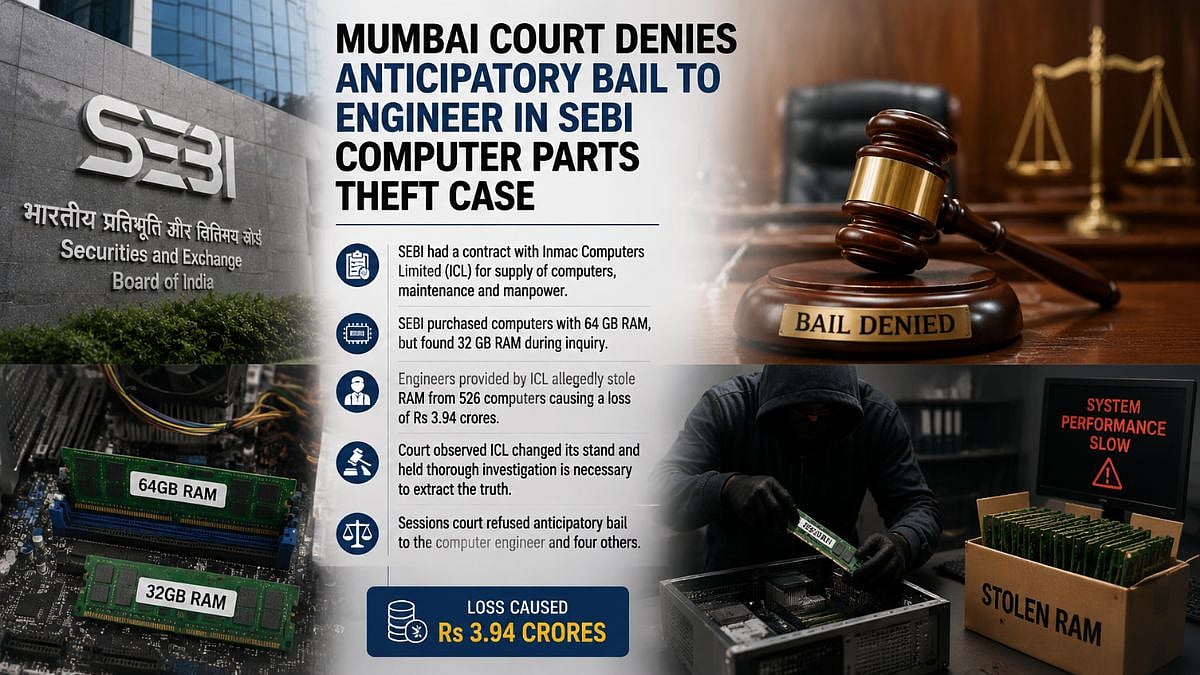
A Mumbai sessions court has refused anticipatory bail to five individuals, including a computer engineer, accused of stealing computer parts from the Securities and Exchange Board of India (SEBI), causing a loss of ₹3.94 crore.
The accused were booked based on a complaint filed by SEBI, which had awarded a contract to Inmac Computers Limited (ICL) for the supply of computers and related services. However, an inquiry revealed that the computers supplied by ICL had 32 GB RAM instead of the specified 64 GB RAM, with 526 computers allegedly affected.
The court noted that ICL had admitted to removing RAM modules from certain systems for repair purposes, but claimed they were stolen from their custody. The court observed that ICL's changing stance on the issue raised doubts and necessitated a thorough investigation.
SEBI had purchased computers equipped with 64 GB RAM from ICL, but when the systems' performance became slow, an inquiry was conducted. The inquiry allegedly revealed that engineers provided by ICL had stolen RAM modules from the computers, causing the estimated loss.
The court's decision to deny bail to the accused indicates that a detailed probe is necessary to extract the truth. The case highlights the importance of ensuring the integrity of computer systems and equipment, particularly in critical institutions like SEBI.
The alleged theft of computer parts from SEBI has significant implications for the organization's operations and data security. The incident also raises questions about the accountability of contractors and service providers in maintaining the integrity of critical systems.
In recent years, there have been several instances of data breaches and cyber attacks on critical infrastructure in India. The SEBI case underscores the need for robust security measures and vigilant monitoring to prevent such incidents.
The Mumbai sessions court's decision to deny bail to the accused is a significant development in the case. The court's observation that a thorough investigation is necessary to extract the truth suggests that the case is complex and requires careful examination.
The alleged theft of computer parts from SEBI has sparked concerns about the vulnerability of critical systems to insider threats. The incident highlights the need for organizations to implement robust security measures, including regular audits and monitoring, to prevent such incidents.
In conclusion, the Mumbai sessions court's decision to deny bail to the five accused in the SEBI computer parts theft case is a significant development in the investigation. The case highlights the importance of ensuring the integrity of critical systems and equipment, and the need for robust security measures to prevent insider threats.
The incident has significant implications for SEBI's operations and data security, and underscores the need for vigilant monitoring and robust security measures to prevent such incidents in the future.
Frequently asked questions
What is the estimated loss in the SEBI computer parts theft case?
The estimated loss is ₹3.94 crore.
How many computers were allegedly affected in the theft?
526 computers were allegedly affected.