Bombay HC: Foreign Law Degree Not Eligible For 3-Year LLB
Bombay HC dismisses petition, rules foreign law degree not enough for 3-year LLB course
'%3E%3Crect%20width%3D'96'%20height%3D'96'%20fill%3D'%23B3261E'%2F%3E%3Ccircle%20cx%3D'30'%20cy%3D'24'%20r%3D'44'%20fill%3D'%23fff'%20opacity%3D'.12'%2F%3E%3Ccircle%20cx%3D'60'%20cy%3D'74'%20r%3D'40'%20fill%3D'%23000'%20opacity%3D'.10'%2F%3E%3C%2Fg%3E%3Cg%20fill%3D'%23fff'%3E%3Crect%20x%3D'29'%20y%3D'49'%20width%3D'8'%20height%3D'19'%20rx%3D'1'%2F%3E%3Crect%20x%3D'39'%20y%3D'40'%20width%3D'9'%20height%3D'28'%20rx%3D'1'%2F%3E%3Crect%20x%3D'50'%20y%3D'45'%20width%3D'8'%20height%3D'23'%20rx%3D'1'%2F%3E%3Crect%20x%3D'60'%20y%3D'53'%20width%3D'7'%20height%3D'15'%20rx%3D'1'%2F%3E%3Crect%20x%3D'41'%20y%3D'34'%20width%3D'5'%20height%3D'6'%2F%3E%3C%2Fg%3E%3C%2Fsvg%3E)
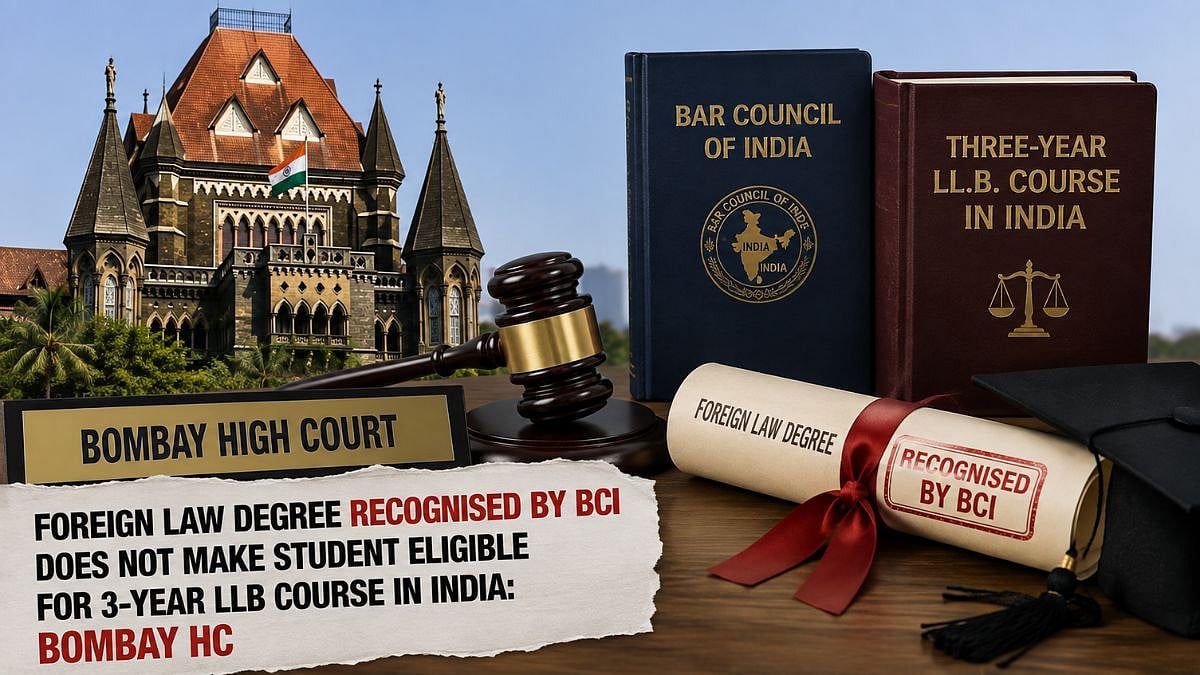
The Bombay High Court has ruled that a foreign law degree, even if recognised by the Bar Council of India (BCI), does not make a student eligible for admission to the three-year LL.B. course in India.
The court's decision came in response to a petition filed by Yohaan Abraham, who had completed a three-year undergraduate law degree from Queen Mary University of London and a Legal Practice Course (LPC). Abraham had applied for the three-year LL.B. course at Chhatrapati Shivaji Maharaj University, Navi Mumbai, and was initially given provisional admission.
However, the university later cancelled his admission, citing that his foreign law degree did not qualify as the required 'First Degree' for admission to the three-year LL.B. course. Abraham argued that his degree was recognised by the BCI under its August 2020 notification, which includes Queen Mary University of London in its list of recognised foreign universities.
The High Court rejected Abraham's argument, stating that the three-year LL.B. course in India is meant for students who have already completed a Bachelor's Degree in another discipline. Since Abraham had started his three-year law degree immediately after Class XII, it was considered his first undergraduate qualification.
The court observed that if every BCI-recognised professional law degree was treated as a 'First Degree', the distinction between a graduate degree and the subsequent three-year law course would become 'substantially meaningless'. The court explained that students who complete Class XII and want to study law directly are expected to take the five-year integrated law course, while the three-year LL.B. comes after graduation.
The court also clarified that BCI recognition of a foreign law degree serves a different purpose, which is relevant when a person seeks enrolment as an advocate in India. However, this recognition does not automatically make the qualification sufficient for admission to another law course.
The judges noted that they were not deciding whether Abraham could eventually enrol as an advocate in India. They also clarified that the judgment would not prevent him from applying for the Bridge Course or Qualifying Examination under the BCI framework.
The court's decision highlights the importance of understanding the eligibility criteria for law courses in India and the distinction between different types of law degrees. It also underscores the need for students to carefully consider their options and plan their academic pursuits accordingly.
In conclusion, the Bombay High Court's ruling provides clarity on the eligibility criteria for the three-year LL.B. course in India and the role of BCI recognition in this context. The decision is likely to have implications for students who have completed foreign law degrees and are seeking to pursue further legal education in India.
The court's judgment is a significant development in the field of legal education in India, and it is expected to guide students and institutions in navigating the complexities of law course eligibility and recognition.
The ruling also emphasizes the importance of the BCI's role in regulating legal education and ensuring that students meet the necessary eligibility criteria for different law courses.
Overall, the Bombay High Court's decision provides a clear and authoritative interpretation of the eligibility criteria for the three-year LL.B. course in India, and it is likely to have a lasting impact on the field of legal education in the country.
Frequently asked questions
Can a foreign law degree make me eligible for a 3-year LLB course in India?
No, a foreign law degree, even if recognised by the BCI, does not make a student eligible for admission to the three-year LL.B. course in India.
What is the purpose of BCI recognition of a foreign law degree?
BCI recognition of a foreign law degree serves a different purpose, which is relevant when a person seeks enrolment as an advocate in India, but it does not automatically make the qualification sufficient for admission to another law course.