Bombay HC: No Sale Deed Needed To Prove Illegal SRA Transfer
Bombay HC rules on SRA tenement transfer, possession key to transfer
'%3E%3Crect%20width%3D'96'%20height%3D'96'%20fill%3D'%23B3261E'%2F%3E%3Ccircle%20cx%3D'30'%20cy%3D'24'%20r%3D'44'%20fill%3D'%23fff'%20opacity%3D'.12'%2F%3E%3Ccircle%20cx%3D'60'%20cy%3D'74'%20r%3D'40'%20fill%3D'%23000'%20opacity%3D'.10'%2F%3E%3C%2Fg%3E%3Cg%20fill%3D'%23fff'%3E%3Crect%20x%3D'29'%20y%3D'49'%20width%3D'8'%20height%3D'19'%20rx%3D'1'%2F%3E%3Crect%20x%3D'39'%20y%3D'40'%20width%3D'9'%20height%3D'28'%20rx%3D'1'%2F%3E%3Crect%20x%3D'50'%20y%3D'45'%20width%3D'8'%20height%3D'23'%20rx%3D'1'%2F%3E%3Crect%20x%3D'60'%20y%3D'53'%20width%3D'7'%20height%3D'15'%20rx%3D'1'%2F%3E%3Crect%20x%3D'41'%20y%3D'34'%20width%3D'5'%20height%3D'6'%2F%3E%3C%2Fg%3E%3C%2Fsvg%3E)
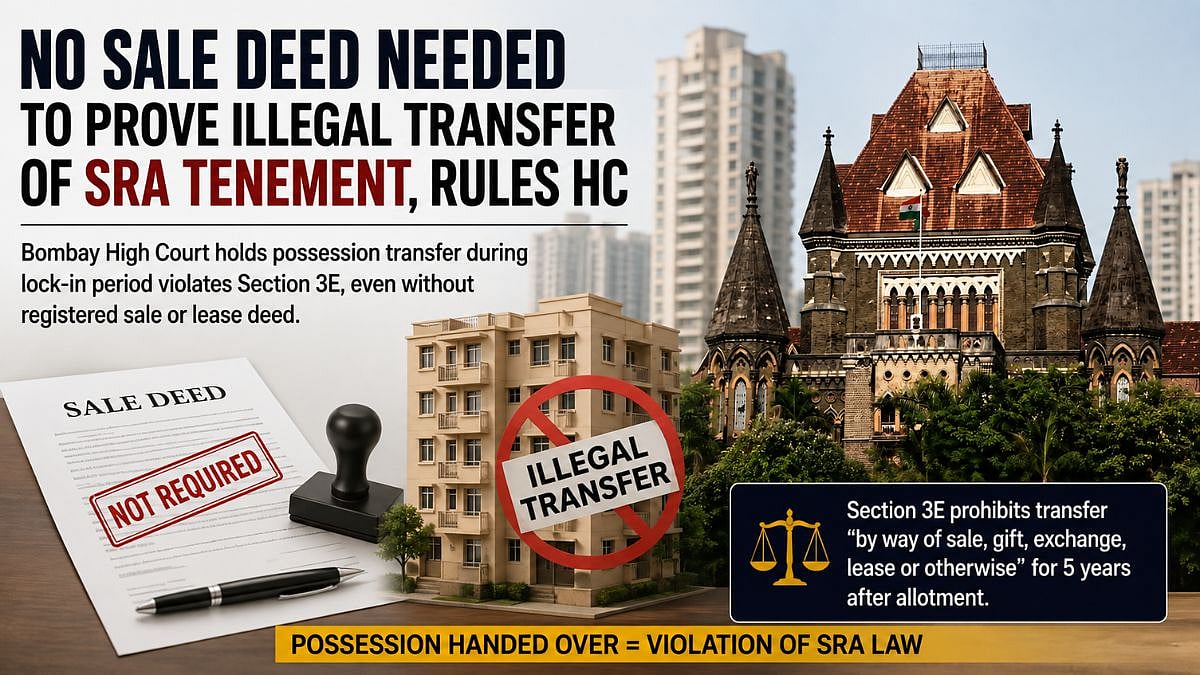
The Bombay High Court has ruled that an allottee of a slum rehabilitation tenement can be found to have illegally transferred the flat even without executing a registered sale deed or lease deed if the person has handed over possession to someone else during the statutory lock-in period.
This decision was made by Justice Amit Borkar, who observed that Section 3E of the Maharashtra Slum Areas (Improvement, Clearance and Redevelopment) Act, 1971, prohibits the transfer of rehabilitation tenements for the first five years after allotment. The court said that the words 'or otherwise' in the section must be interpreted broadly to include indirect methods of transfer and not just formal registered transactions.
The court made this observation while dismissing a petition filed by Chhaya Shinde, who had challenged orders passed by the competent authority and the appellate authority directing eviction from a rehabilitation flat allotted under the Slum Rehabilitation Scheme. Shinde was allotted a rehabilitation flat in 2008, but the authorities later received complaints alleging that the flat had been transferred in violation of Section 3E.
During an inspection in 2015, officials found another woman occupying the flat, who claimed to be a tenant. The court held that if an allottee parts with actual possession of the rehabilitation flat during the prohibited period, such an arrangement may attract the statutory bar even in the absence of a registered conveyance.
The case involved a dispute over the allotment of the flat, with allegations that Shinde had fraudulently got her name included in the list of eligible beneficiaries. However, the High Court said that those allegations were outside the scope of the present proceedings, which were limited to examining whether the rehabilitation tenement had been transferred in breach of the statutory restriction.
Shinde's advocate argued that there was no registered document showing any sale, gift, exchange or lease, and therefore Section 3E could not be invoked. However, the court accepted that possession was the key to determining whether a transfer had taken place, and that the absence of a registered sale or lease deed was not enough to prove that no transfer had occurred.
The court's decision has significant implications for the implementation of the Slum Rehabilitation Scheme, which aims to provide housing to slum dwellers. The scheme has been plagued by allegations of corruption and irregularities, and the court's ruling is likely to help prevent the illegal transfer of rehabilitation tenements.
The Maharashtra Slum Areas (Improvement, Clearance and Redevelopment) Act, 1971, is a crucial piece of legislation that governs the redevelopment of slum areas in the state. The act provides for the establishment of a competent authority to oversee the redevelopment process, and sets out the rules and regulations for the allotment of rehabilitation tenements.
The Slum Rehabilitation Scheme is a key component of the act, and aims to provide housing to slum dwellers who have been displaced by redevelopment projects. The scheme has been implemented in various parts of the state, including Mumbai, and has helped to provide housing to thousands of slum dwellers.
However, the scheme has also been plagued by allegations of corruption and irregularities, with many cases of illegal transfer of rehabilitation tenements being reported. The court's ruling is likely to help prevent such irregularities, and ensure that the scheme is implemented in a fair and transparent manner.
In conclusion, the Bombay High Court's decision is a significant step towards preventing the illegal transfer of rehabilitation tenements under the Slum Rehabilitation Scheme. The court's ruling emphasizes the importance of possession in determining whether a transfer has taken place, and is likely to help ensure that the scheme is implemented in a fair and transparent manner.
The decision is also likely to have implications for the thousands of slum dwellers who have been allotted rehabilitation tenements under the scheme. It is likely to help prevent the exploitation of these beneficiaries by unscrupulous elements, and ensure that they are able to enjoy the benefits of the scheme without fear of harassment or eviction.
Overall, the court's ruling is a welcome step towards ensuring that the Slum Rehabilitation Scheme is implemented in a fair and transparent manner, and that the rights of slum dwellers are protected. It is likely to have a significant impact on the implementation of the scheme, and is a major victory for the thousands of slum dwellers who have been allotted rehabilitation tenements under the scheme.
The court's decision is also likely to have implications for the state government, which has been facing criticism for its handling of the Slum Rehabilitation Scheme. The government has been accused of failing to prevent the illegal transfer of rehabilitation tenements, and of not doing enough to protect the rights of slum dwellers.
The court's ruling is likely to put pressure on the government to take steps to prevent the illegal transfer of rehabilitation tenements, and to ensure that the scheme is implemented in a fair and transparent manner. It is likely to lead to a review of the scheme's implementation, and to the introduction of new measures to prevent irregularities and protect the rights of slum dwellers.
In the end, the Bombay High Court's decision is a significant step towards ensuring that the Slum Rehabilitation Scheme is implemented in a fair and transparent manner, and that the rights of slum dwellers are protected. It is likely to have a major impact on the implementation of the scheme, and is a welcome step towards preventing the exploitation of slum dwellers by unscrupulous elements.
The decision is also likely to have implications for the wider issue of housing for slum dwellers in Mumbai. The city is facing a major housing crisis, with thousands of slum dwellers living in precarious conditions. The Slum Rehabilitation Scheme is a key component of the city's efforts to address this crisis, and the court's ruling is likely to help ensure that the scheme is implemented in a fair and transparent manner.
Overall, the Bombay High Court's decision is a significant step towards addressing the housing crisis in Mumbai, and towards ensuring that the rights of slum dwellers are protected. It is likely to have a major impact on the implementation of the Slum Rehabilitation Scheme, and is a welcome step towards preventing the exploitation of slum dwellers by unscrupulous elements.
In conclusion, the Bombay High Court's decision is a significant step towards ensuring that the Slum Rehabilitation Scheme is implemented in a fair and transparent manner, and that the rights of slum dwellers are protected. The decision is likely to have a major impact on the implementation of the scheme, and is a welcome step towards preventing the exploitation of slum dwellers by unscrupulous elements.
The court's ruling is also likely to have implications for the state government, which has been facing criticism for its handling of the Slum Rehabilitation Scheme. The government has been accused of failing to prevent the illegal transfer of rehabilitation tenements, and of not doing enough to protect the rights of slum dwellers.
The court's decision is likely to put pressure on the government to take steps to prevent the illegal transfer of rehabilitation tenements, and to ensure that the scheme is implemented in a fair and transparent manner. It is likely to lead to a review of the scheme's implementation, and to the introduction of new measures to prevent irregularities and protect the rights of slum dwellers.
In the end, the Bombay High Court's decision is a significant step towards ensuring that the Slum Rehabilitation Scheme is implemented in a fair and transparent manner, and that the rights of slum dwellers are protected. It is likely to have a major impact on the implementation of the scheme, and is a welcome step towards preventing the exploitation of slum dwellers by unscrupulous elements.
The decision is also likely to have implications for the wider issue of housing for slum dwellers in Mumbai. The city is facing a major housing crisis, with thousands of slum dwellers living in precarious conditions. The Slum Rehabilitation Scheme is a key component of the city's efforts to address this crisis, and the court's ruling is likely to help ensure that the scheme is implemented in a fair and transparent manner.
Overall, the Bombay High Court's decision is a significant step towards addressing the housing crisis in Mumbai, and towards ensuring that the rights of slum dwellers are protected. It is likely to have a major impact on the implementation of the Slum Rehabilitation Scheme, and is a welcome step towards preventing the exploitation of slum dwellers by unscrupulous elements.
What it means for Mumbai is that the city's slum dwellers will have greater protection from exploitation, and that the Slum Rehabilitation Scheme will be implemented in a more fair and transparent manner. The decision is likely to lead to a reduction in the number of illegal transfers of rehabilitation tenements, and to an increase in the number of slum dwellers who are able to benefit from the scheme.
In conclusion, the Bombay High Court's decision is a significant step towards ensuring that the Slum Rehabilitation Scheme is implemented in a fair and transparent manner, and that the rights of slum dwellers are protected. The decision is likely to have a major impact on the implementation of the scheme, and is a welcome step towards preventing the exploitation of slum dwellers by unscrupulous elements.
Frequently asked questions
What is the Maharashtra Slum Areas Act
The Maharashtra Slum Areas (Improvement, Clearance and Redevelopment) Act, 1971, is a law that governs the redevelopment of slum areas in the state of Maharashtra.
What is the Slum Rehabilitation Scheme
The Slum Rehabilitation Scheme is a program that provides housing to slum dwellers who have been displaced by redevelopment projects.