Indore Launches Dastak Campaign
Indore screens children for illnesses, aims to reduce infant mortality
'%3E%3Crect%20width%3D'96'%20height%3D'96'%20fill%3D'%23B3261E'%2F%3E%3Ccircle%20cx%3D'30'%20cy%3D'24'%20r%3D'44'%20fill%3D'%23fff'%20opacity%3D'.12'%2F%3E%3Ccircle%20cx%3D'60'%20cy%3D'74'%20r%3D'40'%20fill%3D'%23000'%20opacity%3D'.10'%2F%3E%3C%2Fg%3E%3Cg%20fill%3D'%23fff'%3E%3Crect%20x%3D'29'%20y%3D'49'%20width%3D'8'%20height%3D'19'%20rx%3D'1'%2F%3E%3Crect%20x%3D'39'%20y%3D'40'%20width%3D'9'%20height%3D'28'%20rx%3D'1'%2F%3E%3Crect%20x%3D'50'%20y%3D'45'%20width%3D'8'%20height%3D'23'%20rx%3D'1'%2F%3E%3Crect%20x%3D'60'%20y%3D'53'%20width%3D'7'%20height%3D'15'%20rx%3D'1'%2F%3E%3Crect%20x%3D'41'%20y%3D'34'%20width%3D'5'%20height%3D'6'%2F%3E%3C%2Fg%3E%3C%2Fsvg%3E)
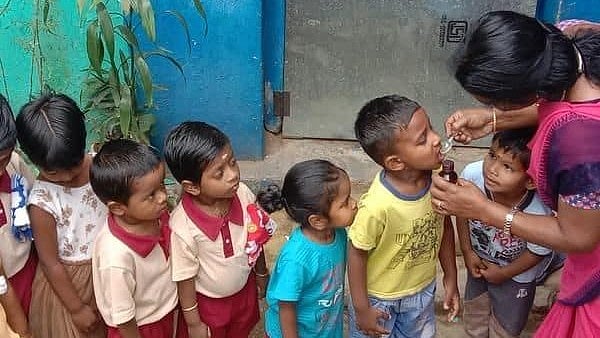
The Health Department in Indore, Madhya Pradesh, has launched the 'Dastak' campaign to improve child health and reduce infant mortality. The campaign, which started on July 14, will continue until August 31 and aims to screen over 4 lakh children below five years of age.
According to Chief Medical and Health Officer Dr Madhav Prasad Hasani, the campaign will be implemented in both urban and rural areas with the support of ASHA workers, Anganwadi workers, and ANMs. The health teams will focus on high-risk locations, including slum settlements, brick kilns, nomadic communities, and under-construction sites.
During the campaign, health teams will screen children for various illnesses such as diarrhoea, pneumonia, severe acute malnutrition, anaemia, and other childhood illnesses. Additionally, awareness about breastfeeding, complementary feeding, hygiene, and nutrition will be provided to families.
Children suffering from severe malnutrition or serious medical conditions will be referred to Nutrition Rehabilitation Centres (NRCs) and healthcare facilities for treatment. Nearly 350 'Dastak' teams have been deployed across the district to achieve this goal.
District Immunisation Officer Dr Tarun Gupta stated that the campaign aims to ensure timely healthcare interventions and improve child survival through community-level screening and referrals. The campaign is expected to cover over four lakh children in the district.
The 'Dastak' campaign is a significant step towards improving child health in Indore. By screening children for illnesses and providing awareness about nutrition and hygiene, the campaign aims to reduce infant mortality and improve the overall health of children in the district.
The campaign's focus on high-risk locations and its community-level approach are notable aspects of the initiative. The involvement of ASHA workers, Anganwadi workers, and ANMs will help reach out to families in rural and urban areas, ensuring that no child is left behind.
The success of the 'Dastak' campaign will depend on the effective implementation of the screening and referral process. The health teams must work diligently to identify children with illnesses and refer them to healthcare facilities in a timely manner.
In the long run, the 'Dastak' campaign is expected to have a positive impact on the health and wellbeing of children in Indore. By reducing infant mortality and improving child health, the campaign will contribute to the overall development of the district.
The campaign's significance extends beyond Indore, as it can serve as a model for other districts and states to improve child health. The 'Dastak' campaign is a testament to the government's commitment to improving healthcare services and reducing infant mortality in the country.
In conclusion, the 'Dastak' campaign is a crucial initiative that aims to improve child health and reduce infant mortality in Indore. With its community-level approach and focus on high-risk locations, the campaign has the potential to make a significant impact on the health and wellbeing of children in the district.
What it means for the country is that such campaigns can be replicated in other areas to improve child health and reduce infant mortality, ultimately contributing to the overall development of the nation.