Tata Hospital Study on Papaya Pill Under Scrutiny
A study on a papaya pill is questioned, chemotherapy effects examined
'%3E%3Crect%20width%3D'96'%20height%3D'96'%20fill%3D'%23B3261E'%2F%3E%3Ccircle%20cx%3D'30'%20cy%3D'24'%20r%3D'44'%20fill%3D'%23fff'%20opacity%3D'.12'%2F%3E%3Ccircle%20cx%3D'60'%20cy%3D'74'%20r%3D'40'%20fill%3D'%23000'%20opacity%3D'.10'%2F%3E%3C%2Fg%3E%3Cg%20fill%3D'%23fff'%3E%3Crect%20x%3D'29'%20y%3D'49'%20width%3D'8'%20height%3D'19'%20rx%3D'1'%2F%3E%3Crect%20x%3D'39'%20y%3D'40'%20width%3D'9'%20height%3D'28'%20rx%3D'1'%2F%3E%3Crect%20x%3D'50'%20y%3D'45'%20width%3D'8'%20height%3D'23'%20rx%3D'1'%2F%3E%3Crect%20x%3D'60'%20y%3D'53'%20width%3D'7'%20height%3D'15'%20rx%3D'1'%2F%3E%3Crect%20x%3D'41'%20y%3D'34'%20width%3D'5'%20height%3D'6'%2F%3E%3C%2Fg%3E%3C%2Fsvg%3E)
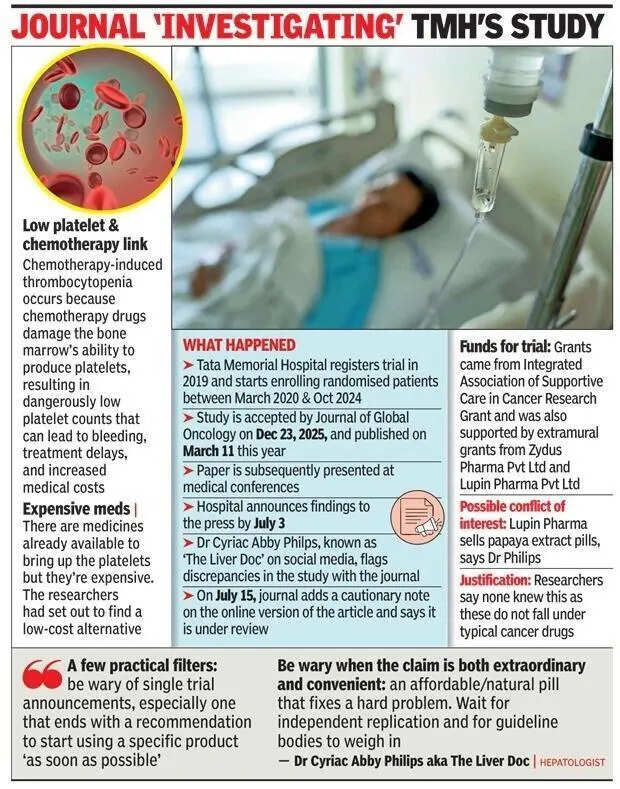
A recent study conducted by the Tata Memorial Hospital in Mumbai has come under scrutiny for its claims about a papaya pill that allegedly raises platelet count in patients undergoing chemotherapy. The study, which was aimed at finding alternative remedies to mitigate the side effects of chemotherapy, had suggested that the papaya pill could be a potential solution.
The researchers at the hospital had administered the papaya pill to a group of patients undergoing chemotherapy and observed a significant increase in their platelet count. However, the study's methodology and findings have been questioned by experts in the field, who have raised concerns about the pill's efficacy and safety.
The Tata Memorial Hospital is one of the leading cancer research centers in India, and its studies are closely watched by the medical community. The hospital's researchers had been exploring alternative remedies to help patients cope with the side effects of chemotherapy, which can be severe and debilitating. The papaya pill was one such remedy that was being investigated for its potential to raise platelet count, which often drops significantly during chemotherapy.
Platelet count is a critical parameter in cancer treatment, as low platelet count can increase the risk of bleeding and infection. Patients undergoing chemotherapy often experience a drop in platelet count, which can lead to serious complications. The researchers at the Tata Memorial Hospital had hoped that the papaya pill could help mitigate this side effect and improve patient outcomes.
However, experts have pointed out that the study's sample size was small, and the methodology used was not robust enough to establish a clear link between the papaya pill and the increase in platelet count. They have also raised concerns about the potential interactions between the papaya pill and other medications that patients may be taking during chemotherapy.
The controversy surrounding the study has sparked a debate about the need for more rigorous research into alternative remedies for cancer treatment. While some experts have welcomed the idea of exploring alternative remedies, others have cautioned against the risks of promoting unproven treatments.
The Tata Memorial Hospital has not commented on the controversy, but experts say that the hospital's reputation for conducting rigorous research is at stake. The hospital's studies are widely respected, and any questions about their methodology or findings can have significant implications for the medical community.
In the context of cancer treatment, the search for alternative remedies is an ongoing effort. Patients often seek out complementary therapies to help manage the side effects of chemotherapy, and researchers are continually exploring new ways to improve treatment outcomes. The controversy surrounding the papaya pill study highlights the need for careful evaluation and rigorous testing of any potential remedy, no matter how promising it may seem.
The implications of this controversy are significant, not just for the Tata Memorial Hospital but for the broader medical community. As researchers continue to explore alternative remedies for cancer treatment, it is essential to ensure that any claims made about their efficacy and safety are thoroughly tested and validated. This is crucial for maintaining the trust and confidence of patients and the medical community, and for ensuring that patients receive the best possible care.
In conclusion, the controversy surrounding the Tata Memorial Hospital study on the papaya pill highlights the need for rigorous research and careful evaluation of any potential remedy for cancer treatment. While the search for alternative remedies is an important one, it is essential to ensure that any claims made about their efficacy and safety are thoroughly tested and validated.