Supreme Court Stays Order On Delhi Riots Evidence Inspection
Delhi Police challenges HC order, SC stays inspection of electronic evidence
'%3E%3Crect%20width%3D'96'%20height%3D'96'%20fill%3D'%231A5276'%2F%3E%3Ccircle%20cx%3D'30'%20cy%3D'24'%20r%3D'44'%20fill%3D'%23fff'%20opacity%3D'.12'%2F%3E%3Ccircle%20cx%3D'60'%20cy%3D'74'%20r%3D'40'%20fill%3D'%23000'%20opacity%3D'.10'%2F%3E%3C%2Fg%3E%3Cg%20fill%3D'%23fff'%3E%3Cpath%20d%3D'M31%2041%20L48%2031%20L65%2041%20Z'%2F%3E%3Crect%20x%3D'33'%20y%3D'43'%20width%3D'4'%20height%3D'17'%2F%3E%3Crect%20x%3D'41'%20y%3D'43'%20width%3D'4'%20height%3D'17'%2F%3E%3Crect%20x%3D'51'%20y%3D'43'%20width%3D'4'%20height%3D'17'%2F%3E%3Crect%20x%3D'59'%20y%3D'43'%20width%3D'4'%20height%3D'17'%2F%3E%3Crect%20x%3D'30'%20y%3D'62'%20width%3D'36'%20height%3D'4'%20rx%3D'1'%2F%3E%3C%2Fg%3E%3C%2Fsvg%3E)
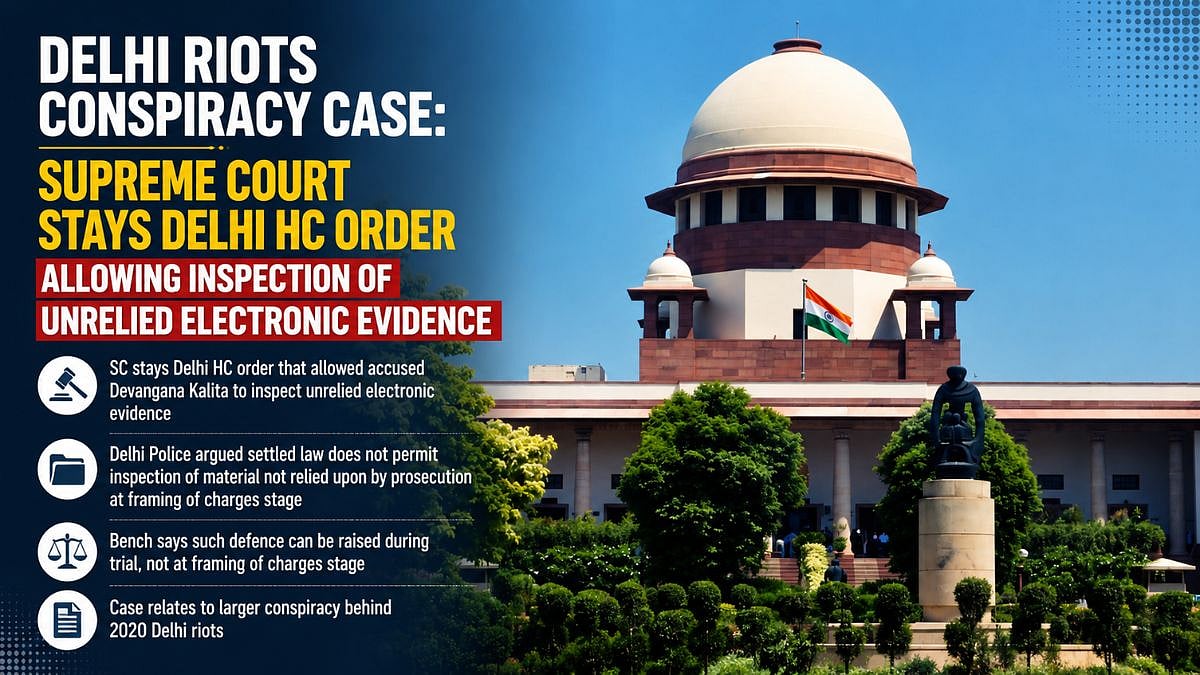
The Supreme Court has stayed a Delhi High Court order that allowed Devangana Kalita, an accused in the 2020 Delhi riots conspiracy case, to inspect electronic evidence collected by the Delhi Police but not relied upon by the prosecution.
The order was passed by a Bench of Justice Aravind Kumar and Justice Alok Aradhe on July 20, while hearing a challenge filed by the Delhi Police against the High Court's June 6 ruling. The High Court had permitted Kalita to inspect electronic records and documents that the prosecution had chosen not to rely upon, citing the sensitive nature of the material.
The Delhi Police argued that the Supreme Court had already settled the issue in previous judgments, and that an accused is not entitled to inspect documents not relied upon by the prosecution at the stage of framing of charges. The police claimed that Kalita's request was an attempt to delay the trial rather than a legitimate legal exercise.
Kalita's counsel, however, argued that the defence was only seeking access to videos that allegedly showed her participating in peaceful protests. The counsel contended that if the footage established she was peacefully protesting and not involved in stone-pelting, it would directly support her discharge from the case before trial.
The Bench was not persuaded by the argument, observing that such a defence could be raised during the trial and not at the stage of framing of charges. The court granted a stay on the High Court's order, remarking that Kalita was not entitled to inspect the unrelied material in light of previous judgments.
The court also made a sharp observation on delays in the proceedings, remarking that arguments could continue for another 10 years while complaints of delay persisted. Kalita was granted bail by the Delhi High Court in June 2021, along with co-accused Asif Iqbal Tanha and Natasha Narwal. The Supreme Court upheld that order in May 2023 after dismissing the Delhi Police's challenge.
In a separate development, the trial court refused Kalita's request for the entire CCTV footage from north-east Delhi and WhatsApp chats of groups involving police officials in the case registered under the Unlawful Activities (Prevention) Act (UAPA). The Supreme Court's latest order marks another significant development in the ongoing legal battle over the scope of access to evidence in the Delhi riots larger conspiracy case.
The Delhi riots conspiracy case is a complex and sensitive matter, with multiple accused and a large amount of evidence. The case has been ongoing for several years, with various twists and turns. The Supreme Court's order is a significant development in the case, and it remains to be seen how the trial will proceed.
The case has also raised questions about the scope of access to evidence in criminal trials, and the balance between the rights of the accused and the need to protect sensitive information. The Supreme Court's judgment will have implications for future cases, and will be closely watched by legal experts and scholars.
In conclusion, the Supreme Court's order staying the inspection of electronic evidence in the Delhi riots conspiracy case is a significant development in the ongoing legal battle. The case has raised important questions about access to evidence and the rights of the accused, and the Supreme Court's judgment will have implications for future cases.
The Delhi riots conspiracy case is a reminder of the importance of ensuring that the criminal justice system is fair and impartial, and that the rights of all parties are protected. The case has also highlighted the need for efficient and timely disposal of cases, to prevent delays and ensure that justice is served.
The Supreme Court's order is a step in the right direction, and it is hoped that the trial will proceed in a fair and timely manner. The case will continue to be closely watched by legal experts and scholars, and its outcome will have significant implications for the criminal justice system in India.
Frequently asked questions
What is the Delhi riots conspiracy case about?
The Delhi riots conspiracy case is a complex and sensitive matter, with multiple accused and a large amount of evidence, related to the 2020 Delhi riots.
What was the Supreme Court's order in the case?
The Supreme Court stayed a Delhi High Court order that allowed Devangana Kalita to inspect electronic evidence collected by the Delhi Police but not relied upon by the prosecution.