Venus May Have Consumed Own Moon
Venus's slow rotation doomed its moon, new study suggests. Researchers propose a theory of celestial cannibalism.
'%3E%3Crect%20width%3D'96'%20height%3D'96'%20fill%3D'%23B3261E'%2F%3E%3Ccircle%20cx%3D'30'%20cy%3D'24'%20r%3D'44'%20fill%3D'%23fff'%20opacity%3D'.12'%2F%3E%3Ccircle%20cx%3D'60'%20cy%3D'74'%20r%3D'40'%20fill%3D'%23000'%20opacity%3D'.10'%2F%3E%3C%2Fg%3E%3Cg%20fill%3D'%23fff'%3E%3Crect%20x%3D'29'%20y%3D'49'%20width%3D'8'%20height%3D'19'%20rx%3D'1'%2F%3E%3Crect%20x%3D'39'%20y%3D'40'%20width%3D'9'%20height%3D'28'%20rx%3D'1'%2F%3E%3Crect%20x%3D'50'%20y%3D'45'%20width%3D'8'%20height%3D'23'%20rx%3D'1'%2F%3E%3Crect%20x%3D'60'%20y%3D'53'%20width%3D'7'%20height%3D'15'%20rx%3D'1'%2F%3E%3Crect%20x%3D'41'%20y%3D'34'%20width%3D'5'%20height%3D'6'%2F%3E%3C%2Fg%3E%3C%2Fsvg%3E)
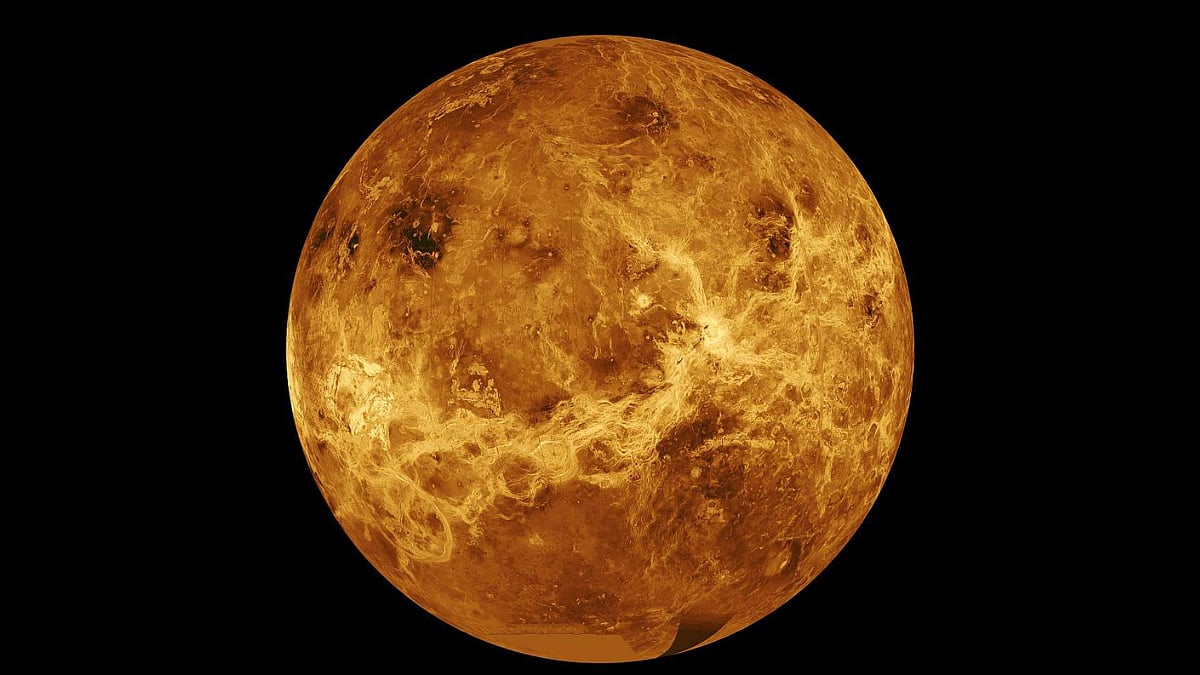
A new theory has emerged to explain why Venus, often referred to as Earth's twin due to their similar size and structure, lacks a moon. Researchers at the University of California, Riverside, propose that Venus may have swallowed its own satellite whole. This theory, presented in a study published in The Astrophysical Journal, suggests that any moon that once orbited Venus would have been destroyed due to the planet's slow rotation.
The study's lead author, Stephen Krane, an astrophysicist, explained that a Venusian satellite would have gradually spiralled inward until it crashed into the planet. Computer simulations modelling the gravitational behaviour of hypothetical moons of varying sizes all pointed to the same outcome - collapse into Venus. This likely occurred within the first billion years of the solar system's 4.5-billion-year history.
The key factor contributing to this outcome is the difference in rotational speed between Venus and Earth. Venus takes 243 Earth days to complete a single rotation, which is actually longer than the time it takes to orbit the sun. In contrast, Earth spins on its axis in just 24 hours, more than 200 times faster than Venus. This difference in rotational speed changes the fate of a moon. Earth's rapid spin transfers energy that gradually pushes our moon further away, causing it to drift outward at about 4 centimetres a year.
Venus's slow rotation, on the other hand, would have had the opposite effect, dragging any moon closer rather than letting it escape. Until now, scientists had largely explained Venus's moonless state in one of two ways: either the planet never captured a moon in the first place, or an early moon was destroyed in a massive impact. Krane's team argues that it's unlikely Venus escaped such a collision altogether, given the crowded and chaotic inner solar system during its formative years.
The findings of this study contribute to broader research on Venus as Earth's planetary twin. Despite similarities in size and rocky composition, Venus today is a hostile world, trapped under a thick, toxic atmosphere that has triggered a runaway greenhouse effect. Studying how the two planets diverged could offer valuable insights into the formation and evolution of our solar system.
The discovery also sheds light on the importance of a planet's rotational speed in determining the fate of its moons. The research team's theory of celestial cannibalism provides a new perspective on the history of our solar system and the potential for moons to exist around other planets. As scientists continue to explore the mysteries of the universe, this study serves as a reminder of the complex and dynamic nature of our cosmic neighbourhood.
In conclusion, the theory that Venus may have consumed its own moon offers a fascinating explanation for the planet's moonless state. The study's findings have significant implications for our understanding of the solar system and the formation of planets. As research continues to uncover the secrets of the universe, we may yet discover more surprises about the history and evolution of our celestial neighbours.
The study's results also highlight the importance of continued research into the formation and evolution of our solar system. By exploring the mysteries of Venus and its potential moon, scientists can gain a deeper understanding of the complex processes that shape the universe. This knowledge can, in turn, inform our understanding of the potential for life to exist elsewhere in the solar system and beyond.
Ultimately, the discovery that Venus may have consumed its own moon serves as a reminder of the awe-inspiring complexity and beauty of the universe. As we continue to explore and learn more about the cosmos, we may yet uncover even more surprising secrets about the history and evolution of our solar system.
Frequently asked questions
Why does Venus not have a moon?
Venus's slow rotation may have caused its moon to spiral inward and collide with the planet.
How does Earth's rotation affect its moon?
Earth's rapid spin transfers energy that pushes the moon further away, causing it to drift outward at about 4 centimetres a year.