CIDCO Chief Outlines Navi Mumbai's Future
Navi Mumbai to emerge as a well-planned city, CIDCO chief discusses development plans.
'%3E%3Crect%20width%3D'96'%20height%3D'96'%20fill%3D'%23B3261E'%2F%3E%3Ccircle%20cx%3D'30'%20cy%3D'24'%20r%3D'44'%20fill%3D'%23fff'%20opacity%3D'.12'%2F%3E%3Ccircle%20cx%3D'60'%20cy%3D'74'%20r%3D'40'%20fill%3D'%23000'%20opacity%3D'.10'%2F%3E%3C%2Fg%3E%3Cg%20fill%3D'%23fff'%3E%3Crect%20x%3D'29'%20y%3D'49'%20width%3D'8'%20height%3D'19'%20rx%3D'1'%2F%3E%3Crect%20x%3D'39'%20y%3D'40'%20width%3D'9'%20height%3D'28'%20rx%3D'1'%2F%3E%3Crect%20x%3D'50'%20y%3D'45'%20width%3D'8'%20height%3D'23'%20rx%3D'1'%2F%3E%3Crect%20x%3D'60'%20y%3D'53'%20width%3D'7'%20height%3D'15'%20rx%3D'1'%2F%3E%3Crect%20x%3D'41'%20y%3D'34'%20width%3D'5'%20height%3D'6'%2F%3E%3C%2Fg%3E%3C%2Fsvg%3E)
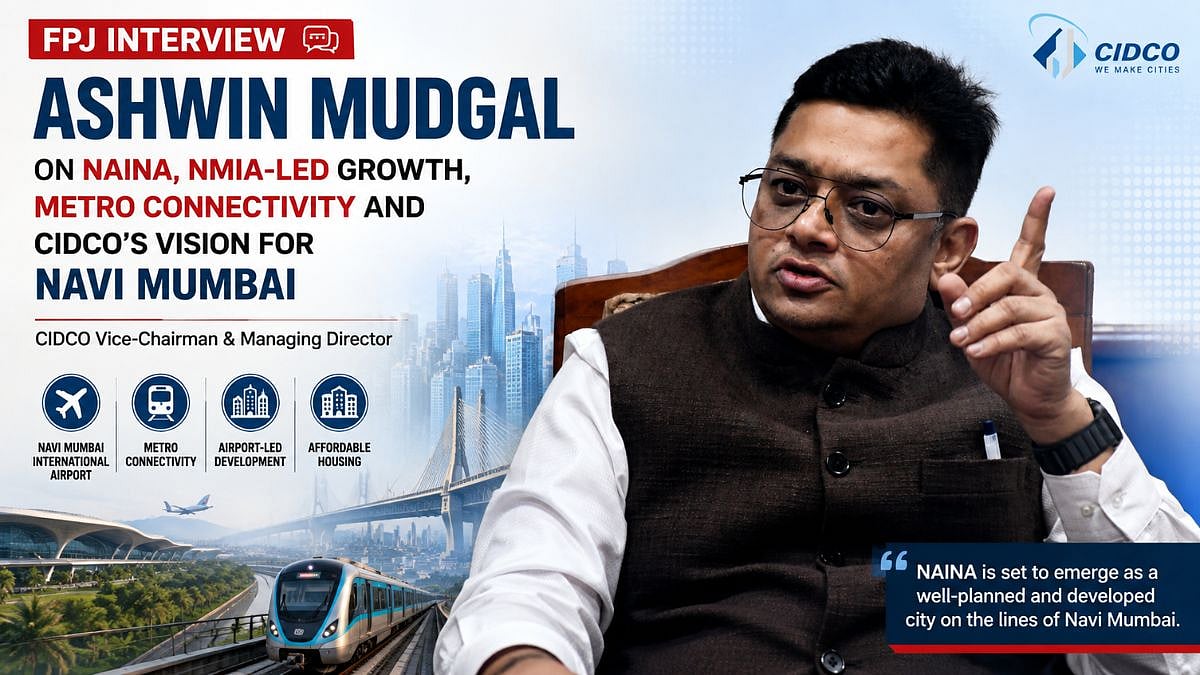
Navi Mumbai is set to become a well-planned and developed city, according to Ashwin Mudgal, Vice-Chairman and Managing Director of CIDCO. In a recent interview, Mudgal discussed CIDCO's vision for Navi Mumbai and the region's rapidly evolving urban landscape.
Mudgal, an IAS officer of the 2007 batch, took charge of CIDCO on June 17, 2026. Prior to joining CIDCO, he served as Additional Metropolitan Commissioner at the Mumbai Metropolitan Region Development Authority (MMRDA).
The Navi Mumbai International Airport, which is now operational, is a key part of CIDCO's development plans. The airport is being developed in three phases, with a planned capacity of 90 million passengers per year. This is significant, as the Mumbai airport currently handles around 50 million passengers annually.
Mudgal emphasized the importance of Metro connectivity in integrating Navi Mumbai International Airport with the wider Mumbai Metropolitan Region. A Metro line is proposed to connect the airport to Sagar Sangam station, near the Navi Mumbai Municipal Corporation headquarters, and from there to Belapur. Another connection, Line 8, will connect the Navi Mumbai airport to Terminal 2 of Mumbai airport, passing through Chembur and Mankhurd.
The CIDCO chief also discussed the status of NAINA and Third Mumbai, as well as the challenges in implementing Town Planning Schemes. He highlighted the importance of ground verification and plot demarcation in ensuring that development plans are implemented effectively.
In addition to the airport, CIDCO is also planning to develop AeroCity, EduCity, and MediCity, as part of its vision for airport-led development. The region's growing population and the need for affordable housing are also key priorities for CIDCO.
The Trans Harbour Link and Metro network will play a crucial role in shaping Navi Mumbai's future, according to Mudgal. The Metro network will provide connectivity to major parts of Mumbai and the surrounding region, making it easier for people to travel and access amenities.
Overall, CIDCO's vision for Navi Mumbai is one of a well-planned and developed city, with a strong focus on connectivity, affordability, and sustainability. With the Navi Mumbai International Airport now operational, the city is poised for significant growth and development in the coming years.
The development of Navi Mumbai is not just important for the city itself, but also for the wider Mumbai Metropolitan Region. As the region continues to grow and evolve, it is likely that Navi Mumbai will play an increasingly important role in the regional economy and infrastructure.
In the coming years, CIDCO will face several challenges as it works to implement its development plans. However, with a clear vision and a strong focus on connectivity and affordability, the city is well-placed to become a major hub for business, education, and healthcare in the region.
The success of Navi Mumbai's development plans will depend on several factors, including the ability of CIDCO to work effectively with other stakeholders, such as the MMRDA and the Maharashtra state government. However, with the right planning and investment, there is no doubt that Navi Mumbai can emerge as a well-planned and developed city, with a bright future ahead.
As the city continues to grow and develop, it is likely that we will see significant changes in the coming years. With its strong focus on connectivity, affordability, and sustainability, Navi Mumbai is poised to become a major player in the regional economy and infrastructure.
Frequently asked questions
What is the planned capacity of Navi Mumbai International Airport?
90 million passengers per year
How will Metro connectivity integrate Navi Mumbai International Airport with the wider MMR network?
A Metro line is proposed to connect the airport to Sagar Sangam station and from there to Belapur, and another connection, Line 8, will connect the airport to Terminal 2 of Mumbai airport