Indian Airlines Recover In International Traffic
Indian airlines see rebound in international traffic, passengers cross 25 lakh mark in July.
'%3E%3Crect%20width%3D'96'%20height%3D'96'%20fill%3D'%23B3261E'%2F%3E%3Ccircle%20cx%3D'30'%20cy%3D'24'%20r%3D'44'%20fill%3D'%23fff'%20opacity%3D'.12'%2F%3E%3Ccircle%20cx%3D'60'%20cy%3D'74'%20r%3D'40'%20fill%3D'%23000'%20opacity%3D'.10'%2F%3E%3C%2Fg%3E%3Cg%20fill%3D'%23fff'%3E%3Crect%20x%3D'29'%20y%3D'49'%20width%3D'8'%20height%3D'19'%20rx%3D'1'%2F%3E%3Crect%20x%3D'39'%20y%3D'40'%20width%3D'9'%20height%3D'28'%20rx%3D'1'%2F%3E%3Crect%20x%3D'50'%20y%3D'45'%20width%3D'8'%20height%3D'23'%20rx%3D'1'%2F%3E%3Crect%20x%3D'60'%20y%3D'53'%20width%3D'7'%20height%3D'15'%20rx%3D'1'%2F%3E%3Crect%20x%3D'41'%20y%3D'34'%20width%3D'5'%20height%3D'6'%2F%3E%3C%2Fg%3E%3C%2Fsvg%3E)
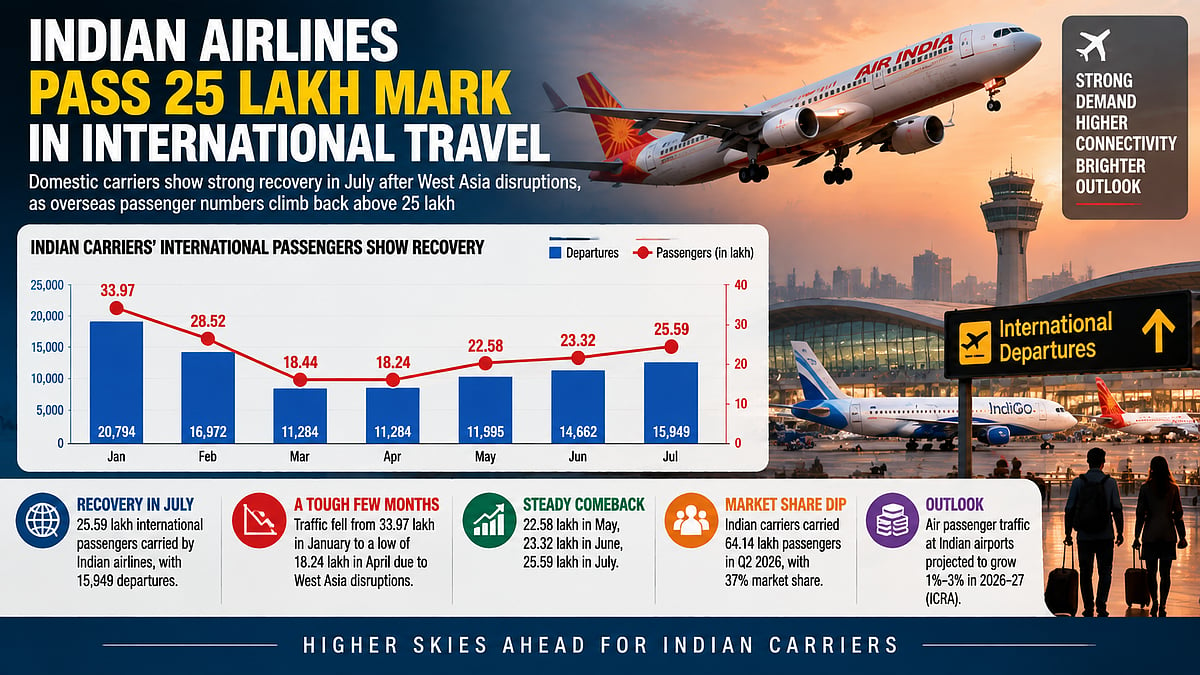
Indian airlines have shown a significant recovery in international operations, with monthly international passenger volumes breaching the 25 lakh threshold in July for the first time since February. According to the Directorate General of Civil Aviation (DGCA), Indian carriers carried 25.59 lakh passengers in July, operating 15,949 departures.
The recovery comes after a sharp contraction in international air passenger traffic in the second quarter of 2026, triggered by geopolitical disruptions in West Asia. The total number of passengers dropped to 1.72 crore between April and June, down from 1.89 crore in the corresponding period in the previous year.
The market share of Indian airlines also dropped to 37% during this period, with only 64.14 lakh passengers carried in three months. However, the latest data from the DGCA shows signs of recovery, with Indian airlines adapting to changing flight conditions and restructuring their network schedules.
The disruption began in late February, resulting in a steep contraction in international flight operations by Indian carriers. The traffic dropped to 28.52 lakh in February and further declined to 18.44 lakh in March. The downturn bottomed out in April, with 11,508 departures carrying only 18.24 lakh passengers.
However, operational metrics began climbing month-over-month through the second quarter. In May, 13,995 departures carried 22.58 lakh passengers, which increased to 14,662 departures and 23.32 lakh passengers in June.
Industry experts attribute the rebound to strong demand for international travel from India, despite higher operational costs from longer flight routes. The recovery is driven by strategic airspace rerouting, with Indian carriers recalibrating long-haul flight paths, strong outbound summer travel demand, and aggressive capacity deployment by market leaders like IndiGo and the Air India group.
The traffic recorded in July was still 24% lower than the 33.97 lakh passengers flown in January. However, the recovery is a positive sign for the Indian aviation industry, which is expected to grow by a modest 1% to 3% in the financial year, according to credit rating agency ICRA.
The growth in international air passenger traffic is expected to be driven by increasing demand for travel, particularly from India. The country's growing middle class and increasing disposable income are expected to drive growth in the aviation sector.
In conclusion, the recovery of Indian airlines in international traffic is a significant development, driven by strong demand and strategic adaptations by airlines. The growth in international air passenger traffic is expected to continue, driven by increasing demand for travel and aggressive capacity deployment by market leaders.
The Indian aviation industry is expected to play a crucial role in the country's economic growth, with the government investing heavily in infrastructure development and policy reforms. The recovery of Indian airlines in international traffic is a positive sign for the industry, and it is expected to continue to grow in the coming months.
The growth in international air passenger traffic will also have a positive impact on the tourism industry, with increasing numbers of tourists expected to visit India. The country's rich cultural heritage and natural beauty are expected to attract more tourists, driving growth in the tourism sector.
Overall, the recovery of Indian airlines in international traffic is a significant development, driven by strong demand and strategic adaptations by airlines. The growth in international air passenger traffic is expected to continue, driven by increasing demand for travel and aggressive capacity deployment by market leaders.
Frequently asked questions
What was the international passenger traffic in July?
Indian airlines carried 25.59 lakh passengers in July, operating 15,949 departures.
What triggered the decline in international air passenger traffic?
Geopolitical disruptions in West Asia triggered the decline in international air passenger traffic.