Muslim Representation Declines in India's Electoral Politics
Muslims make up 15% of India's population, but their electoral representation is dwindling. The BJP's rise to power has intensified the debate.
'%3E%3Crect%20width%3D'96'%20height%3D'96'%20fill%3D'%231A5276'%2F%3E%3Ccircle%20cx%3D'30'%20cy%3D'24'%20r%3D'44'%20fill%3D'%23fff'%20opacity%3D'.12'%2F%3E%3Ccircle%20cx%3D'60'%20cy%3D'74'%20r%3D'40'%20fill%3D'%23000'%20opacity%3D'.10'%2F%3E%3C%2Fg%3E%3Cg%20fill%3D'%23fff'%3E%3Cpath%20d%3D'M31%2041%20L48%2031%20L65%2041%20Z'%2F%3E%3Crect%20x%3D'33'%20y%3D'43'%20width%3D'4'%20height%3D'17'%2F%3E%3Crect%20x%3D'41'%20y%3D'43'%20width%3D'4'%20height%3D'17'%2F%3E%3Crect%20x%3D'51'%20y%3D'43'%20width%3D'4'%20height%3D'17'%2F%3E%3Crect%20x%3D'59'%20y%3D'43'%20width%3D'4'%20height%3D'17'%2F%3E%3Crect%20x%3D'30'%20y%3D'62'%20width%3D'36'%20height%3D'4'%20rx%3D'1'%2F%3E%3C%2Fg%3E%3C%2Fsvg%3E)
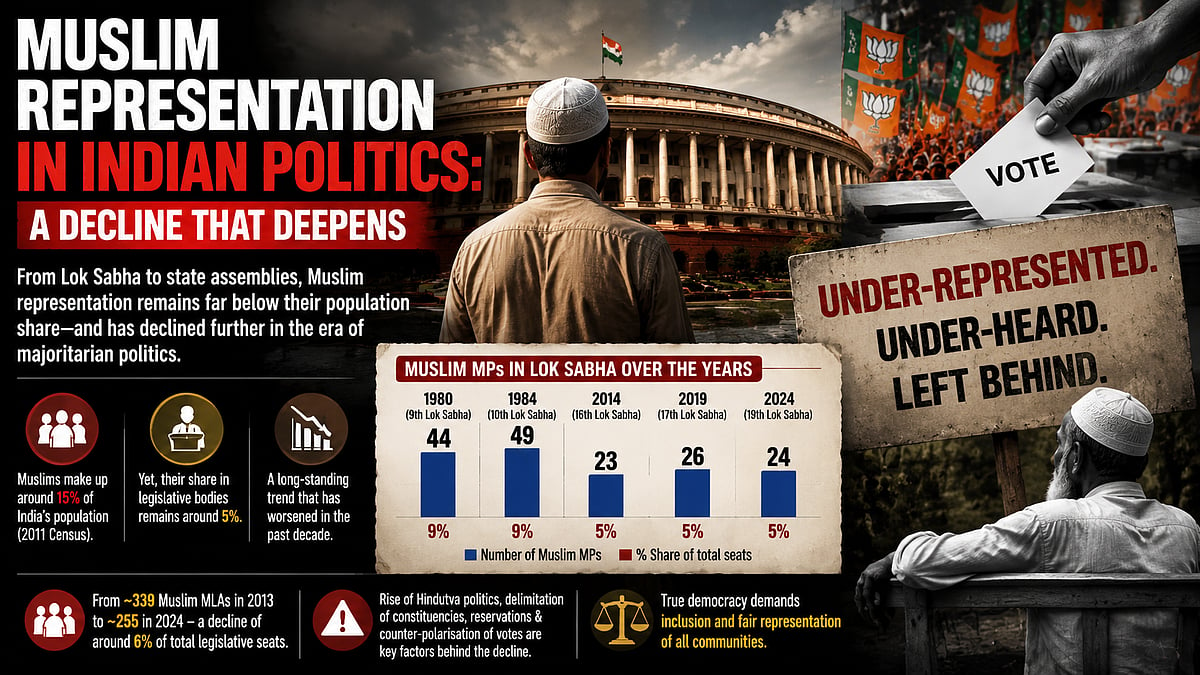
The decline of Muslim representation in India's electoral politics has been a topic of discussion for decades. However, the debate has gained more traction since the Bharatiya Janata Party (BJP) came to power in 2014. The party's reluctance to field Muslim candidates has been attributed to the fear of being accused of 'minority appeasement.' This phenomenon is not unique to the BJP, as other parties have also been hesitant to field Muslim candidates due to the shifting electoral discourse towards the right.
The BJP has successfully cultivated its own vote bank and has frequently won elections without relying on large shares of Muslim votes. In contrast, 'secular' parties like the Congress still count on the Muslim vote. The BJP's opponents accuse the party of being anti-Muslim, who make up around 15% of India's population, according to the 2011 Census. The party has also been criticized for not fielding Muslim candidates in constituencies with significant Muslim populations, such as Uttar Pradesh.
The BJP's march to political dominance can be attributed to its electoral and ideological strategy, which seeks to unify diverse castes under a single Hindu identity. This approach has allowed the party to burnish its pro-Hindu credentials and cement its hold on the majority community voters. It is unlikely that the BJP will abandon this winning formula, which has enabled the party to transition its core ideological agendas from the fringes to the mainstream.
In recent years, the divide between the BJP and 'secular' parties has become more pronounced, with elections being fought less on governance issues and more on polarizing rhetoric and communal politics. The 2024 general election and the recent assembly elections in West Bengal and Assam are prime examples of this trend. Almost all political parties have been guilty of exploiting religion and caste to build vote banks over the decades, particularly since the late 1980s and 1990s.
The rise of the BJP has been accompanied by the rise of aggressive religious nationalism, which has turned religious identity and majoritarian mobilization into an effective electoral strategy. This approach has broken the post-Independence dominance of broad, cross-communal parties and has ushered in an era of identity and social justice mobilization. The decline of Muslim representation in India's electoral politics is a significant concern, as it highlights the growing marginalization of minority communities in the country's political landscape.
The implications of this trend are far-reaching, as it threatens to undermine the principles of secularism and inclusivity that are enshrined in India's Constitution. The erosion of Muslim representation in electoral politics also has significant consequences for the country's social fabric, as it can exacerbate communal tensions and create divisions along religious lines. Ultimately, the decline of Muslim representation in India's electoral politics is a complex issue that requires a nuanced understanding of the country's electoral dynamics and the role of religion in shaping political discourse.
In conclusion, the decline of Muslim representation in India's electoral politics is a pressing concern that requires attention from policymakers, politicians, and civil society. It is essential to address the underlying factors that contribute to this trend, including the fear of 'minority appeasement' and the exploitation of religion and caste for electoral gain. By promoting inclusivity and secularism, India can ensure that its electoral politics remains representative of its diverse population and that the rights of minority communities are protected.
The significance of this issue for India cannot be overstated, as it has the potential to impact the country's social cohesion, political stability, and economic development. As India continues to navigate the complexities of its electoral politics, it is essential to prioritize the representation and inclusion of minority communities, including Muslims. By doing so, India can ensure that its democracy remains vibrant, inclusive, and representative of its diverse population.
In the context of India's electoral politics, the decline of Muslim representation is a symptom of a broader trend towards polarization and communalization. This trend has significant implications for the country's future, as it can lead to increased social tensions, communal violence, and political instability. Therefore, it is essential to address this issue through a combination of policy reforms, political engagement, and social activism.
The way forward for India is to promote a more inclusive and secular electoral politics, one that values diversity and promotes the representation of minority communities. This can be achieved through a range of measures, including electoral reforms, political party reforms, and social activism. By working together, Indians can ensure that their democracy remains strong, vibrant, and representative of its diverse population.
In the end, the decline of Muslim representation in India's electoral politics is a challenge that requires a collective response from Indians. It is a reminder that the country's democracy is not just about winning elections, but about promoting inclusivity, secularism, and social justice. By addressing this issue, India can ensure that its democracy remains a beacon of hope for its citizens and a model for other countries to follow.
The future of India's electoral politics depends on its ability to promote inclusivity and secularism. The decline of Muslim representation is a warning sign that the country's democracy is at risk of becoming increasingly polarized and communalized. Therefore, it is essential to take immediate action to address this issue and promote a more inclusive and secular electoral politics.
The consequences of inaction will be severe, as the decline of Muslim representation can lead to increased social tensions, communal violence, and political instability. Therefore, it is essential to prioritize the representation and inclusion of minority communities, including Muslims, and to promote a more inclusive and secular electoral politics.
In conclusion, the decline of Muslim representation in India's electoral politics is a pressing concern that requires immediate attention. It is a symptom of a broader trend towards polarization and communalization, and it has significant implications for the country's social cohesion, political stability, and economic development. By promoting inclusivity and secularism, India can ensure that its democracy remains vibrant, inclusive, and representative of its diverse population.
The importance of addressing this issue cannot be overstated, as it has the potential to impact the country's future in significant ways. The decline of Muslim representation is a reminder that India's democracy is not just about winning elections, but about promoting inclusivity, secularism, and social justice. By working together, Indians can ensure that their democracy remains strong, vibrant, and representative of its diverse population.
The way forward for India is to promote a more inclusive and secular electoral politics, one that values diversity and promotes the representation of minority communities. This can be achieved through a range of measures, including electoral reforms, political party reforms, and social activism. By taking immediate action to address the decline of Muslim representation, India can ensure that its democracy remains a beacon of hope for its citizens and a model for other countries to follow.
The future of India's democracy depends on its ability to promote inclusivity and secularism. The decline of Muslim representation is a warning sign that the country's democracy is at risk of becoming increasingly polarized and communalized. Therefore, it is essential to prioritize the representation and inclusion of minority communities, including Muslims, and to promote a more inclusive and secular electoral politics.
In the end, the decline of Muslim representation in India's electoral politics is a challenge that requires a collective response from Indians. It is a reminder that the country's democracy is not just about winning elections, but about promoting inclusivity, secularism, and social justice. By addressing this issue, India can ensure that its democracy remains strong, vibrant, and representative of its diverse population.
Frequently asked questions
What is the percentage of Muslims in India's population?
According to the 2011 Census, Muslims make up around 15% of India's population.
Why is the BJP reluctant to field Muslim candidates?
The party's reluctance to field Muslim candidates has been attributed to the fear of being accused of 'minority appeasement'.