Chinese Robot Beats Usain Bolt's 100m Record
Chinese humanoid robot Lightning runs 100m in 9.32 seconds, beating Usain Bolt's record.
'%3E%3Crect%20width%3D'96'%20height%3D'96'%20fill%3D'%23B3261E'%2F%3E%3Ccircle%20cx%3D'30'%20cy%3D'24'%20r%3D'44'%20fill%3D'%23fff'%20opacity%3D'.12'%2F%3E%3Ccircle%20cx%3D'60'%20cy%3D'74'%20r%3D'40'%20fill%3D'%23000'%20opacity%3D'.10'%2F%3E%3C%2Fg%3E%3Cg%20fill%3D'%23fff'%3E%3Crect%20x%3D'29'%20y%3D'49'%20width%3D'8'%20height%3D'19'%20rx%3D'1'%2F%3E%3Crect%20x%3D'39'%20y%3D'40'%20width%3D'9'%20height%3D'28'%20rx%3D'1'%2F%3E%3Crect%20x%3D'50'%20y%3D'45'%20width%3D'8'%20height%3D'23'%20rx%3D'1'%2F%3E%3Crect%20x%3D'60'%20y%3D'53'%20width%3D'7'%20height%3D'15'%20rx%3D'1'%2F%3E%3Crect%20x%3D'41'%20y%3D'34'%20width%3D'5'%20height%3D'6'%2F%3E%3C%2Fg%3E%3C%2Fsvg%3E)
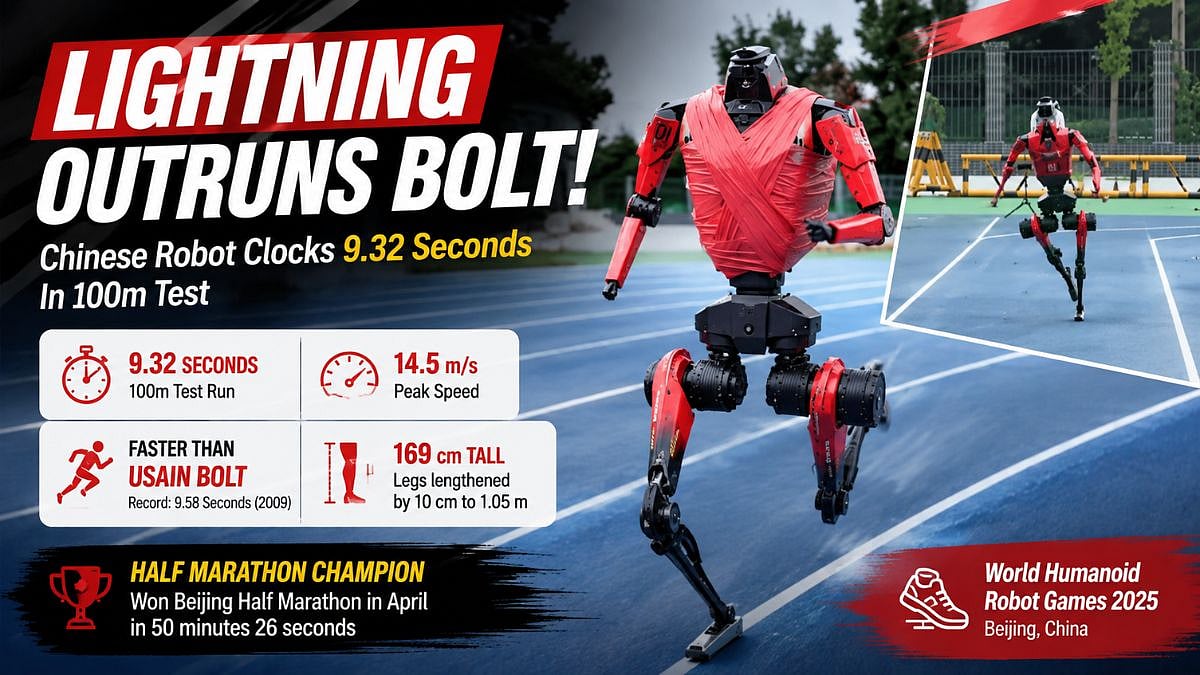
A Chinese humanoid robot named Lightning has achieved a remarkable feat by running 100 meters in 9.32 seconds, surpassing the human world record held by Jamaican sprinter Usain Bolt. The robot, developed by Chinese smartphone maker Honor, reached a peak speed of 14.5 meters per second during a test event for the second World Humanoid Robot Games in Beijing.
The 9.32-second performance by Lightning has beaten the men's 100-meter world record of 9.58 seconds set by Bolt at the World Athletics Championships in Berlin in 2009. This achievement highlights the rapid development of humanoid robots and their potential to outperform humans in various physical tasks.
Lightning's run was a test event, not a human athletics competition, but its ability to cover 100 meters faster than the standing human world record is a striking example of advances in robotics. China has been promoting humanoid robots as a strategic emerging industry, with policymakers and companies betting on advances in artificial intelligence (AI) and hardware to accelerate their use in manufacturing, logistics, and consumer applications.
The robot has already demonstrated its speed over a longer distance, winning the 21-kilometer Beijing half marathon in April with a time of 50 minutes and 26 seconds, faster than the elite men's human world-record pace. Researchers have since made modifications to Lightning, including lengthening its legs by 10 cm to 1.05 meters, to improve its performance.
The changes to Lightning, along with its latest 100-meter performance, underline the efforts of developers to push humanoid robots towards greater speed and physical capability. With China placing increasing emphasis on the sector, the robot's record-beating test run provides a glimpse of how quickly the technology is progressing.
The development of humanoid robots like Lightning has significant implications for various industries, including manufacturing, logistics, and healthcare. As the technology continues to advance, we can expect to see more robots being used in these sectors, potentially leading to increased efficiency and productivity.
The achievement of Lightning also raises interesting questions about the potential of humanoid robots to outperform humans in various physical tasks. While the robot's performance is impressive, it is essential to note that its capabilities are still limited to specific tasks and environments.
In conclusion, the achievement of Chinese humanoid robot Lightning is a significant milestone in the development of robotics and artificial intelligence. As the technology continues to advance, we can expect to see more impressive feats from humanoid robots, potentially leading to significant changes in various industries and aspects of our lives.
The rapid progress in robotics and AI is a testament to human innovation and the potential for technology to transform our world. As we continue to push the boundaries of what is possible with humanoid robots, we can expect to see more exciting developments in the future.
The second World Humanoid Robot Games, which opened in Beijing on Saturday, will feature various competitions and demonstrations of humanoid robots, showcasing their capabilities and potential applications. The event is expected to attract significant attention and interest from robotics enthusiasts, researchers, and industry experts.
Overall, the achievement of Lightning is a remarkable feat that highlights the potential of humanoid robots to outperform humans in various physical tasks. As the technology continues to advance, we can expect to see more impressive developments in the field of robotics and AI.
Frequently asked questions
What is the name of the Chinese humanoid robot that beat Usain Bolt's 100m record?
The robot's name is Lightning.
What is the time achieved by the Chinese humanoid robot in the 100m run?
The robot achieved a time of 9.32 seconds.