Modi Urges Eco-Friendly Ganesh Idols Amidst Pollution Concerns
PM Modi advocates for eco-friendly Ganesh idols, but state governments are slow to act. Pollution from idols is a national concern.
'%3E%3Crect%20width%3D'96'%20height%3D'96'%20fill%3D'%23B3261E'%2F%3E%3Ccircle%20cx%3D'30'%20cy%3D'24'%20r%3D'44'%20fill%3D'%23fff'%20opacity%3D'.12'%2F%3E%3Ccircle%20cx%3D'60'%20cy%3D'74'%20r%3D'40'%20fill%3D'%23000'%20opacity%3D'.10'%2F%3E%3C%2Fg%3E%3Cg%20fill%3D'%23fff'%3E%3Crect%20x%3D'29'%20y%3D'49'%20width%3D'8'%20height%3D'19'%20rx%3D'1'%2F%3E%3Crect%20x%3D'39'%20y%3D'40'%20width%3D'9'%20height%3D'28'%20rx%3D'1'%2F%3E%3Crect%20x%3D'50'%20y%3D'45'%20width%3D'8'%20height%3D'23'%20rx%3D'1'%2F%3E%3Crect%20x%3D'60'%20y%3D'53'%20width%3D'7'%20height%3D'15'%20rx%3D'1'%2F%3E%3Crect%20x%3D'41'%20y%3D'34'%20width%3D'5'%20height%3D'6'%2F%3E%3C%2Fg%3E%3C%2Fsvg%3E)
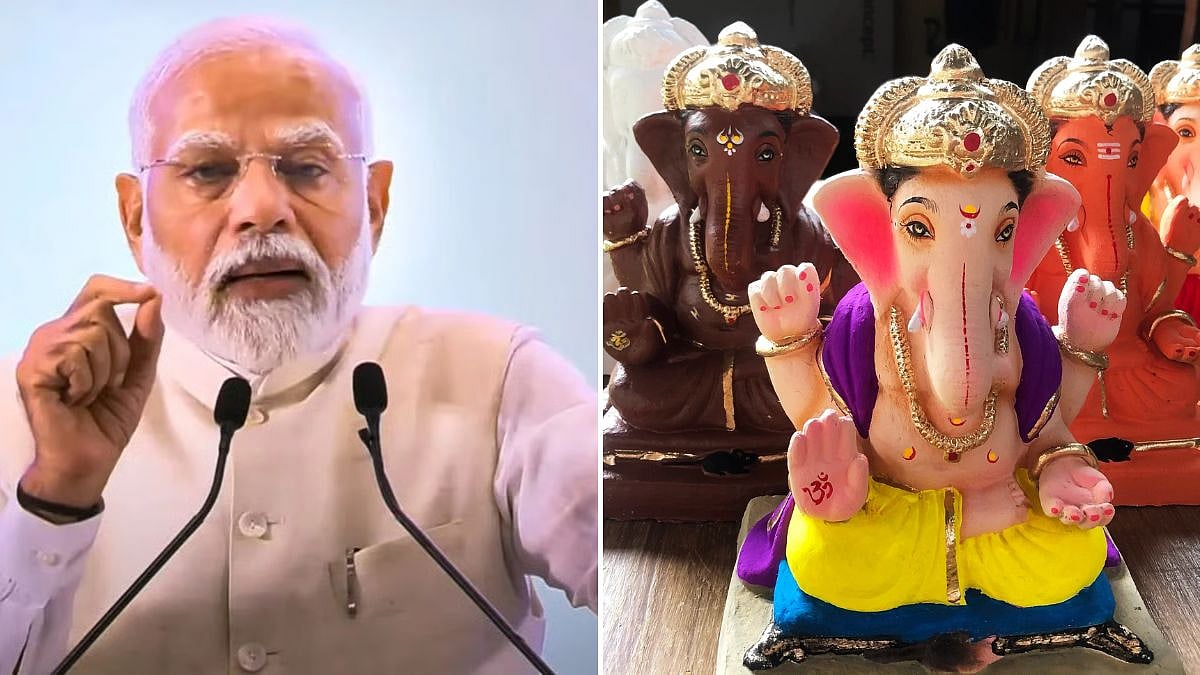
Prime Minister Narendra Modi recently emphasized the importance of using eco-friendly Ganesh idols in his Mann Ki Baat address, as court cases push for a ban on idols made from artificial materials. However, state governments seem reluctant to make festivals more environmentally friendly.
In Maharashtra, the use of Plaster of Paris (PoP) to make idols has been a subject of public interest litigation since 2024, but the state administration claims that a ban on PoP is not possible this year. The state allows idols larger than six feet to be immersed in natural water bodies, while smaller ones are immersed in artificial ponds.
The pollution caused by idols made from synthetic materials like PoP and toxic paints is a significant national concern. In Maharashtra alone, 1.96 lakh small idols and 7,000 large ones were immersed last year, highlighting the scale of the environmental challenge.
Karnataka has taken a forward-looking approach by banning PoP idols, in line with the revised Central Pollution Control Board (CPCB) guidelines of 2020. The state has also taken enforcement action, including seizing idols. In contrast, Tamil Nadu has been criticized for its lack of implementation of the guidelines, prompting the National Green Tribunal to question why identified PoP idols are allowed to be immersed in the sea.
West Bengal, known for its vibrant Durga puja, has had an eight-year-old ban on the use of thermocol and flimsy plastics, but enforcement remains weak. It appears that environmental concerns are being overlooked by states, with a 'do nothing' policy being considered expedient.
The growing prosperity of communities has led to more ostentatious and environmentally unsustainable festivals. The negative impact of pollution extends far beyond state or national borders, with waste materials dumped in the sea being transmitted to other countries. Microscopic plastics, for example, have been found in remote locations such as the Himalayas and Antarctica.
Governments must take responsibility for the long-term consequences of pollution. Courts cannot assume that lawmakers and administrators will recognize their duty to uphold the right to life without any compulsion. The principles of polluter pays and intergenerational equity must be upheld through a persuasive dialogue with communities.
Some citizens have taken the initiative to recycle natural clay, a non-renewable mined material, by retrieving it after immersion to produce new idols. This kind of environmental leadership is necessary to make such initiatives mainstream in the years to come.
In conclusion, while PM Modi's call for eco-friendly Ganesh idols is a step in the right direction, state governments must take concrete actions to address the environmental concerns surrounding festivals. The long-term consequences of pollution require immediate attention and collective action from governments, courts, and communities.
Frequently asked questions
What is the main environmental concern with Ganesh idols?
The main environmental concern is the pollution caused by idols made from synthetic materials like Plaster of Paris (PoP) and toxic paints.
Which state has banned PoP idols?
Karnataka has banned PoP idols in a forward-looking measure to advance the objective of the revised Central Pollution Control Board (CPCB) guidelines of 2020.