Supreme Court Asks NHAI To Install CCTV At Toll Plazas
Supreme Court flags highway encroachments, NHAI to install CCTV at toll plazas.
'%3E%3Crect%20width%3D'96'%20height%3D'96'%20fill%3D'%23B3261E'%2F%3E%3Ccircle%20cx%3D'30'%20cy%3D'24'%20r%3D'44'%20fill%3D'%23fff'%20opacity%3D'.12'%2F%3E%3Ccircle%20cx%3D'60'%20cy%3D'74'%20r%3D'40'%20fill%3D'%23000'%20opacity%3D'.10'%2F%3E%3C%2Fg%3E%3Cg%20fill%3D'%23fff'%3E%3Crect%20x%3D'29'%20y%3D'49'%20width%3D'8'%20height%3D'19'%20rx%3D'1'%2F%3E%3Crect%20x%3D'39'%20y%3D'40'%20width%3D'9'%20height%3D'28'%20rx%3D'1'%2F%3E%3Crect%20x%3D'50'%20y%3D'45'%20width%3D'8'%20height%3D'23'%20rx%3D'1'%2F%3E%3Crect%20x%3D'60'%20y%3D'53'%20width%3D'7'%20height%3D'15'%20rx%3D'1'%2F%3E%3Crect%20x%3D'41'%20y%3D'34'%20width%3D'5'%20height%3D'6'%2F%3E%3C%2Fg%3E%3C%2Fsvg%3E)
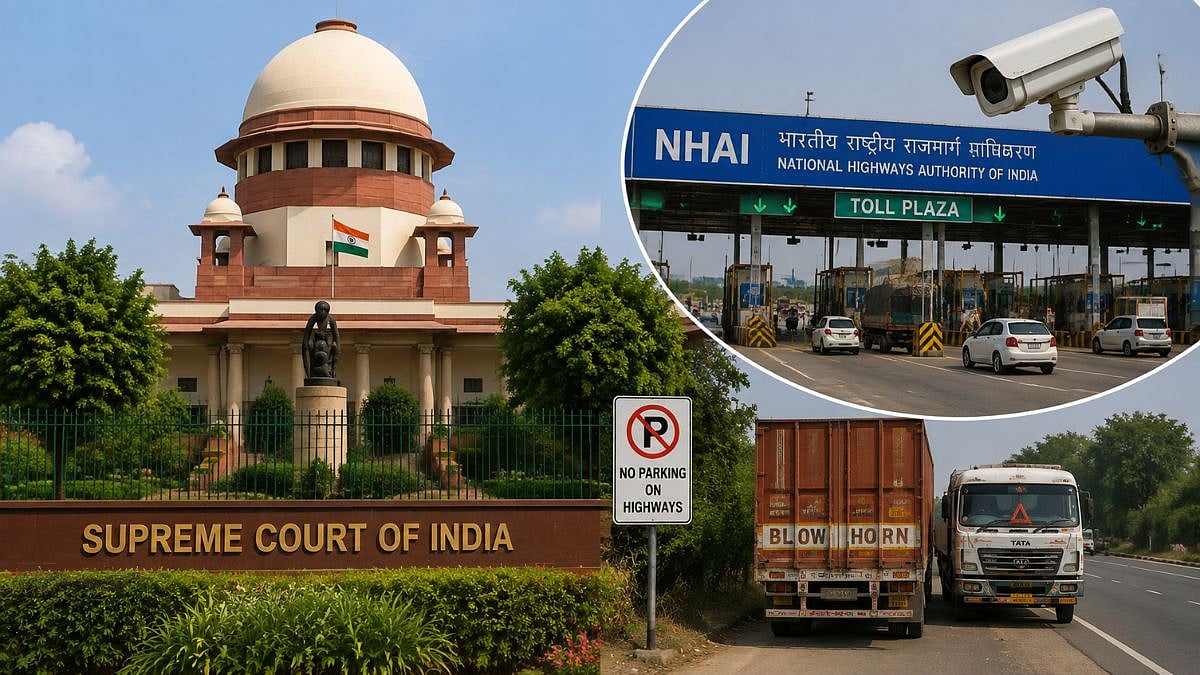
The Supreme Court on Thursday raised concerns over encroachments and stationary vehicles on highways, posing a significant threat to road safety. A bench of Justices Vikram Nath and Sandeep Mehta, hearing a suo motu case regarding a road accident in Rajasthan's Phalodi area that claimed 15 lives, identified these issues as major problems that require attention.
The court suggested the installation of camera surveillance systems and monitoring rooms at toll plazas to strengthen highway vigil. This proposal aims to utilize toll plazas as key points for monitoring highways and preventing violations. The NHAI counsel informed the court that the authority had issued circulars for regular inspections and patrolling to check unauthorized parking on highways.
The bench questioned the NHAI's inability to install camera surveillance systems, stating that monitoring rooms could be established at all toll plazas. Senior advocate ANS Nadkarni, assisting the Supreme Court as amicus curiae, highlighted the issue of illegal parking of vehicles on highways as a significant contributor to road accidents.
The court noted that the Ministry of Road Transport and Highways, the Ministry of Home Affairs, and the Tamil Nadu government had not yet filed their compliance affidavits in the matter. The bench granted the two ministries two weeks to file their affidavits and directed the Tamil Nadu government to file its affidavit before the next hearing, scheduled for October 6.
The case originated from a November 2 road accident in Phalodi last year, in which a tempo traveler collided with a stationary trailer truck, resulting in 15 fatalities. The Supreme Court took suo motu cognizance of the accident and has since been examining highway safety.
On April 13, the Supreme Court issued interim directions, including an order that no heavy or commercial vehicle should park or stop on the carriageway or paved shoulder of any national highway except at a designated bay, lay-by, or wayside amenity. The court also prohibited the construction or operation of any new dhaba, eatery, or commercial structure within the right of way of any national highway.
The Supreme Court's actions aim to address the hazards posed by stationary vehicles and encroachments on highways, ensuring a safer environment for motorists. The installation of CCTV cameras at toll plazas could be a significant step towards achieving this goal.
The court's decision has significant implications for road safety in India, highlighting the need for stricter monitoring and regulation of highways. The use of technology, such as camera surveillance systems, can play a crucial role in preventing accidents and reducing the risk of fatalities on national highways.
In conclusion, the Supreme Court's directive to the NHAI to install CCTV cameras at toll plazas is a positive step towards improving road safety in India. The court's actions demonstrate a commitment to addressing the hazards posed by stationary vehicles and encroachments on highways, and its decisions are likely to have a lasting impact on the safety of India's national highways.
The issue of road safety is a critical concern in India, with thousands of lives lost every year due to accidents on national highways. The Supreme Court's efforts to address this issue are commendable, and its decisions are likely to save countless lives in the future.
Frequently asked questions
Why did the Supreme Court ask NHAI to install CCTV at toll plazas?
The Supreme Court asked NHAI to install CCTV at toll plazas to strengthen highway vigil and prevent accidents caused by stationary vehicles and encroachments.
What was the origin of the Supreme Court case?
The case originated from a November 2 road accident in Phalodi last year, in which a tempo traveler collided with a stationary trailer truck, resulting in 15 fatalities.