NEET Attendance Reveals Regional Disparities
Kerala sees low attendance, Rajasthan excels in NEET-UG 2026. Regional disparities emerge.
'%3E%3Crect%20width%3D'96'%20height%3D'96'%20fill%3D'%23B3261E'%2F%3E%3Ccircle%20cx%3D'30'%20cy%3D'24'%20r%3D'44'%20fill%3D'%23fff'%20opacity%3D'.12'%2F%3E%3Ccircle%20cx%3D'60'%20cy%3D'74'%20r%3D'40'%20fill%3D'%23000'%20opacity%3D'.10'%2F%3E%3C%2Fg%3E%3Cg%20fill%3D'%23fff'%3E%3Crect%20x%3D'29'%20y%3D'49'%20width%3D'8'%20height%3D'19'%20rx%3D'1'%2F%3E%3Crect%20x%3D'39'%20y%3D'40'%20width%3D'9'%20height%3D'28'%20rx%3D'1'%2F%3E%3Crect%20x%3D'50'%20y%3D'45'%20width%3D'8'%20height%3D'23'%20rx%3D'1'%2F%3E%3Crect%20x%3D'60'%20y%3D'53'%20width%3D'7'%20height%3D'15'%20rx%3D'1'%2F%3E%3Crect%20x%3D'41'%20y%3D'34'%20width%3D'5'%20height%3D'6'%2F%3E%3C%2Fg%3E%3C%2Fsvg%3E)
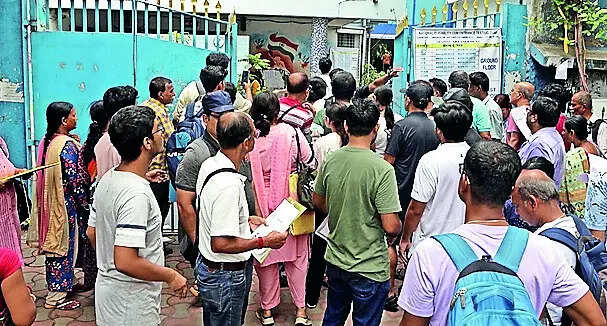
A recent analysis of the NEET-UG 2026 attendance has shed light on the regional disparities in medical entrance examination participation across India.
The data reveals that Kerala experienced a significant absenteeism rate, with one in four candidates skipping the exam. This trend was also observed in other southern states, including Tamil Nadu and Karnataka, which reported notable candidate absenteeism.
In contrast, Rajasthan posted a impressive 69% success rate, indicating a strong performance by its candidates. The state also saw an increase in registrations, suggesting a growing interest in medical education among its students.
Other northern states, such as Uttar Pradesh, also reported lower absentee numbers, highlighting a shift in the participation patterns in medical entrance examinations.
The regional disparities in NEET-UG 2026 attendance can be attributed to various factors, including differences in education systems, socio-economic conditions, and awareness about the examination.
Kerala, known for its high literacy rates and emphasis on education, has consistently produced talented students in various fields. However, the low attendance rate in NEET-UG 2026 raises questions about the state's preparedness for medical education and the factors influencing student decisions.
On the other hand, Rajasthan's strong performance can be seen as a result of the state's efforts to improve its education system and promote medical education. The state has implemented various initiatives to enhance the quality of education and provide better opportunities for its students.
The NEET-UG examination is a crucial step for students aspiring to pursue medical education in India. The exam is conducted annually, and its results determine the eligibility of candidates for admission to medical colleges across the country.
The regional disparities in NEET-UG 2026 attendance highlight the need for a more nuanced understanding of the factors influencing medical education in India. It also underscores the importance of addressing the regional disparities to ensure that students from all parts of the country have equal opportunities to pursue medical education.
In conclusion, the NEET-UG 2026 attendance data reveals significant regional disparities in medical entrance examination participation across India. While some states like Rajasthan have performed well, others like Kerala have raised concerns about their preparedness for medical education.
The implications of these disparities are far-reaching, and it is essential to address them to ensure that India's medical education system is equitable and accessible to all.
The evolving patterns in medical entrance examination participation will likely have a significant impact on the country's healthcare sector, and it is crucial to monitor these trends to ensure that India produces a sufficient number of skilled medical professionals to meet its healthcare needs.