Elon Musk Questions Future of Money
Elon Musk sparks debate on money's relevance, abundance and inequality.
'%3E%3Crect%20width%3D'96'%20height%3D'96'%20fill%3D'%230B6E4F'%2F%3E%3Ccircle%20cx%3D'30'%20cy%3D'24'%20r%3D'44'%20fill%3D'%23fff'%20opacity%3D'.12'%2F%3E%3Ccircle%20cx%3D'60'%20cy%3D'74'%20r%3D'40'%20fill%3D'%23000'%20opacity%3D'.10'%2F%3E%3C%2Fg%3E%3Cg%20fill%3D'none'%20stroke%3D'%23fff'%20stroke-width%3D'3.2'%20stroke-linecap%3D'round'%20stroke-linejoin%3D'round'%3E%3Cpolyline%20points%3D'31%2C59%2041%2C49%2049%2C54%2063%2C37'%2F%3E%3Cpolyline%20points%3D'55%2C37%2063%2C37%2063%2C45'%2F%3E%3C%2Fg%3E%3C%2Fsvg%3E)
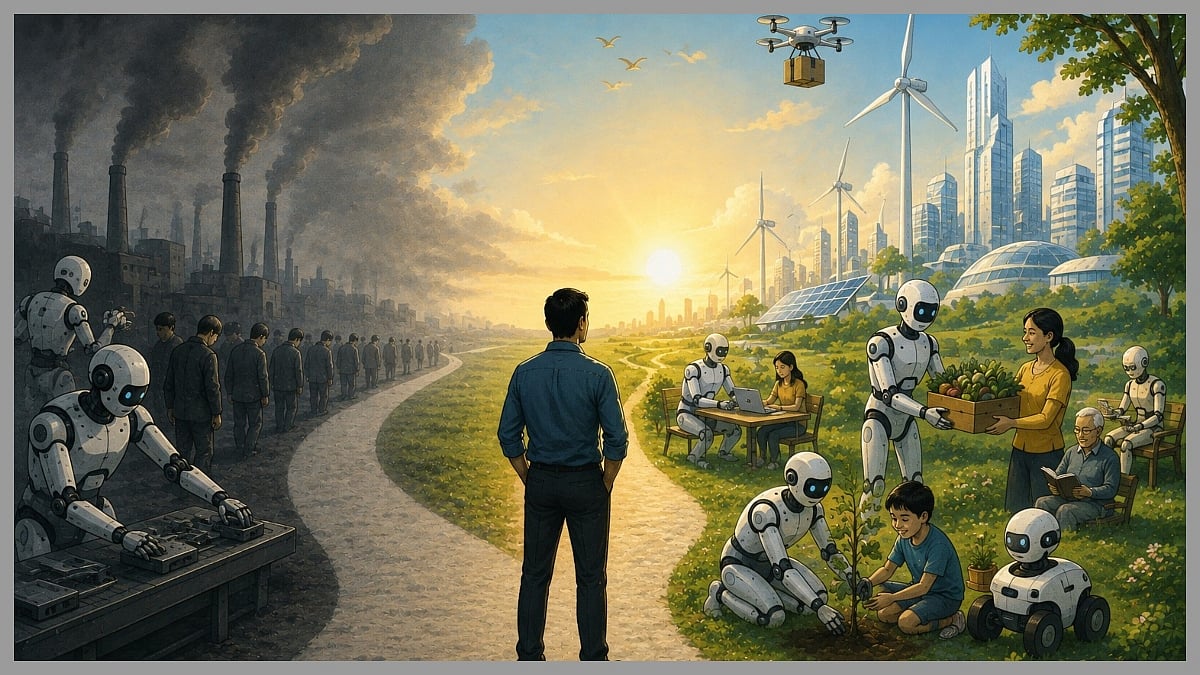
Elon Musk, the world's first trillionaire, has posed a thought-provoking question: what comes after money? He suggests that money could eventually cease to matter, a notion that sounds almost heretical in a civilization ruled by salaries, currencies, and stock markets. However, this idea is rooted in an old economic truth: abundance can destroy price.
In the past, Indians have witnessed a miniature version of this phenomenon. With the advent of internet calls, the cost of conversation has become negligible, regardless of distance. Similarly, smartphones have made photography, music, and access to information virtually free. This technological deflation could be extended to intelligence and labor with the help of Artificial Intelligence (AI).
AI could revolutionize various industries, such as farming, manufacturing, and healthcare, making them more efficient and cost-effective. Robots could perform tasks that were previously done by humans, and AI tutors could make education more accessible. Intelligent systems could also reduce routine healthcare, legal, and financial costs. Furthermore, governments could leverage AI to process applications, taxes, and licenses, reducing bureaucracy and friction.
However, this abundance raises questions about ownership. Who owns the algorithms, chips, data centers, energy, and robot fleets? If ownership remains concentrated, extraordinary abundance could coexist with extraordinary inequality. To address this issue, governments may consider implementing AI dividends, sovereign AI wealth funds, or universal income, ensuring that citizens share in machine-generated productivity.
Another challenge is the impact of abundance on debt. Mortgages, farm and education loans, credit-card balances, and business borrowings will not vanish because AI makes things cheaper. If technology destroys incomes before debts, abundance could initially deepen financial distress. The wealthy often borrow against productive assets, while the poor frequently borrow to survive. Perhaps abundance's greatest financial freedom would be freedom from borrowing merely to live.
In conclusion, while Elon Musk's question may seem radical, it highlights the potential for abundance to transform our economy. As technology continues to advance, it is essential to consider the implications of abundance on our society, including issues of ownership, inequality, and debt. Ultimately, the future of money and our economic system will depend on how we choose to harness the power of abundance.
The concept of abundance and its effects on the economy is not new, but it has gained significant attention in recent years due to advancements in technology. As we move forward, it is crucial to address the challenges associated with abundance, such as ownership and inequality, to ensure that its benefits are shared by all.
In the context of India, the shift towards AI-powered phones and the growth of the mobile gaming market are examples of how abundance is transforming industries. The Realme P4s 5G, which targets performance, display, and battery, is a testament to the increasing demand for affordable and efficient technology.
As we navigate the complexities of abundance, it is essential to consider the potential consequences of a world where money is no longer the primary driver of economic activity. While it is unlikely that money will disappear entirely, it is possible that its role will evolve, and new forms of currency or exchange may emerge.
In the end, the question of what comes after money is a complex one, and its answer will depend on how we choose to shape the future of our economy. As Elon Musk's question sparks debate and discussion, it is essential to consider the implications of abundance and its potential to transform our world.
The future of money and the economy is uncertain, but one thing is clear: abundance has the potential to bring about significant changes. As we move forward, it is crucial to address the challenges associated with abundance and ensure that its benefits are shared by all.
Frequently asked questions
What is Elon Musk's proposition about money?
Elon Musk suggests that money could eventually cease to matter due to abundance.
How could AI affect the economy?
AI could make various industries more efficient and cost-effective, potentially leading to abundance and changes in the economic system.