CPI(M) MP Challenges Delhi Police's Facial Recognition Use
CPI(M) MP AA Rahim files PIL against Delhi Police's use of facial recognition technology at Jantar Mantar protests. The petition alleges violation of fundamental rights to privacy and free speech.
'%3E%3Crect%20width%3D'96'%20height%3D'96'%20fill%3D'%231A5276'%2F%3E%3Ccircle%20cx%3D'30'%20cy%3D'24'%20r%3D'44'%20fill%3D'%23fff'%20opacity%3D'.12'%2F%3E%3Ccircle%20cx%3D'60'%20cy%3D'74'%20r%3D'40'%20fill%3D'%23000'%20opacity%3D'.10'%2F%3E%3C%2Fg%3E%3Cg%20fill%3D'%23fff'%3E%3Cpath%20d%3D'M31%2041%20L48%2031%20L65%2041%20Z'%2F%3E%3Crect%20x%3D'33'%20y%3D'43'%20width%3D'4'%20height%3D'17'%2F%3E%3Crect%20x%3D'41'%20y%3D'43'%20width%3D'4'%20height%3D'17'%2F%3E%3Crect%20x%3D'51'%20y%3D'43'%20width%3D'4'%20height%3D'17'%2F%3E%3Crect%20x%3D'59'%20y%3D'43'%20width%3D'4'%20height%3D'17'%2F%3E%3Crect%20x%3D'30'%20y%3D'62'%20width%3D'36'%20height%3D'4'%20rx%3D'1'%2F%3E%3C%2Fg%3E%3C%2Fsvg%3E)
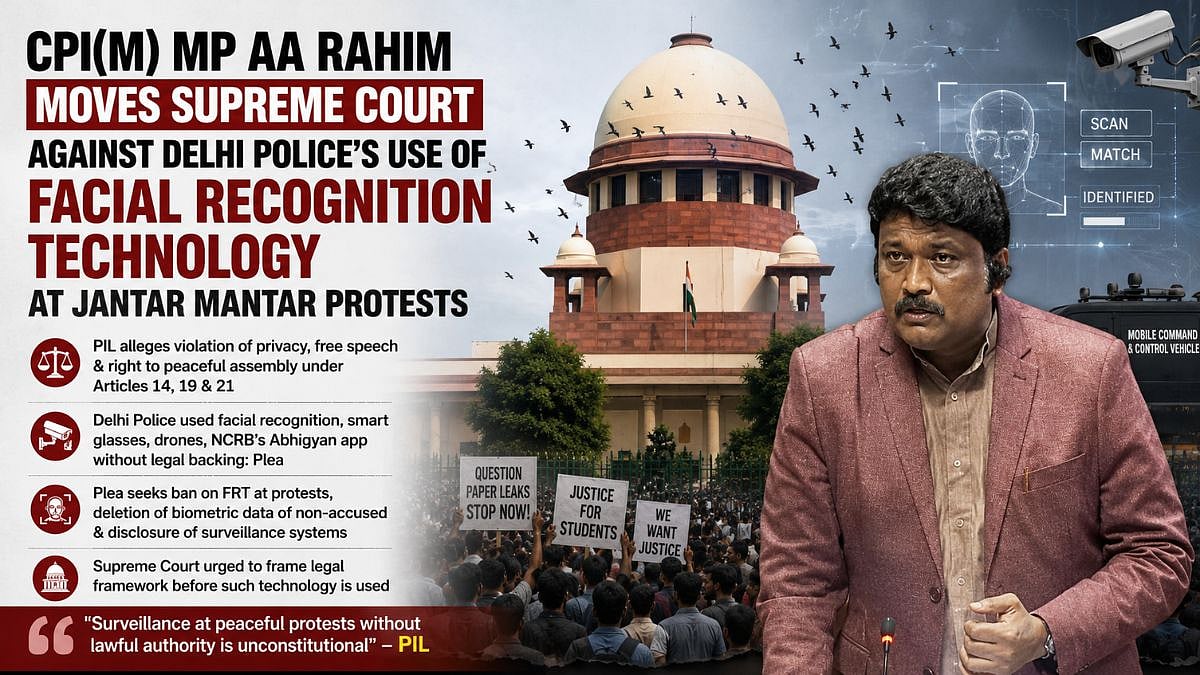
A Public Interest Litigation (PIL) has been filed in the Supreme Court by CPI(M) leader and Rajya Sabha MP A A Rahim, challenging the Delhi Police's use of facial recognition technology (FRT) and biometric surveillance during recent protests at Jantar Mantar in Delhi.
The protests, organised by the online collective Cockroach Janta Party (CJP), demanded the resignation of then Union Education Minister Dharmendra Pradhan over repeated question paper leaks. Pradhan resigned on July 25, following which the protests were called off.
The petition alleges that the Delhi Police deployed facial recognition systems, AI-enabled smart glasses, fingerprint identification tools, CCTV cameras, drones, and a Mobile Command and Control Vehicle to monitor protesters, journalists, and bystanders throughout the demonstrations. It claims these technologies were used without any statutory backing or published safeguards.
According to the petitioner, the police also used the National Crime Records Bureau's (NCRB) Abhigyan mobile fingerprint identification application to collect and process biometric data. The plea alleges that facial images and fingerprints of thousands of protesters were matched against undisclosed databases without informing those being surveilled.
Rahim has argued that the Delhi Police carried out automated and algorithmic extraction of biometric identifiers and linked them with permanent national criminal databases despite having no legal authority to do so. The petition contends that neither the Delhi Police's standing orders on protests nor the Criminal Procedure (Identification) Act, 2022, authorises biometric surveillance of people attending peaceful civilian assemblies.
The petition also refers to an RTI response from the Delhi Police, claiming it confirms that no privacy impact assessment has ever been conducted for the use of facial recognition technology. It further states that the police had earlier maintained that the technology was intended only for tracing missing persons and identifying the deceased.
Citing the Supreme Court's landmark judgment in K S Puttaswamy v Union of India (2017), the petitioner has argued that any restriction on privacy must satisfy the tests of legality, legitimate aim, and proportionality. It contends that the use of facial recognition technology at peaceful protests does not meet these constitutional requirements and amounts to surveillance in a legal vacuum.
The use of facial recognition technology has raised concerns about privacy and surveillance in India. The petition highlights the need for a clear regulatory framework to govern the use of such technologies, especially in the context of peaceful protests and assemblies.
The Supreme Court's decision on this petition will have significant implications for the right to privacy and free speech in India. It will also set a precedent for the use of facial recognition technology in the country, and whether it can be used to surveil citizens without their consent.
In conclusion, the petition filed by CPI(M) MP AA Rahim challenges the Delhi Police's use of facial recognition technology at Jantar Mantar protests, alleging violation of fundamental rights to privacy and free speech. The case highlights the need for a clear regulatory framework to govern the use of such technologies, and the Supreme Court's decision will have significant implications for the right to privacy and free speech in India.
The issue of surveillance and privacy is a critical one in India, and the use of facial recognition technology has raised concerns about the potential for abuse of power. The petition filed by Rahim is an important step in challenging the use of such technologies and ensuring that the rights of citizens are protected.
The case will be closely watched by civil liberties groups and privacy advocates, who have long argued that the use of facial recognition technology without proper safeguards is a threat to democracy and individual freedoms. The outcome of the case will have significant implications for the future of surveillance and privacy in India.
Frequently asked questions
What is the petition filed by CPI(M) MP AA Rahim about?
The petition challenges the Delhi Police's use of facial recognition technology at Jantar Mantar protests, alleging violation of fundamental rights to privacy and free speech.
What technologies did the Delhi Police use to surveil protesters?
The Delhi Police used facial recognition systems, AI-enabled smart glasses, fingerprint identification tools, CCTV cameras, drones, and a Mobile Command and Control Vehicle to monitor protesters, journalists, and bystanders.