Lebanon Abolishes Death Penalty, Replaces With Life Term
Lebanon becomes first Arab nation to end capital punishment, replaces with life imprisonment.
'%3E%3Crect%20width%3D'96'%20height%3D'96'%20fill%3D'%234A235A'%2F%3E%3Ccircle%20cx%3D'30'%20cy%3D'24'%20r%3D'44'%20fill%3D'%23fff'%20opacity%3D'.12'%2F%3E%3Ccircle%20cx%3D'60'%20cy%3D'74'%20r%3D'40'%20fill%3D'%23000'%20opacity%3D'.10'%2F%3E%3C%2Fg%3E%3Cg%20fill%3D'none'%20stroke%3D'%23fff'%20stroke-width%3D'3'%3E%3Ccircle%20cx%3D'48'%20cy%3D'48'%20r%3D'16'%2F%3E%3Cellipse%20cx%3D'48'%20cy%3D'48'%20rx%3D'6.5'%20ry%3D'16'%2F%3E%3Cline%20x1%3D'32'%20y1%3D'42'%20x2%3D'64'%20y2%3D'42'%2F%3E%3Cline%20x1%3D'32'%20y1%3D'54'%20x2%3D'64'%20y2%3D'54'%2F%3E%3C%2Fg%3E%3C%2Fsvg%3E)
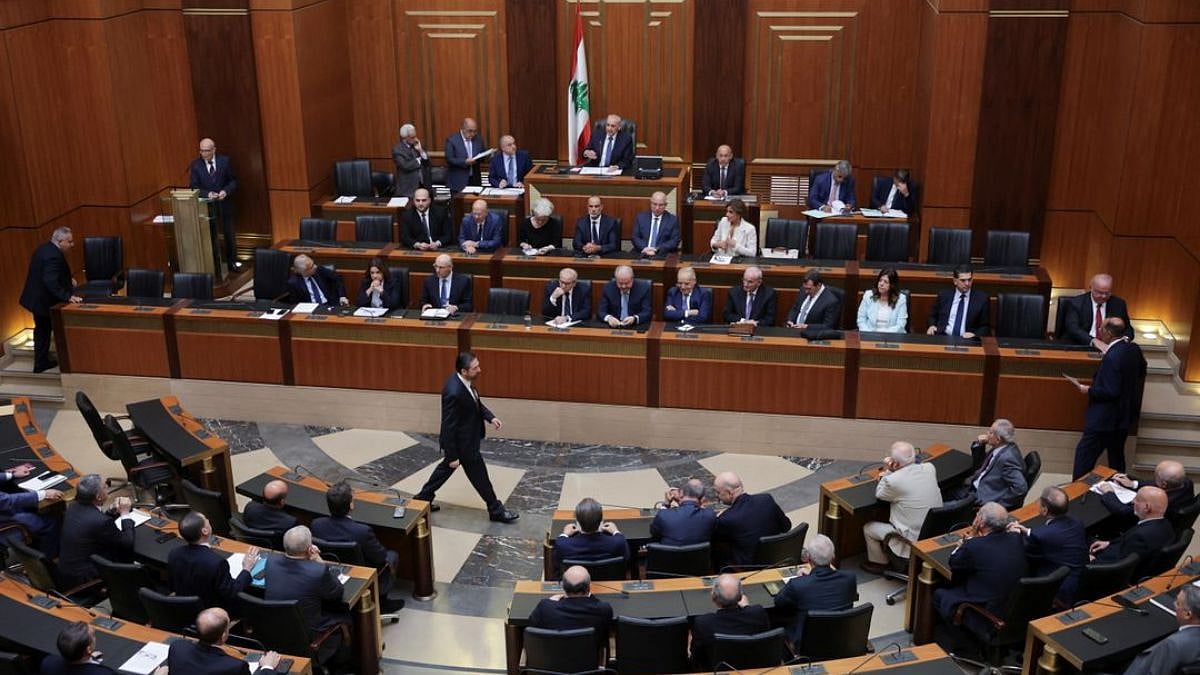
Lebanon's parliament voted on Tuesday to abolish the death penalty, making it the first Arab country to do so. The decision replaces capital punishment with life imprisonment with aggravated hard labour.
The vote was a significant step forward for human rights in the country, with a majority of the 128-member parliament supporting the move. However, not all parties were in favour, with Hezbollah's parliamentary bloc opposing the decision.
Justice Minister Adel Nassar described the decision as a 'historic step' for Lebanon. The country has observed an unofficial moratorium on executions since January 2004, but dozens of death sentences have been handed down since then, only to be suspended or commuted.
Rights groups have long sought the formalisation of the moratorium or the complete abolition of capital punishment. Ramzi Kaiss, Lebanon researcher at Human Rights Watch, welcomed the vote, saying that the country was 'marking a final break from a cruel sentence that should never be imposed.'
The implementation of aggravated hard labour as a punishment is still unclear, with some legislators saying that the terms of the new punishment have yet to be clearly defined. Hard labour already exists as a punishment under Lebanese law, but it has rarely been enforced in recent years.
The country's financial difficulties have left it with limited resources and capacity in its overcrowded prisons. The abolition of the death penalty comes as Parliament debates a controversial general amnesty law, which could reduce sentences or lead to the release of convicted militants and drug dealers.
Relatives of Lebanese soldiers and servicemen killed or attacked by Islamist militant groups have protested against the proposed law, saying that they had hoped those responsible would be executed rather than receive reduced prison sentences.
The decision to abolish the death penalty is a significant step forward for human rights in Lebanon. It marks a shift away from capital punishment and towards more humane forms of punishment.
The impact of the decision will be closely watched, particularly in the context of the proposed general amnesty law. It remains to be seen how the new punishment will be implemented and how it will affect the country's prison system.
In the broader context, the abolition of the death penalty in Lebanon is a significant development in the Arab world. It sets a precedent for other countries in the region to follow and marks a step forward for human rights.
The decision is also significant in the context of Lebanon's diverse religious institutions, which have their own court systems. The death penalty is considered legal in some of these systems, but the decision to abolish it at the national level may have implications for these institutions.
Overall, the abolition of the death penalty in Lebanon is a significant step forward for human rights and a major development in the Arab world. It marks a shift away from capital punishment and towards more humane forms of punishment, and sets a precedent for other countries in the region to follow.
The decision is a major victory for human rights groups, who have long campaigned for the abolition of the death penalty. It is also a significant step forward for the country, which has been working to strengthen its human rights record in recent years.
In conclusion, the abolition of the death penalty in Lebanon is a significant development that marks a major step forward for human rights in the country. It sets a precedent for other countries in the region to follow and marks a shift away from capital punishment and towards more humane forms of punishment.
Frequently asked questions
What has Lebanon's parliament voted to abolish?
Lebanon's parliament has voted to abolish the death penalty.
What will replace the death penalty in Lebanon?
The death penalty will be replaced with life imprisonment with aggravated hard labour.