Teaching Profession Faces High Stress Levels
Teaching is a highly demanding profession, teachers face multiple stressors, impacting their wellbeing and effectiveness.
'%3E%3Crect%20width%3D'96'%20height%3D'96'%20fill%3D'%23B3261E'%2F%3E%3Ccircle%20cx%3D'30'%20cy%3D'24'%20r%3D'44'%20fill%3D'%23fff'%20opacity%3D'.12'%2F%3E%3Ccircle%20cx%3D'60'%20cy%3D'74'%20r%3D'40'%20fill%3D'%23000'%20opacity%3D'.10'%2F%3E%3C%2Fg%3E%3Cg%20fill%3D'%23fff'%3E%3Crect%20x%3D'29'%20y%3D'49'%20width%3D'8'%20height%3D'19'%20rx%3D'1'%2F%3E%3Crect%20x%3D'39'%20y%3D'40'%20width%3D'9'%20height%3D'28'%20rx%3D'1'%2F%3E%3Crect%20x%3D'50'%20y%3D'45'%20width%3D'8'%20height%3D'23'%20rx%3D'1'%2F%3E%3Crect%20x%3D'60'%20y%3D'53'%20width%3D'7'%20height%3D'15'%20rx%3D'1'%2F%3E%3Crect%20x%3D'41'%20y%3D'34'%20width%3D'5'%20height%3D'6'%2F%3E%3C%2Fg%3E%3C%2Fsvg%3E)
Teaching is widely regarded as a profession of immense social value, but it also comes with significant responsibilities and stress. Teachers are not only responsible for delivering curriculum content, but also for fostering students' cognitive, emotional, and social development. They must engage with parents and communities, pursue research activities, and adapt to evolving policy and technological demands. As a result, teaching is inherently stressful, and prolonged occupational stress can have severe consequences on teacher wellbeing, classroom effectiveness, and student outcomes.
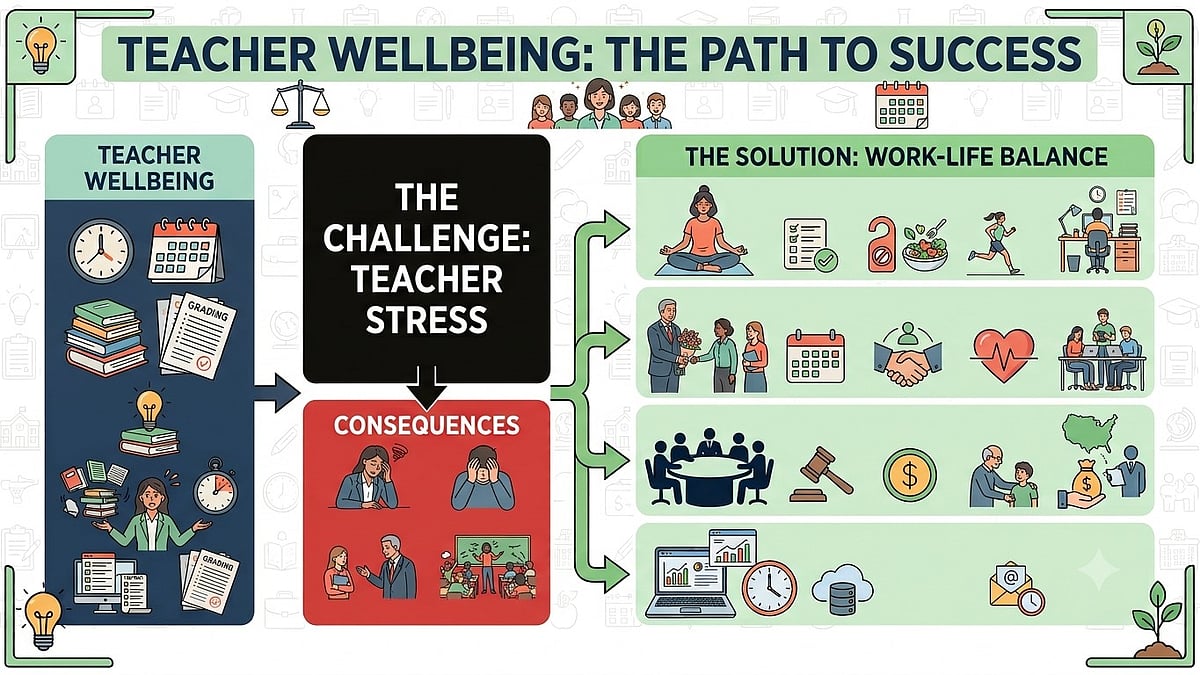
The sources of teacher stress are multifaceted and often interconnected. Workload and time pressure are primary contributors, with tasks such as planning lessons, grading, and preparing materials frequently extending beyond scheduled work hours. Classroom management and student behavioural issues also demand continuous emotional labour, which can be particularly taxing in contexts of insufficient support or large class sizes. Additionally, resource limitations, insufficient instructional materials, inadequate facilities, and constrained budgets can exacerbate job strain by impeding teachers' ability to deliver effective instruction.
Furthermore, excessive research pressure, particularly at the higher education level, can be a significant source of stress. The pressure to publish research in premier publications can be overwhelming and can take a toll on the health of many young teachers. Policy volatility and accountability regimes, including high-stakes testing and performance evaluations, can also add pressure and shift the focus from pedagogy to measurable outputs. Professional isolation, lack of mentoring for early-career teachers, and limited opportunities for professional development can further contribute to occupational stress.
The consequences of chronic stress among teachers are far-reaching and can have significant impacts on personal, professional, and systemic domains. At the individual level, prolonged stress can lead to burnout, characterised by emotional exhaustion, depersonalisation, and reduced personal accomplishment. This can precipitate physical health problems, sleep disturbances, anxiety, and depression. Professionally, stress can undermine instructional quality, leading to punitive classroom management strategies, diminished creativity in lesson planning, and lower levels of enthusiasm and responsiveness.
In the Indian context, the education system is in dire need of a national consensus to address the issue of teacher stress. The consequences of unmanaged stress can be severe, not only for teachers but also for students and the education system as a whole. It is essential to recognize the importance of maintaining a balanced professional and personal life for teachers, not only for their individual welfare but also for the quality and sustainability of education.
The Indian education system must prioritize the wellbeing and development of its teachers, providing them with the necessary support and resources to manage their workload and stress. This can include initiatives such as mentoring programs, professional development opportunities, and resources to support student wellbeing. By addressing the issue of teacher stress, the Indian education system can work towards creating a more sustainable and effective education environment.
In conclusion, the teaching profession is a highly demanding and stressful profession that requires a balanced approach to manage workload and stress. The consequences of unmanaged stress can be severe, and it is essential to prioritize the wellbeing and development of teachers to ensure the quality and sustainability of education.
Frequently asked questions
What are the main sources of stress for teachers?
The main sources of stress for teachers include workload and time pressure, classroom management and student behavioural issues, resource limitations, and excessive research pressure.
What are the consequences of chronic stress among teachers?
The consequences of chronic stress among teachers can include burnout, physical health problems, sleep disturbances, anxiety, and depression, as well as diminished instructional quality and lower levels of enthusiasm and responsiveness.