Supreme Court Orders Health Plan For Captive Elephants
SC directs Union government to set up elephant clinics, issues guidelines for private owners.
'%3E%3Crect%20width%3D'96'%20height%3D'96'%20fill%3D'%23B3261E'%2F%3E%3Ccircle%20cx%3D'30'%20cy%3D'24'%20r%3D'44'%20fill%3D'%23fff'%20opacity%3D'.12'%2F%3E%3Ccircle%20cx%3D'60'%20cy%3D'74'%20r%3D'40'%20fill%3D'%23000'%20opacity%3D'.10'%2F%3E%3C%2Fg%3E%3Cg%20fill%3D'%23fff'%3E%3Crect%20x%3D'29'%20y%3D'49'%20width%3D'8'%20height%3D'19'%20rx%3D'1'%2F%3E%3Crect%20x%3D'39'%20y%3D'40'%20width%3D'9'%20height%3D'28'%20rx%3D'1'%2F%3E%3Crect%20x%3D'50'%20y%3D'45'%20width%3D'8'%20height%3D'23'%20rx%3D'1'%2F%3E%3Crect%20x%3D'60'%20y%3D'53'%20width%3D'7'%20height%3D'15'%20rx%3D'1'%2F%3E%3Crect%20x%3D'41'%20y%3D'34'%20width%3D'5'%20height%3D'6'%2F%3E%3C%2Fg%3E%3C%2Fsvg%3E)
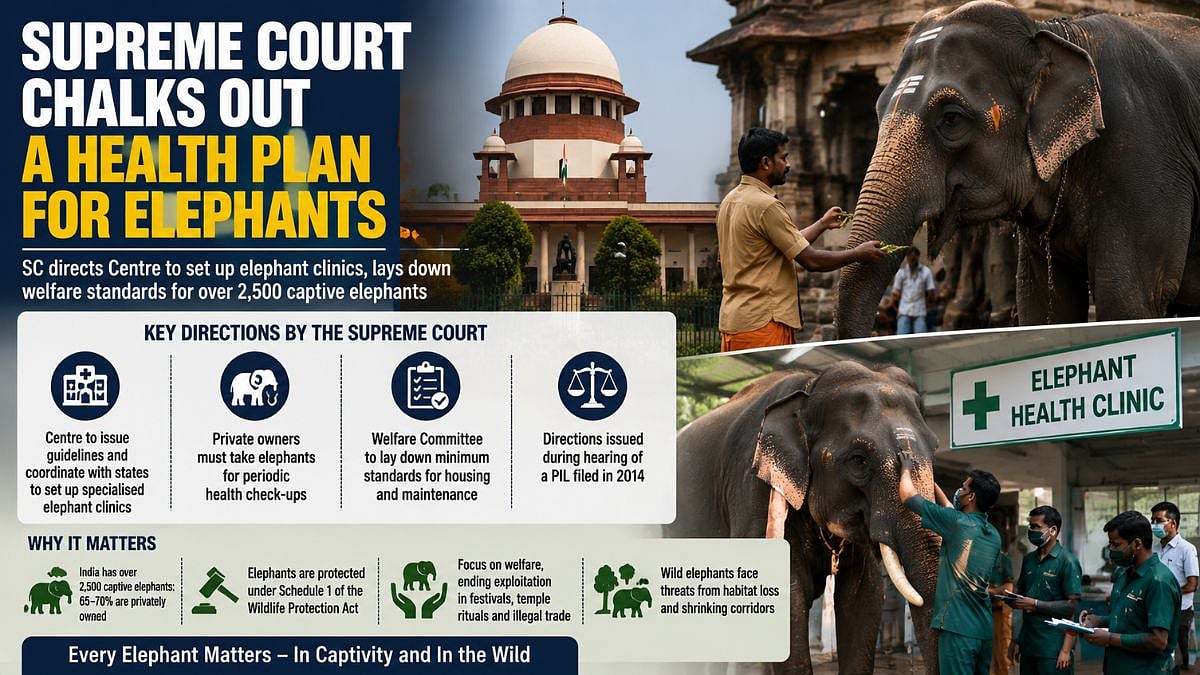
The Supreme Court of India has taken a significant step towards ensuring the health and well-being of captive elephants across the country. A three-judge Bench headed by Chief Justice Surya Kant directed the Union government to issue guidelines and coordinate with states to set up specialised elephant clinics.
These clinics will provide periodic health check-ups for privately owned elephants. The court also directed the Captive Elephant Healthcare and Welfare Committee to lay down minimum standards for the housing and maintenance of captive elephants.
The directions came during hearings of a Public Interest Litigation (PIL) filed in 2014 on the issue of captive elephant welfare. India has over 2,500 captive elephants, with approximately 65-70 per cent privately owned by temples, tourist operators, and individuals.
Although the Asian elephant is protected under Schedule 1 of the Wildlife Protection Act, private ownership has been allowed due to an exemption made decades ago. However, this has led to a continuous battle between owners and authorities over the health and welfare of captive elephants.
The SC directions have now clearly drawn the boundaries of who is responsible for the health and well-being of these elephants and how state authorities can support this through clinics and other measures. While the legal framework and state-specific rules exist for wildlife protection, implementing them with a focus on elephant welfare has been a challenge.
The SC’s directions have established a line of command and shown pathways towards addressing this issue. The number of captive elephants may be just about 10 per cent of the elephant population in India, but every elephant matters from the perspectives of ecology and multispecies justice.
India is home to nearly 60 per cent of the world’s wild Asian elephants, with 22,446 elephants counted in their ecological habitats around the country. The focus has been on protecting wild elephants, with 33 dedicated elephant reserves and 150 identified elephant corridors.
However, wild elephants are now threatened by urbanisation, with the Assam government seeking to reduce the buffer eco-sensitive zone in the Kaziranga National Park. This highlights the need for protection of both captive and wild elephants.
The SC directions are a significant step towards ensuring the health and well-being of captive elephants, and it remains to be seen how the Union government and states will implement these guidelines.
The protection of elephants, both in captivity and in the wild, is crucial for maintaining ecological balance and promoting multispecies justice. The Supreme Court’s intervention is a welcome move towards addressing the welfare of these majestic creatures.
In conclusion, the Supreme Court’s directions on captive elephant welfare mark a significant milestone in the journey towards protecting these animals. It is now up to the Union government and states to implement these guidelines and ensure the health and well-being of captive elephants across the country.
Frequently asked questions
How many captive elephants are there in India?
There are over 2,500 captive elephants in India, with approximately 65-70 per cent privately owned.
What is the main challenge in protecting captive elephants?
The main challenge is implementing existing laws and rules with a focus on elephant welfare, despite the legal framework and state-specific rules being in place.