REC Signs ₹15,000 Crore MoUs for Tripura Power Projects
REC Limited signs MoUs with Tripura government to support power and renewable energy projects.

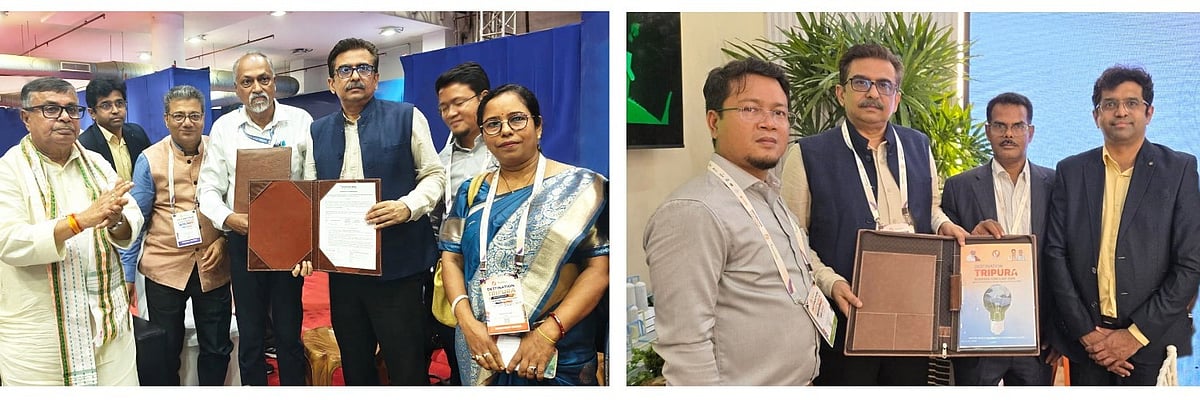
REC Limited, a leading NBFC under the Ministry of Power, has signed two Memoranda of Understanding (MoUs) with the Government of Tripura to support power and renewable energy projects worth ₹15,000 crore.
The MoUs were signed during the Destination Tripura Business Conclave 2026, reflecting REC's commitment to enabling sustainable development and strengthening power infrastructure in the Northeast.
Under the first MoU, REC Limited has partnered with the Tripura Renewable Energy Development Agency (TREDA) to provide financial assistance for renewable energy projects worth up to ₹5,000 crore. The agreement was signed by Sh. Subhendu Roy, Chief Program Manager, REC Regional Office, Guwahati, and Sh. D. S. Das, Director General (In-charge), TREDA.
The partnership is expected to accelerate clean energy adoption, unlock Tripura's renewable energy potential, and contribute significantly to the region's sustainable development. TREDA will facilitate the implementation of renewable power projects across the state, while REC Limited will provide financial support to enable investments in the green energy sector.
Further strengthening its partnership with the state, REC Limited also signed an MoU with the Department of Power, Government of Tripura, through the Tripura State Electricity Corporation Limited (TSECL), to support power sector projects worth ₹10,000 crore. The signing ceremony was graced by Sh. Ratan Lal Nath, Hon'ble Minister of Power, Government of Tripura.
The MoU was signed by Sh. Subhendu Roy, Chief Program Manager, REC Regional Office, Guwahati, and Sh. Biswajit Basu, Managing Director, TSECL. The ₹10,000 crore partnership aims to facilitate financing for key power sector initiatives in the state, contributing to the expansion and modernization of Tripura's power infrastructure while ensuring reliable and sustainable electricity access for its citizens.
The Northeast region of India has been a focus area for REC Limited, with the company aiming to support the region's power and renewable energy development. The signing of these MoUs is a significant step towards achieving this goal.
The partnership between REC Limited and the Government of Tripura is expected to have a positive impact on the state's economy and environment. The development of renewable energy projects will not only reduce the state's reliance on non-renewable energy sources but also create new job opportunities and stimulate local economic growth.
In recent years, the Indian government has been actively promoting the development of renewable energy sources, with a target of achieving 500 GW of installed renewable energy capacity by 2030. The partnership between REC Limited and the Government of Tripura is a significant step towards achieving this goal.
Overall, the signing of these MoUs is a significant development for the power and renewable energy sector in Tripura, and is expected to have a positive impact on the state's economy and environment.
The move is also expected to contribute to India's goal of reducing its carbon footprint and promoting sustainable development. As the country continues to grow and develop, it is essential that it does so in a sustainable and environmentally friendly manner. The partnership between REC Limited and the Government of Tripura is a significant step towards achieving this goal.
In conclusion, the signing of the MoUs between REC Limited and the Government of Tripura is a significant development for the power and renewable energy sector in the state. The partnership is expected to accelerate clean energy adoption, unlock Tripura's renewable energy potential, and contribute significantly to the region's sustainable development.
It will also contribute to the expansion and modernization of Tripura's power infrastructure, ensuring reliable and sustainable electricity access for its citizens. The move is a significant step towards achieving India's goal of promoting sustainable development and reducing its carbon footprint.