Scientists Discover 'Devil Flower' in Thailand
Rare plant found, no leaves, gets nutrients from fungi
'%3E%3Crect%20width%3D'96'%20height%3D'96'%20fill%3D'%23B3261E'%2F%3E%3Ccircle%20cx%3D'30'%20cy%3D'24'%20r%3D'44'%20fill%3D'%23fff'%20opacity%3D'.12'%2F%3E%3Ccircle%20cx%3D'60'%20cy%3D'74'%20r%3D'40'%20fill%3D'%23000'%20opacity%3D'.10'%2F%3E%3C%2Fg%3E%3Cg%20fill%3D'%23fff'%3E%3Crect%20x%3D'29'%20y%3D'49'%20width%3D'8'%20height%3D'19'%20rx%3D'1'%2F%3E%3Crect%20x%3D'39'%20y%3D'40'%20width%3D'9'%20height%3D'28'%20rx%3D'1'%2F%3E%3Crect%20x%3D'50'%20y%3D'45'%20width%3D'8'%20height%3D'23'%20rx%3D'1'%2F%3E%3Crect%20x%3D'60'%20y%3D'53'%20width%3D'7'%20height%3D'15'%20rx%3D'1'%2F%3E%3Crect%20x%3D'41'%20y%3D'34'%20width%3D'5'%20height%3D'6'%2F%3E%3C%2Fg%3E%3C%2Fsvg%3E)
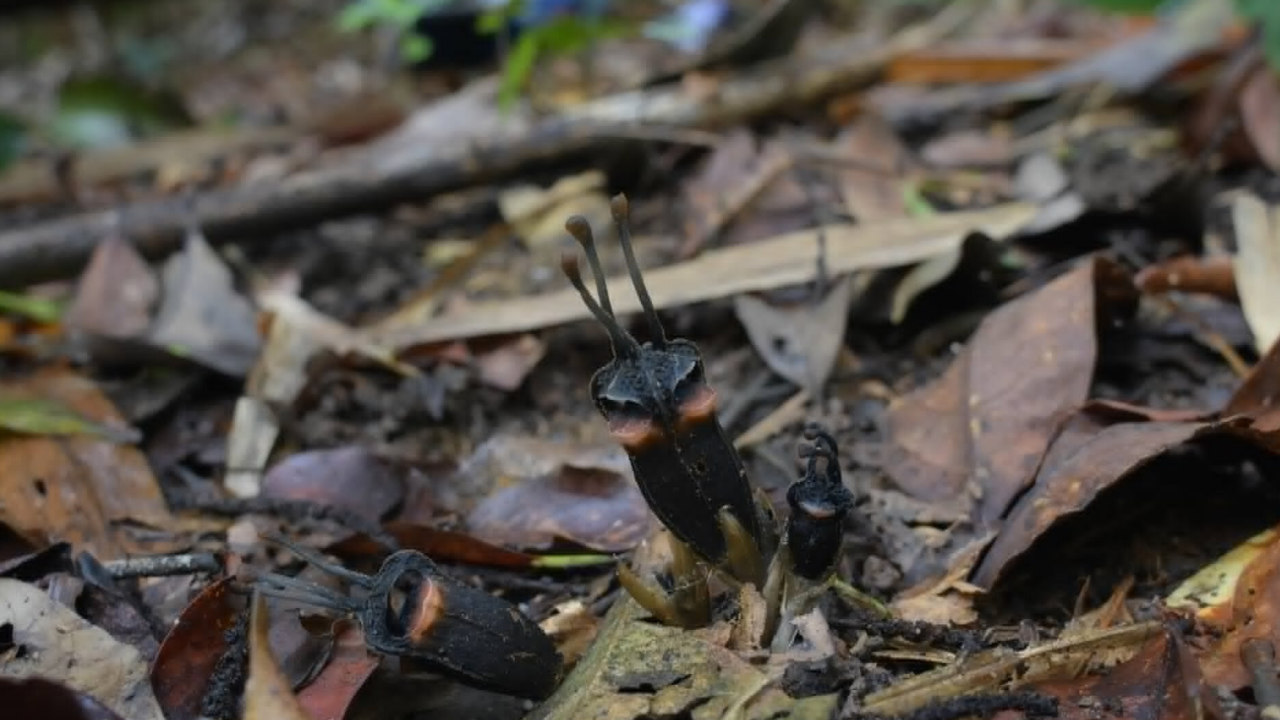
Scientists have made a remarkable discovery in Thailand's Thong Pha Phum National Park, finding a unique flowering plant called Thismia daemona. This plant, which has been dubbed the 'devil flower' due to its eerie, horn-like appearance, is particularly interesting because it has no leaves or green structures. Instead, it gets its nutrients from subterranean fungi.
The discovery of Thismia daemona is significant because it is a member of a rare group of plants that do not have the typical characteristics of most plants. These plants, which are known as mycoheterotrophs, get their nutrients by parasitizing fungi that are associated with the roots of other plants.
Thismia daemona is a small plant that grows in the forest floor of Thong Pha Phum National Park. It has a distinctive horn-like shape and produces small, yellowish flowers. The plant's lack of leaves and green structures is due to its unique relationship with the fungi that it parasitizes.
The discovery of Thismia daemona was made by a team of scientists who were conducting research in the park. The team was led by a botanist who has been studying the unique plant species of the park for several years.
The study of mycoheterotrophs like Thismia daemona is important because it can provide insights into the evolution of plant relationships with fungi. These relationships are complex and not fully understood, and the study of rare plants like Thismia daemona can help scientists to better understand how they work.
Thong Pha Phum National Park is a protected area in western Thailand that is known for its unique and diverse plant species. The park is home to many rare and endangered plants, and it is an important location for botanical research.
The discovery of Thismia daemona is a significant find for scientists and highlights the importance of continuing to explore and study the natural world. It also underscores the need to protect and conserve unique and rare plant species like this one.
In conclusion, the discovery of Thismia daemona is an important botanical find that highlights the unique and diverse plant species that can be found in Thailand's Thong Pha Phum National Park. The study of this plant and others like it can provide valuable insights into the evolution of plant relationships with fungi and the importance of conserving rare and endangered plant species.
Frequently asked questions
What is the 'devil flower'?
The 'devil flower' is a unique flowering plant called Thismia daemona that has no leaves and gets its nutrients from subterranean fungi.
Where was the 'devil flower' discovered?
The 'devil flower' was discovered in Thailand's Thong Pha Phum National Park.