California Teen Discovers Cancer Cell Blockage Method
Teen's research finds blocking pathway stops cancer spread. Study analyzed 479 cell lines.
'%3E%3Crect%20width%3D'96'%20height%3D'96'%20fill%3D'%23B3261E'%2F%3E%3Ccircle%20cx%3D'30'%20cy%3D'24'%20r%3D'44'%20fill%3D'%23fff'%20opacity%3D'.12'%2F%3E%3Ccircle%20cx%3D'60'%20cy%3D'74'%20r%3D'40'%20fill%3D'%23000'%20opacity%3D'.10'%2F%3E%3C%2Fg%3E%3Cg%20fill%3D'%23fff'%3E%3Crect%20x%3D'29'%20y%3D'49'%20width%3D'8'%20height%3D'19'%20rx%3D'1'%2F%3E%3Crect%20x%3D'39'%20y%3D'40'%20width%3D'9'%20height%3D'28'%20rx%3D'1'%2F%3E%3Crect%20x%3D'50'%20y%3D'45'%20width%3D'8'%20height%3D'23'%20rx%3D'1'%2F%3E%3Crect%20x%3D'60'%20y%3D'53'%20width%3D'7'%20height%3D'15'%20rx%3D'1'%2F%3E%3Crect%20x%3D'41'%20y%3D'34'%20width%3D'5'%20height%3D'6'%2F%3E%3C%2Fg%3E%3C%2Fsvg%3E)
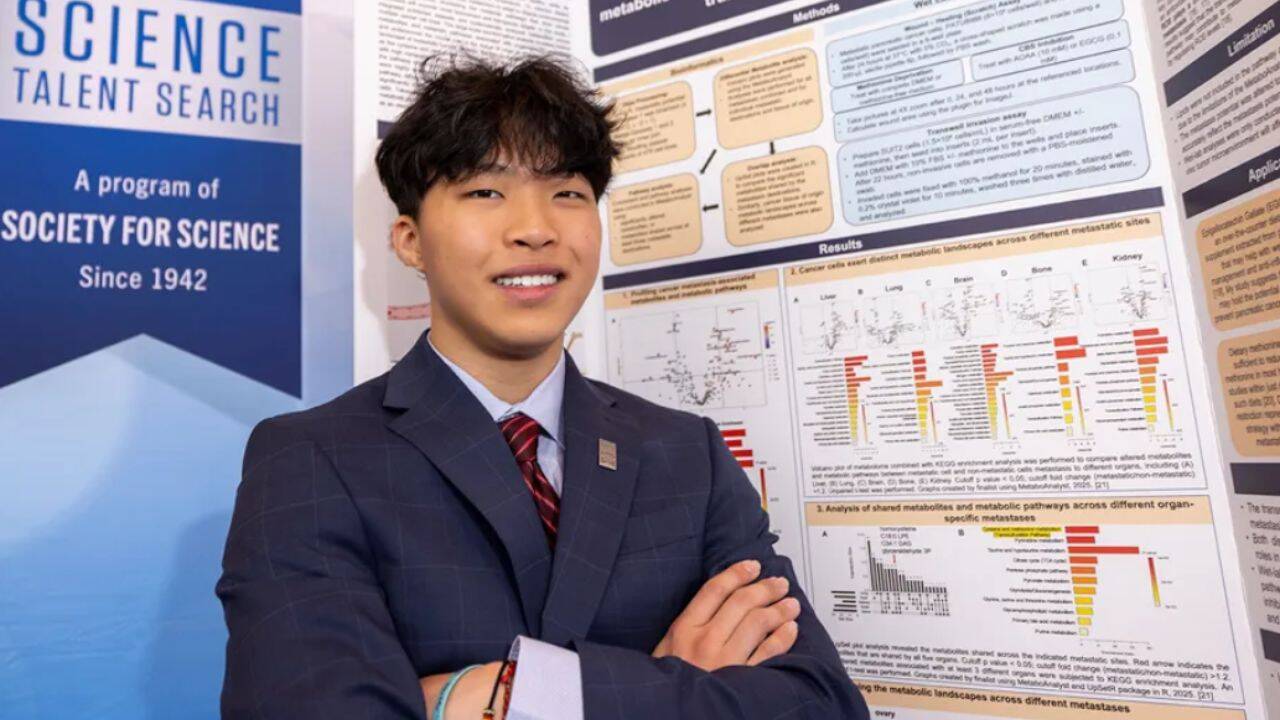
Jonathan Yan, an 18-year-old student from California, has made a significant discovery in the field of cancer research. He studied data from 479 human cancer cell lines to understand how cancer spreads.
His research focused on identifying the pathways that cancer cells use to metastasize. After analyzing the data, Yan found that the transsulfuration pathway was highly active in metastatic cancers.
This pathway plays a crucial role in the spread of cancer cells. When Yan blocked the transsulfuration pathway in cancer cell lines, the cells stopped spreading. This breakthrough points to a possible area for further research into cancer metastasis.
Cancer metastasis is a complex process that involves the spread of cancer cells from the primary site to other parts of the body. It is a major cause of death in cancer patients. Understanding the mechanisms of metastasis is essential for developing effective treatments.
Yan's research has identified a potential target for cancer therapy. By blocking the transsulfuration pathway, it may be possible to prevent cancer cells from spreading. This could lead to the development of new treatments for cancer patients.
The study's findings are significant, and further research is needed to confirm the results. However, Yan's discovery has opened up new avenues for research into cancer metastasis.
The transsulfuration pathway is a metabolic pathway that involves the conversion of homocysteine to cysteine. It plays a crucial role in the synthesis of glutathione, an antioxidant that protects cells from damage.
In cancer cells, the transsulfuration pathway is often upregulated, leading to an increase in glutathione production. This can make cancer cells more resistant to chemotherapy and radiation therapy.
By blocking the transsulfuration pathway, it may be possible to make cancer cells more vulnerable to treatment. This could lead to the development of more effective treatments for cancer patients.
Yan's research has the potential to make a significant impact on our understanding of cancer metastasis. His discovery has identified a new target for cancer therapy, and further research is needed to explore this avenue.
In conclusion, Jonathan Yan's research has made a significant contribution to the field of cancer research. His discovery has opened up new avenues for research into cancer metastasis, and has the potential to lead to the development of more effective treatments for cancer patients.
Frequently asked questions
What did Jonathan Yan's research discover about cancer cells?
Jonathan Yan's research found that blocking the transsulfuration pathway in cancer cell lines stopped the cells from spreading.
What is the transsulfuration pathway and its role in cancer?
The transsulfuration pathway is a metabolic pathway involved in the synthesis of glutathione, an antioxidant that protects cells from damage. In cancer cells, it is often upregulated, making them more resistant to treatment.