NGT Orders Rejuvenation of Kshipra River in Ujjain
NGT directs UMC to stop untreated sewage discharge, State Pollution Control Board to conduct inspections
'%3E%3Crect%20width%3D'96'%20height%3D'96'%20fill%3D'%231A5276'%2F%3E%3Ccircle%20cx%3D'30'%20cy%3D'24'%20r%3D'44'%20fill%3D'%23fff'%20opacity%3D'.12'%2F%3E%3Ccircle%20cx%3D'60'%20cy%3D'74'%20r%3D'40'%20fill%3D'%23000'%20opacity%3D'.10'%2F%3E%3C%2Fg%3E%3Cg%20fill%3D'%23fff'%3E%3Cpath%20d%3D'M31%2041%20L48%2031%20L65%2041%20Z'%2F%3E%3Crect%20x%3D'33'%20y%3D'43'%20width%3D'4'%20height%3D'17'%2F%3E%3Crect%20x%3D'41'%20y%3D'43'%20width%3D'4'%20height%3D'17'%2F%3E%3Crect%20x%3D'51'%20y%3D'43'%20width%3D'4'%20height%3D'17'%2F%3E%3Crect%20x%3D'59'%20y%3D'43'%20width%3D'4'%20height%3D'17'%2F%3E%3Crect%20x%3D'30'%20y%3D'62'%20width%3D'36'%20height%3D'4'%20rx%3D'1'%2F%3E%3C%2Fg%3E%3C%2Fsvg%3E)
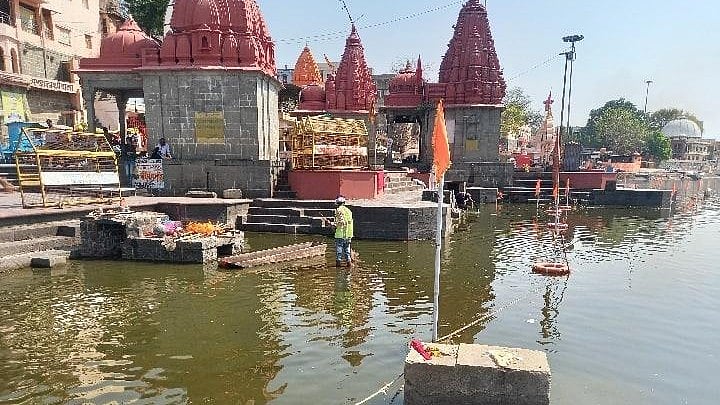
The National Green Tribunal (NGT) has ordered the rejuvenation of the Kshipra River in Ujjain, Madhya Pradesh. On August 17, the NGT's Central Zone Bench in Bhopal directed the Ujjain Municipal Corporation (UMC) and Ujjain Collector to ensure that no untreated sewage or wastewater is discharged into the river.
The order was passed in response to an application filed by Ramesh Dwivedi against the State of Madhya Pradesh and others. The NGT has issued significant directions for the protection, rejuvenation, and ecological restoration of the river Kshipra, particularly in view of the upcoming Simhastha Mahaparv-2028.
The Tribunal observed that the river Kshipra is an integral part of the religious, cultural, and civilisational identity of Ujjain/Avantika. The bench emphasized that protection of the river is both an environmental necessity and a duty towards the religious and cultural heritage of the region.
According to the Joint Committee constituted by the NGT, Ujjain presently generates approximately 85 MLD of sewage, which is expected to increase to nearly 350 MLD during Simhastha 2028. Water samples collected from the Kshipra showed BOD levels ranging from 8-12 mg/L, against the prescribed bathing-water standard of 3 mg/L.
The NGT also noted that the Kshipra has been identified by the Central Pollution Control Board (CPCB) as a Priority III polluted river stretch, based on the 2022-2023 assessment. Out of 14 drains in and around Ujjain, 11 have reportedly been tapped. However, three drains were found to be continuing to discharge untreated or contaminated wastewater into the river.
The NGT has directed that proposed STPs and sewerage networks be expedited, existing STPs and the waste stabilisation pond be properly operated and maintained, and untreated drains be intercepted, diverted, and treated. The Tribunal has also ordered the removal of solid waste from ghats, drains, and riverbanks, and the removal of encroachments on water bodies and public land in the Simhastha area within 30 days.
A dedicated grievance redressal system/app and mobile number have been established for complaints relating to water quality and encroachments. The NGT has also ordered the submission of a comprehensive report regarding solid-waste generation, available treatment capacity, existing gaps, and arrangements proposed for Simhastha 2028.
The State Pollution Control Board has been directed to conduct inspections at 15-day intervals and ensure remedial and punitive action, including calculation and recovery of environmental compensation, wherever violations are found.
The order is significant for the protection and rejuvenation of the river Kshipra, which is an important part of the cultural and religious heritage of Ujjain. The NGT's directions are expected to improve the water quality of the river and prevent pollution during the upcoming Simhastha Mahaparv-2028.
The NGT's order highlights the importance of protecting the environment and preserving the cultural heritage of the region. The implementation of the NGT's directions will be crucial in ensuring the rejuvenation of the Kshipra River and preventing pollution in the future.
In conclusion, the NGT's order is a significant step towards the protection and rejuvenation of the Kshipra River in Ujjain. The implementation of the directions will require the cooperation of the UMC, Ujjain Collector, and other stakeholders to ensure the improvement of the water quality of the river and the prevention of pollution during the upcoming Simhastha Mahaparv-2028.
Frequently asked questions
What is the current status of the Kshipra River in Ujjain?
The Kshipra River has been identified as a Priority III polluted river stretch by the Central Pollution Control Board, with BOD levels ranging from 8-12 mg/L, against the prescribed bathing-water standard of 3 mg/L.
What are the NGT's directions for the protection of the Kshipra River?
The NGT has directed the UMC and Ujjain Collector to ensure that no untreated sewage or wastewater is discharged into the river, and has ordered the implementation of various measures to improve the water quality of the river.